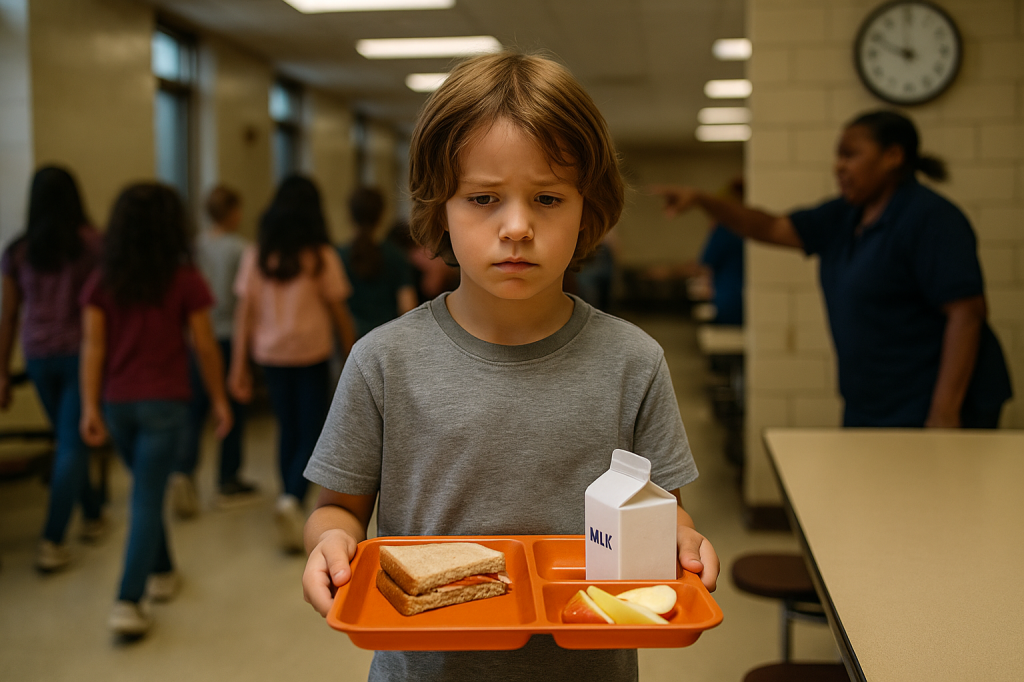

In many schools, the lunch period is listed as 20 minutes, but students who reach the cafeteria line later often get far less actual time to eat. After waiting to be served, grabbing utensils, and finding a seat, those at the back may have only a few minutes—sometimes barely enough to open a milk and peel a fruit cup—before dismissal. In practice, the last students seated rarely receive the same eating window as those served first.
This isn’t an isolated cafeteria story. Parents from across JCPS—elementary through high school—describe the same pattern: long lines, short meals, and children who come home ravenous or, worse, trained to scarf food as if eating were a race. Preschool teachers say that twenty four- and five-year-olds still learning to open packaging simply can’t eat unassisted within twenty minutes. Special-needs families add that rushed eating collides with motor, sensory, and attention needs. The result is predictable: hungry kids, afternoon headaches, and classrooms full of students whose bodies are telling them something school schedules ignore.
Kentucky’s rule is straightforward about the spirit of mealtime. 702 KAR 6:060 exists to carry out federal child nutrition law and to ensure schoolchildren have sufficient time to eat in an educational setting. It doesn’t set a stopwatch number for every school, but the intent is crystal clear: adequate time to enjoy a complete meal. A schedule that lists “20 minutes” but yields only a handful of seated minutes for the last kids through the line does not meet that intent.
What JCPS families and staff report right now
- “Posted ≠ seated.” Multiple parents say the block is 20 minutes including walking in, queuing, entering the PIN, grabbing utensils, finding a seat, and then eating—meaning the last students get 10 minutes or less.
- “Back of the line always loses.” When classes line up in the same order every day, the same kids routinely get the shortest meals.
- “Preschool and primary are hit hardest.” A preschool teacher points out the obvious: young children need help opening milks, yogurts, and fruit cups, which burns precious minutes for the entire table.
- “Slow eaters suffer most.” Fourth- and fifth-grade parents say children who are careful or distracted eaters come home starving; some now rush at home because school taught them to gulp.
- “Recess is inconsistent.” Some schools schedule daily wellness/recess (outdoors when weather allows; indoors otherwise). Others report days with no meaningful movement, yet kids are still expected to sit still and focus.
- “Teachers feel the squeeze.” Educators note that lunch doesn’t count toward state instructional minutes and that there’s pressure to keep transitions tiny. They aren’t indifferent; they’re navigating constraints.
What the research says (and why the minutes matter)
You don’t need to be a nutritionist to see the pattern, but the data back it up. Studies of school cafeterias consistently find that when students have less than 20 minutes of seated time, they consume less entrée, fewer vegetables, and less milk, and they’re less likely to select fruit. In typical cafeterias with a single serving line, it’s common for some students to wind up with ~10 minutes of actual eating time. Public-health guidance often recommends scheduling about 30 minutes total to yield 20 minutes seated for everyone—including the slowest eaters and the last kids served.
Translate that to the school day and it’s easy to see downstream effects: rushed eating elevates stress, increases choking risk, and contributes to afternoon slumps in attention—especially for students with ADHD or sensory needs. We can’t reasonably ask children to regulate their bodies and minds if the schedule tells them lunch is a sprint.
Why lunch minutes get crunched (even when everyone cares)
- Lines devour time. A single hot line for a large grade means “20 minutes” on paper often becomes 10 minutes or less for the kids at the back.
- PINs and packaging slow primary grades. K–2 students are still learning number recall and fine-motor skills; every stuck foil lid or forgotten PIN adds friction.
- Instructional-minutes pressure is real. Administrators must protect class time; lunch doesn’t count, and transitions are supposed to be short.
- Capacity didn’t keep up with scale. More students relying on school meals is a win for access—but without more serving capacity, the line becomes the bottleneck.
- “Always been this way” inertia. Old practice quietly becomes policy, even when it isn’t kid-friendly.
A better standard: Seated 20
The simplest way to keep the promise of “adequate time” is to define lunch as 20 minutes of seated eating time for every student, measured from when the last student is served. That’s the seated lunch time policy for JCPS families should ask for. It doesn’t automatically extend the school day or cut instruction; it rebalances the block so the clock measures eating, not standing.
Practical fixes that work inside real schedules
- Add a serving/transition buffer. Build in 3–5 minutes before the seated block for walking in and moving through the line. The posted “20” then becomes what it claims: time to eat.
- Rotate the front of the line. If students line up numerically or by table, rotate so the same kids aren’t always last. Low-cost, immediate equity.
- Create two service points. A second check-out or a cold-item satellite table (milk, fruit, salads, utensils) can halve wait time.
- Use PIN/ID cards for K–2. Laminated cards (or QR/barcode IDs) keep the line moving. Practice PINs during morning meeting for older grades. Search phrase: reduce elementary lunch line time with PIN cards Louisville.
- Seat slow eaters near the line. Students who need more time should be the first to sit.
- Enlist volunteers early. Background-checked family helpers can open packaging and coach routines for the first month; small supports compound.
- Time it and adjust. Conduct a three-day time check: first child seated, last child seated, first table dismissed. Share results and tweak until every student gets a Seated 20.
Recess belongs in this conversation
Movement and mealtime support each other. A predictable wellness/recess block—outdoors when possible, indoors when not—helps children self-regulate so they can learn. If your school’s recess feels inconsistent, ask when wellness appears in the schedule and how indoor recess is handled. For ADHD-friendly school lunch schedules, a calm body plus unhurried eating equals a calmer classroom.
“But won’t longer lunch break the day?”
A fair concern—and a solvable one.
- We’re not asking for a longer day. We’re asking for 20 seated minutes within the existing block.
- Protect instructional minutes. You can keep class time intact by adding a brief buffer before the eating period and by increasing serving capacity.
- Start with low-cost steps. Line rotation, PIN cards, a cold-item satellite, and strategic seating make a visible difference without redrawing the master schedule.
Real voices from JCPS (what families are seeing)
- “The last kids through the line get about 10 minutes, sometimes less.”
- “My child comes home and scarfs dinner because they’re conditioned to rush.”
- “In preschool, 20 minutes for twenty kids still learning to open milk doesn’t add up.”
- “As a teacher, I walk them through the line as fast as I can—I want them to have the time, too.”
- “We were told students are supposed to have daily wellness; sometimes it’s not happening.”
- “When my child forgets the PIN, the whole line slows.”
These aren’t complaints about cafeteria workers or teachers; they’re signals from a system that needs a small, smart tune-up.
What parents can do this week
- Ask your principal for a “Seated 20” standard—twenty minutes of eating after the last student sits.
- Request a brief time audit (three days, three timestamps) and share the results with families.
- Offer low-cost help: PTA funds for PIN cards and a label printer; volunteers for the first month; a cold-item satellite table.
- Encourage line rotation so the same children aren’t always at the end.
- If you can, pack lunch sometimes so your child goes straight to a table—but keep advocating so school-meal students get the same fair shot.
To help other families find this information, it’s worth using specific search phrases when you share: JCPS lunch line time fairness elementary, Kentucky 702 KAR 6:060 adequate time to eat, seated lunch time policy for JCPS, implement seated 20 minutes lunch policy JCPS elementary.
Bottom line
A humane school lunch isn’t a luxury; it’s part of the learning day. Kentucky’s rule expects adequate time to enjoy a complete meal. For that promise to be real in JCPS, “20 minutes” on paper must become 20 minutes seated for every child, every day. With a few practical tweaks—tiny buffers, smarter lines, simple tools we can make the schedule match the promise. Your child’s body (and teacher) will thank you.


2 Responses
Profoundly relatable
I have worked in the public education system for only two years, and I saw this every single day. The lunch period is definitely an issue, but breakfast is another as well. We would have kids coming in either right before the first bell rang, or minutes after expecting to get breakfast still. Luckily, we had a pretty cool lunch manager and principal, so the kids were allowed to take their breakfast to their classrooms. Either way, it was taking up instruction time. These issues are more on the parents since the kids have very little control over when they arrived, but there needs to be more accountability or awareness for the parents who are not feeding their kids at home but expect the school to feed them regardless of the set schedule.
Very interesting read!