
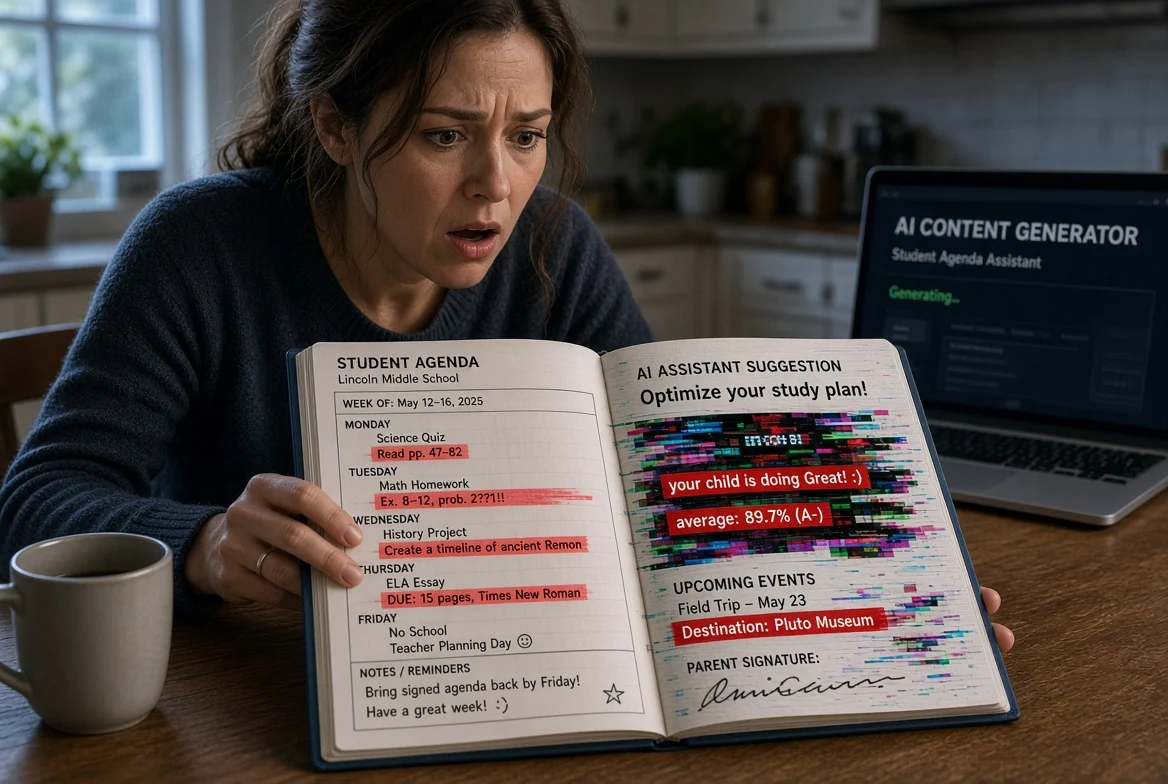
A problem involving student agendas distributed at Farnsley Middle School is raising questions about how artificial intelligence-generated content is reviewed before it reaches students and families.
A WDRB reporter has confirmed that the station is working on a story involving AI-generated content in Farnsley Middle student agendas and is seeking accounts from parents. Multiple Farnsley parents have also referenced receiving school notifications concerning student agenda misprints.
What remains unclear is exactly what the AI-generated content contained, what errors appeared and how the material was reviewed before the agendas were distributed.
JCPS Insider has not independently obtained the original agenda pages containing the reported errors or a complete copy of the school's communication explaining them. As of August 12, 2026, we also have not located a published WDRB report or a public Farnsley Middle or JCPS website post explaining the incident.
For now, the confirmed picture is limited: AI-generated content was involved in student agendas, errors or misprints were identified, families were notified, and a local news organization is investigating.
The biggest question is what happened before the agendas were printed.
Why the Review Process Matters
Student agendas can contain calendars, school procedures, schedules, behavioral expectations, policies and other information students and families may rely on throughout the school year.
Whether that information is written entirely by a person or created with the assistance of AI, someone ultimately has to verify that it is accurate.
AI producing an error by itself is not particularly surprising. Generative AI systems can produce incorrect information, awkward wording or inaccurate details.
The more significant issue is whether those errors were caught during the human-review process — and, if not, why.
That question is especially relevant because JCPS has repeatedly said that human involvement should remain central as the district expands its use of artificial intelligence.
JCPS Has Been Expanding Its Use of AI
The Farnsley situation comes during a significant expansion of artificial intelligence within Jefferson County Public Schools.
On February 27, 2026, JCPS announced that its migration to Google Workspace had been completed and that Google's Gemini AI technology was being integrated into classrooms in what the district described as a secure, enterprise-level environment. JCPS said the initiative was intended to remove barriers and empower teachers.
The district also maintains a public page titled Generative AI in JCPS: A Commitment to Responsible Innovation.
On that page, JCPS says it views generative AI not as a replacement for human intellect or educators, but as a tool to enhance learning, teaching and operational efficiency. The district also says its implementation is intended to be deliberate and phased, with attention to responsible use and potential risks.
Then, on March 30, 2026, WDRB reported that JCPS teachers were already using AI tools to help generate lesson plans, quizzes and other instructional materials. District officials said JCPS had also created a generative AI task force and was working directly with Google as the technology developed.
Most relevant to the Farnsley situation was the district's stated priority:
“We want to keep humans in the loop.”
The agenda issue now provides an early real-world test of what that principle looks like when AI-assisted material is prepared for students.
The Most Important Question: Who Reviewed the Agenda?
Several details still need answers, but one stands above the others:
What review process did the agenda go through before it was printed and distributed?
If AI was used to generate portions of the agenda, was a staff member responsible for checking that content against current school information?
Was there a second review before printing?
Were the errors difficult to identify, or were they mistakes that should reasonably have been caught during proofreading?
Those answers matter more than simply knowing that AI was used.
The community should also eventually receive answers to three related questions:
How much of the agenda was AI-generated?
There is a significant difference between using AI to assist with a small section and using it to produce substantial portions of the document.
What specific errors appeared?
Until the actual pages or an official explanation become available, it is impossible to determine whether these were minor wording or formatting problems, incorrect school information, or something more substantial.
How will the errors be corrected?
Families should know whether Farnsley intends to issue replacement agendas, printed corrections, digital updates or another form of correction.
Together, those answers will show whether this was a routine mistake caught shortly after distribution or whether the district should consider additional safeguards for AI-generated materials.
AI Isn't Necessarily the Problem
There are legitimate reasons for schools to use artificial intelligence.
AI can help educators draft materials, organize information, develop differentiated lessons and reduce time spent on routine administrative work. JCPS has specifically identified those kinds of efficiencies as potential benefits.
The concern arises when AI-generated material moves from draft to finished product without sufficient verification.
That doesn't mean the Farnsley incident proves JCPS has a districtwide AI problem. There isn't enough information to support that conclusion.
Instead, it raises a narrower and more useful question: Are the safeguards JCPS says it wants to maintain working as intended?
As school systems around the country continue adopting AI, that distinction will become increasingly important. The technology can assist in creating content, but responsibility for the accuracy of what reaches students still belongs with people.
What Farnsley Families Can Do
Farnsley families should follow the school's most recent guidance regarding the agendas and any corrected information provided directly by the school.
Parents who have an agenda containing an apparent error may also want to keep it and document the specific pages involved. Firsthand documentation will be much more useful than rumors or secondhand descriptions as the situation becomes clearer.
Anyone who received the school's notification, has photographs of the agenda errors or received corrected information from Farnsley can also share those materials with JCPS Insider.
We will update this story when official information, documentation or a full news report becomes available.
The question isn't whether AI made a mistake. It's why the mistake reached students before a person caught it.