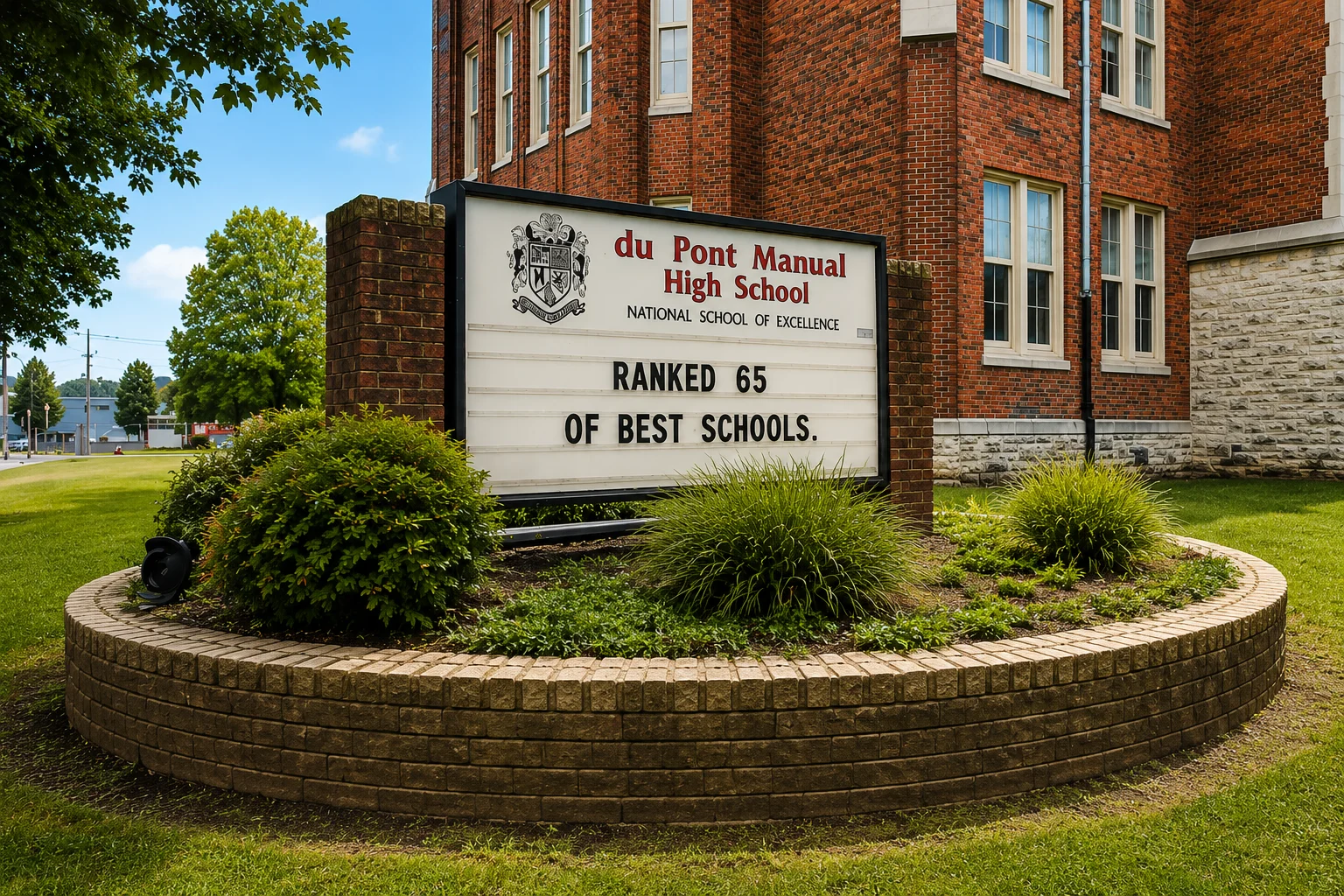
duPont Manual High School is officially back among the 100 highest ranked public high schools in America.
The U.S. News & World Report rankings released Aug. 18 place Manual at No. 1 in Kentucky and No. 65 nationally. That is a jump of 71 spots from last year, when Manual ranked No. 136 nationally. Manual has been here before. In 2019, U.S. News ranked it No. 30 in the country.
That raises an obvious question for JCPS families.
How can one district high school compete with some of the strongest public schools in the country while other JCPS high schools struggle with attendance, test scores and graduation?
The answer is not that Manual discovered one teaching method everyone else refuses to use.
Manual is built differently from most JCPS high schools, beginning with who enrolls there. It also offers an unusually deep academic program, has a remarkably stable student body and benefits from a culture where advanced coursework is common rather than exceptional.
That combination is difficult to reproduce.
Manual does not start with a typical group of high school students
Manual is a magnet school. Students apply to one of five specialized programs: High School University, Journalism and Communication, Math Science Technology, Visual Arts, or the Youth Performing Arts School.
Admission is competitive.
Manual's own school materials say the process can consider academic achievement, essays, teacher recommendations, portfolios and performing arts auditions, depending on the magnet. Students are not simply assigned to Manual because they happen to live near 120 West Lee Street.
The difference is visible in the student data.
JCPS lists 1,918 Manual students for the 2025 to 2026 school year. Of those, 1,137 are identified as gifted and talented. That works out to about 59 percent of the school. Only 21.5 percent of Manual students are classified as economically disadvantaged.
That is an extraordinary concentration of students who have already demonstrated academic achievement, artistic talent, or both.
If another high school is responsible for nearly every student who arrives from its attendance area, including teenagers who enter significantly behind academically, students learning English and students who move between schools during the year, that school begins with a different challenge.
The national ranking rewards what Manual does especially well
U.S. News says its 2026 to 2027 rankings evaluate schools using six measures, including state assessment performance, college readiness, college curriculum breadth, graduation and the performance of underserved students. The rankings use data from the 2023 to 2024 school year. More than 27,000 public high schools were evaluated and nearly 18,000 received national rankings.
Manual performs exceptionally well in many of those areas.
According to JCPS data for 2024 to 2025, 87 percent of Manual students scored proficient or distinguished in reading and 83 percent did so in math. Its four year graduation rate was 99.8 percent. The average ACT composite for eleventh graders was 25.
Then there is Advanced Placement.
In 2024 to 2025, JCPS reported 1,206 Manual students enrolled in at least one AP course. The school's AP pass rate was 88.6 percent.
Those numbers are not merely impressive statistics for a school brochure. They line up closely with what U.S. News rewards.
Selection explains part of the gap. It does not explain all of it
It would be easy to stop here and say Manual succeeds because Manual gets to choose strong students.
The JCPS data complicates that answer.
Among Manual students receiving free or reduced price lunch, 71 percent scored proficient or distinguished in reading in 2024 to 2025 and 68 percent did so in math. Those results remained strong even within a student group that national ranking systems specifically examine when measuring whether a school succeeds beyond its most advantaged students.
That does not prove Manual alone caused the difference. The public data does not tell us how those students were performing before entering Manual or how much of the result comes from classmates, curriculum, family support, teachers, or the admissions process itself.
But selection is not the entire story.
Manual surrounds students with advanced courses, specialized magnet classes, dual credit opportunities and classmates who also competed for admission. Its school materials describe Honors, Advanced and Advanced Placement coursework along with university partnerships that allow some students to take classes through the University of Louisville.
There is another advantage that gets less attention: students and teachers tend to stay.
Manual's student stability rate is 98.4 percent for 2025 to 2026. Teacher retention is 96.2 percent. Chronic absenteeism during 2024 to 2025 was 13.1 percent.
A school can build a lot when almost everyone keeps showing up.
Look at the attendance gap before blaming the curriculum
Ballard High School provides a useful comparison because it is also one of Kentucky's stronger public high schools.
The new 2026 U.S. News rankings place Ballard No. 12 in Kentucky. JCPS data for 2024 to 2025 show 938 Ballard students taking at least one AP course, with a 74.5 percent AP pass rate. Its four year graduation rate was 95.4 percent.
Those are strong numbers.
But chronic absenteeism at Ballard was 32 percent that same year, more than twice Manual's rate. Its student stability rate was 89.7 percent. About 37 percent of Ballard students were classified as economically disadvantaged.
Louisville Male is another revealing comparison.
Male is No. 18 in Kentucky in the new rankings. Its four year graduation rate was 97.8 percent in 2024 to 2025. But chronic absenteeism was 29.5 percent and its AP pass rate was 59.8 percent. Nearly 48 percent of its students were classified as economically disadvantaged that year.
That is already a different operating environment.
Then consider Iroquois High School.
JCPS data show Iroquois had an attendance rate of 82.7 percent in 2024 to 2025. Chronic absenteeism was 57.5 percent. Student mobility was 13.1 percent and stability was 78.3 percent. Teacher retention for 2025 to 2026 is 81.4 percent.
Nearly 80 percent of Iroquois students are currently classified as economically disadvantaged. JCPS also reports hundreds of multilingual learners at the school.
A principal cannot solve an AP participation problem before solving the problem of students not being in the building.
And a teacher who receives new students throughout the year, including some who are learning English or have experienced interrupted schooling, is being asked to accomplish something different from a teacher whose class roster is academically selected and highly stable.
That is not an argument for lower expectations.
It is the context behind the numbers.
More money alone does not reproduce Manual
There is another wrinkle.
Manual is not simply winning because JCPS pours more money into it.
For the 2023 to 2024 school year, JCPS reported per pupil spending of $17,738 at Manual. Ballard was slightly higher at $17,940.
Iroquois was $23,476.
That does not mean Iroquois enjoys more academic advantages. Schools serving larger numbers of students with intensive needs can require additional staffing, specialized programs and support services.
But the numbers make a simple argument that JCPS could fix every high school by funding it like Manual difficult to sustain.
Manual's advantage is a combination of student selection, program design, attendance, stability, advanced course participation, staffing continuity and school culture.
Money matters.
It just isn't the whole explanation.
Could JCPS copy the parts of Manual that are actually copyable?
Some of them, yes.
The district can expand AP and dual credit access. It can build stronger partnerships with universities and employers. It can create clearer academic identities inside large high schools. It can focus on teacher retention. It can identify promising students earlier and make sure advanced opportunities do not depend on whether a family already knows how to navigate the system.
JCPS is already trying a different version of that idea through the Academies of Louisville. The model includes about 20,000 students across 56 academies and 15 high schools, with career pathways supported by more than 200 business partners.
That matters when comparing schools.
A high school designed to prepare students for skilled careers, industry credentials and immediate employment may be doing valuable work that a ranking heavily influenced by AP performance does not fully capture.
There is also one part of Manual that cannot simply be copied across the district: selective admission.
If every JCPS high school screened applicants for academic performance, recommendations, essays, portfolios and auditions, the district would not suddenly produce thousands of additional high achieving students.
It would mostly move the existing students around.
The harder question is how JCPS creates more of the conditions that help students become Manual ready before ninth grade, then keeps challenging them wherever they attend high school.
Other JCPS high schools are already closer than the headline suggests
Manual is the outlier, but it is not the district's only high performing high school.
In the U.S. News rankings released this week, J. Graham Brown School is No. 2 in Kentucky and No. 176 nationally. Atherton is No. 5 in Kentucky. Ballard is No. 12 and Male is No. 18.
Five JCPS high schools are now among Kentucky's top 20.
So the story is not Manual versus a district full of failing high schools.
The more useful question is why the gap between JCPS high schools is so large, which parts of Manual's success are transferable and which are products of a selective magnet model.
For a parent choosing a high school, the national rank should be one piece of the decision, not the decision itself. Look at the courses your child can actually take, the magnet or academy pathway, AP and dual credit access, attendance, graduation, school stability and whether the program fits what your child wants to do after graduation.
Manual has built a school that performs exceptionally well on the measures national rankings reward.
The challenge for JCPS is not to build 20 Manuals.
It is to figure out how many more Manual level opportunities it can build for students who never get admitted to Manual in the first place.