
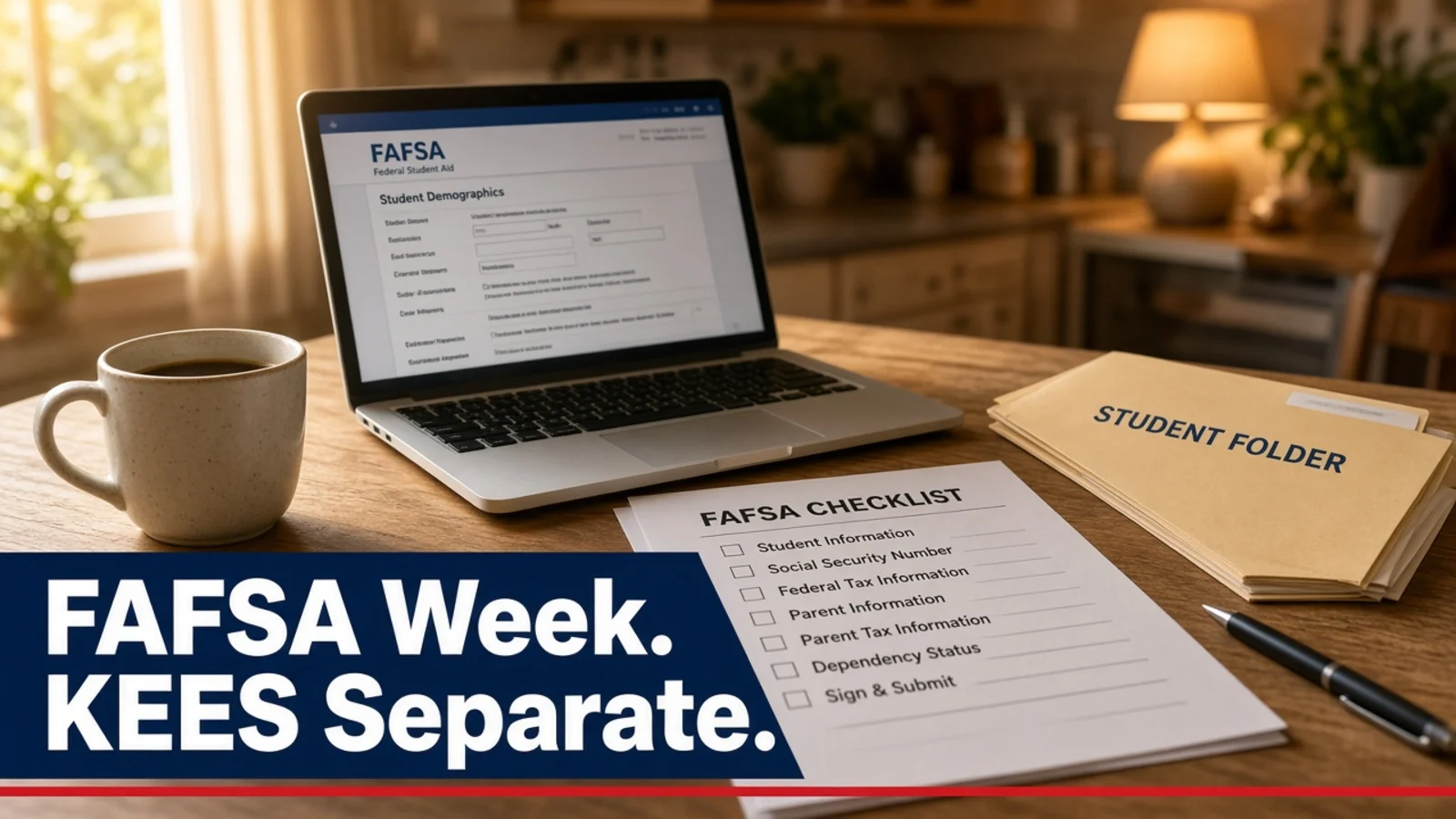
The 2027 to 2028 FAFSA opened this week for students heading to college or trade school between July 2027 and June 2028. Kentucky’s KEES money is separate from the federal form...
If your JCPS senior is aiming for fall 2027, the federal aid form that matters right now is the 2027 to 2028 FAFSA.
The U.S. Department of Education made the 2027 to 2028 Free Application for Federal Student Aid available this week, earlier than the old October 1 habit. Families start at fafsa.gov or StudentAid.gov. That form covers aid for college or career and trade programs between July 1, 2027, and June 30, 2028.
Kentucky aid is not the same pile of money. KEES is a state merit scholarship earned in high school. CAP and the Kentucky Tuition Grant are state need based programs that start with the FAFSA. Mix those up and you will chase the wrong deadline.
Federal track: FAFSA first
The FAFSA is how students apply for federal grants, loans, and work study. Many colleges also use it to build their own aid offers. Kentucky’s CAP and Kentucky Tuition Grant programs tell families to complete the FAFSA for the school year they need aid.
Gather this before you sit down, using Federal Student Aid’s FAFSA checklist as the source:
A StudentAid.gov account for the student, and a separate StudentAid.gov account for every required contributor (usually a parent, sometimes a spouse).
Contributor email addresses so the student can send the invite inside the form.
Social Security information for the student. Parents without a Social Security number can still create a StudentAid.gov account and complete their sections.
Federal income tax information for the required year. The FAFSA uses prior prior year tax data. For the 2027 to 2028 form, that is generally 2025 federal tax information. Contributors must give consent so the IRS can transfer tax data into the form.
Records of child support received, if any.
Current cash, checking, and savings balances, plus records of investments and the net worth of businesses or income producing farms when the form asks.
A list of colleges or trade schools to send the FAFSA to. The online form lets families list multiple schools.
Dependent students invite a parent as a contributor. Federal Student Aid’s steps for parents and the “Who’s My FAFSA Parent?” wizard help divorced and separated families figure out which parent the form wants. The form is not finished until every required contributor signs.
If income crashed after the 2025 tax year the form uses, ask each school’s financial aid office about a special circumstances review. Some private colleges still want a CSS Profile in addition to the FAFSA; check each school’s aid page rather than assuming one form covers everything.
Federal deadlines live on StudentAid.gov’s FAFSA deadlines page. The federal clock is long. College priority dates and Kentucky’s first come, first served state grants are not. File early enough for the schools on your list, then confirm each school’s own aid deadline on its financial aid site.
Kentucky track: KEES does not wait on the FAFSA
KEES, the Kentucky Educational Excellence Scholarship, is run by the Kentucky Higher Education Assistance Authority. It is merit based state aid, not a federal grant.
KHEAA’s current KEES page says students can earn a base award for each high school year they post at least a 2.75 GPA while meeting KEES curriculum rules at a certified Kentucky high school. Base amounts run from $187 for a 2.75 GPA year to $500 for a 4.00 GPA year. Those yearly amounts stack. A student who earns KEES in more than one high school year carries the total into college, subject to renewal rules.
The 2.75 floor is new for awards earned starting with the 2026 to 2027 high school year, under the 2026 state budget. Awards already earned under the old 2.50 rule stay on the books. A Class of 2027 senior can keep ninth through eleventh grade money earned that way and still earn nothing new for senior year if that GPA is under 2.75. If a year on MyKHEAA looks low next to the new floor, start with the counseling office before you assume the site is wrong.
ACT or SAT scores can add a bonus. KHEAA currently starts that bonus at an ACT composite of 15 (or an SAT evidence based reading and writing plus math score of 830) and tops out at $500 per year of college for an ACT of 28 or higher. Free or reduced price lunch eligible students can also earn supplemental awards for qualifying AP, IB, or Cambridge exam scores.
There is no separate KEES application for most public high school students. The high school reports the grades. After graduation, the earned total can be used at participating Kentucky colleges and universities for up to eight semesters, within five years, or until a bachelor’s degree, whichever comes first. Students check balances and notices in MyKHEAA.
College renewal is its own gate. After the first college year, KHEAA wants at least a 2.50 cumulative GPA. In later years, full renewal generally needs a 3.00 GPA, or a GPA between 2.50 and 2.99 with the college certifying the student is on track to graduate. Summer grades do not rescue a weak spring term for KEES renewal.
KEES is built for Kentucky campuses. Out of state use is narrow and runs through Academic Common Market rules administered with the Kentucky Council on Postsecondary Education. Ohio, Indiana, and Illinois do not participate in that market, per KHEAA’s current guidance.
Kentucky need based aid still starts with the FAFSA
If your family needs help with tuition beyond KEES, KHEAA’s need based programs matter.
The College Access Program grant is for Kentucky residents with financial need who enroll at least half time at an eligible school. KHEAA awards CAP on a first come, first served basis by FAFSA completion date until the money is gone. Filing this week beats filing after winter break. The latest amounts posted on KHEAA’s scholarships page for 2026 to 2027 are up to $2,500 at a two year school and up to $5,300 at a four year school. Confirm the figures for the award year your student will attend.
The Kentucky Tuition Grant helps Kentucky residents with need attend eligible private Kentucky colleges. KHEAA’s posted 2026 to 2027 maximum is $3,300. It also runs first come, first served by FAFSA date until funds run out.
Other KHEAA programs, including Work Ready Kentucky, have separate rules and often need a FAFSA plus a MyKHEAA application. Check the current KHEAA scholarships page before treating KEES as the whole state story.
What JCPS families should do this week
Start with people, then screens.
Ask your child’s JCPS counselor how the school wants seniors to request transcripts and whether the campus is hosting FAFSA help nights. JCPS does not publish one districtwide FAFSA night calendar for the Class of 2027, so the home high school counseling office is the first call. KHEAA is the state aid source of truth for KEES, CAP, and related programs.
University of Louisville, Jefferson Community and Technical College, Bellarmine, Spalding, and other schools on your student’s list set their own priority dates for institutional aid. Those dates, not June 30, 2028, are the ones that matter for campus money. Confirm each school’s financial aid deadline on its own site. If University of Louisville is on the list, UofL’s FAFSA school code is 001999.
Create or unlock StudentAid.gov accounts for the student and parent before you try to finish the form in one sitting. Mismatched emails and missing contributor invites are how kitchen table sessions die at 10 p.m.
Open MyKHEAA and look at the KEES total already on file. If a GPA year looks wrong, start with the high school counseling office. KHEAA’s KEES desk is kees@kheaa.com. Broader student aid questions can go to studentaid@kheaa.com or 800 928 8926.
When the StudentAid.gov submission summary appears, save it, check the school list, and complete any extra aid forms those colleges still require. Put college priority dates on the same calendar as scores, fees, and recommendation deadlines.
Start here: fafsa.gov, StudentAid.gov FAFSA help, and KHEAA scholarships and grants.