
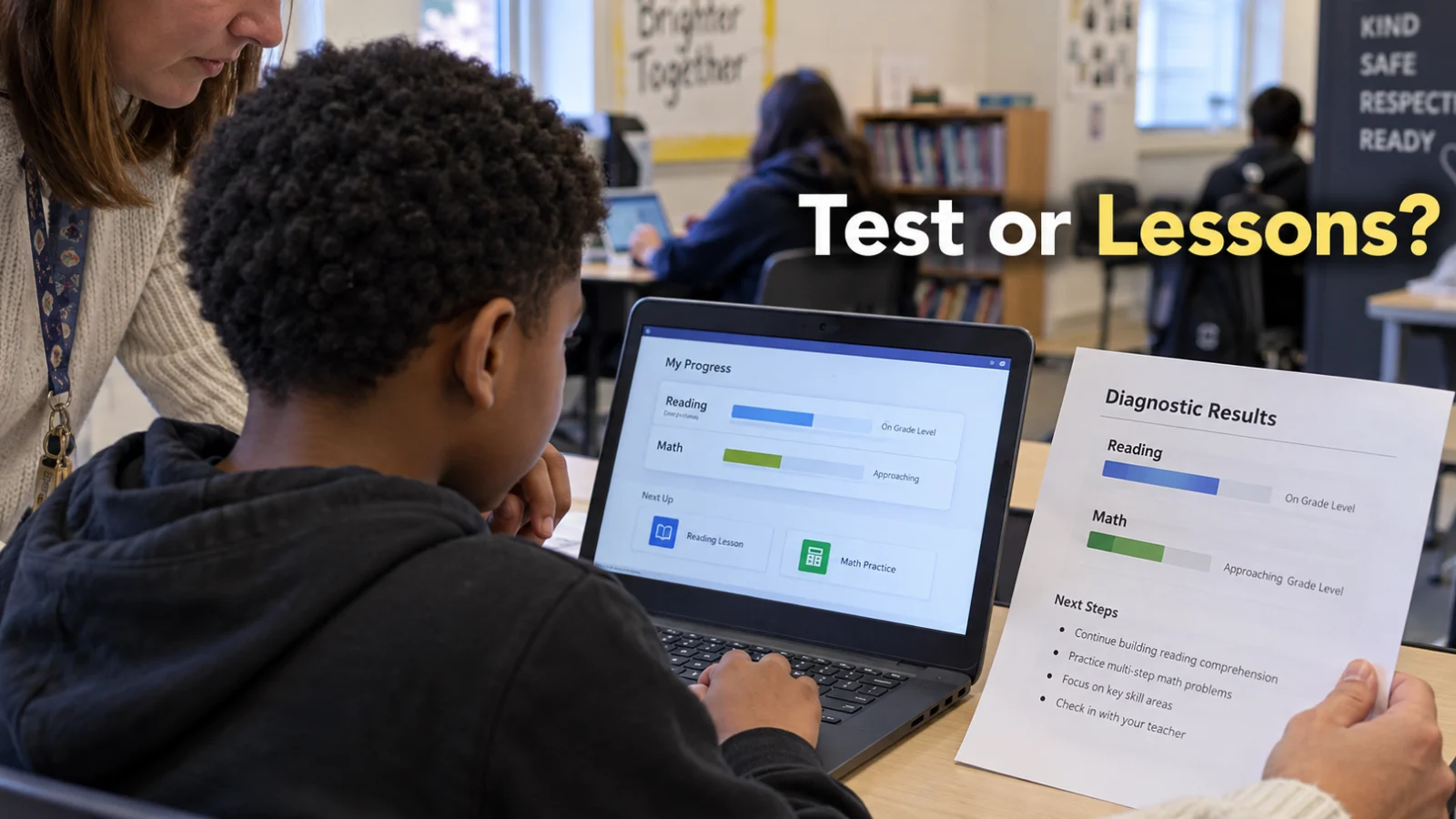
JCPS approved an estimated $561,000 districtwide iReady assessment contract for K through 8. But a 2024 JCPS agreement shows individual schools could already buy Personalized Instruction. What remains unclear is how much weekly iReady lesson time students are expected to get this year.
JCPS bought iReady districtwide this year as a reading and math screener and diagnostic assessment for K through 8.
But district records show another piece of iReady was already available to individual JCPS schools.
A 2024 JCPS data privacy agreement with Curriculum Associates allowed participating schools to buy an iReady Assessment and Personalized Instruction site license using individual school budgets. The agreement lists a license for 351 to 500 students for 18 months, and an attached quote was prepared for Indian Trail Elementary for $30,075.
The agreement and quote do not show whether Indian Trail ultimately completed that purchase. They do establish that JCPS had a school level route for buying the online lesson product before this year's districtwide assessment switch.
What JCPS has not published is one districtwide requirement telling every K through 8 student how many minutes per week to spend in Personalized Instruction.
What JCPS bought districtwide
The Jefferson County Board of Education approved Proposal 3161 on December 9, 2025.
The Board award names Curriculum Associates as the vendor for reading and math universal screener and diagnostic assessments. The contract runs from July 1, 2026, through June 30, 2027, with two annual renewal options. The estimated cost on the Board item is $561,000.
The separate bid tabulation says the purchase covers annual districtwide assessment platform licenses for JCPS elementary and middle schools and all K through 8 students. Curriculum Associates submitted a price of $8.25 per license.
Another Curriculum Associates number that has circulated should not be treated as the JCPS contract price.
A quote totaling $464,378.50 is addressed to Elizabeth Dant at Oldham County School District, lists a Crestwood address and was later included in Oldham County Board records as that district's iReady yearly services contract. It is not a JCPS quote.
Kentucky currently lists iReady among its approved screening options. KDE also says approval of a screening assessment is not an endorsement of the entire platform.
What two JCPS schools told families
Hawthorne Elementary told families on August 12 that iReady was replacing MAP in reading and math.
Its newsletter said K through 5 students would take the computer based assessment three times during the year, that testing would begin the following week and that teachers would share schedules and results.
J. Graham Brown School gave families more detail on August 26 about what can happen after the assessment.
Brown said the diagnostic provides skill breakdowns and grade level placements. It also said the software automatically generates individualized online lessons and that teachers can use the data for small group instruction and targeted activities. The message did not give families a required weekly number of lesson minutes.
The Courier Journal asked JCPS in August how much time students would be expected to spend in iReady outside the three assessment periods.
That amount was still unclear.
JCPS spokesman Barnard Baker said teachers would use the data to guide instruction, from broader classroom needs to individual skills, and that teachers would determine how best to incorporate those results into instruction and targeted support during the year.
JCPS Insider could not locate a public districtwide weekly Personalized Instruction target or a published closing date for the districtwide fall iReady window.
The assessments add up to about four and a half hours a year
KDE's current reading and mathematics information sheets both list an average testing time of 45 minutes per student and a frequency of three times per year. The reading sheet was revised August 12, 2026. The mathematics sheet was revised August 13.
If a student takes reading and math three times each, that works out to about 270 minutes, or four and a half hours, of iReady assessment time during the school year.
That is a JCPS Insider calculation based on KDE's published averages. Individual students can take less or more time.
Curriculum Associates recommends approximately 30 to 49 minutes per subject per week for schools that use Personalized Instruction, generally spread across two or three sessions. The company also says not every school using its assessment uses the lesson product.
Why the national criticism is mostly about what comes after the test
National complaints about iReady frequently involve weekly lessons, not just the diagnostic assessment.
Parents and teachers interviewed by Chalkbeat have complained about repetitive exercises, student frustration and the amount of school time spent on the software. Curriculum Associates says Personalized Instruction is meant to supplement teacher led instruction rather than replace it.
Washoe County, Nevada, is one example.
Its school board considered a three year iReady renewal this spring but approved only a one year extension in May. The $2.02 million agreement covers site licenses that provide assessment, academic growth monitoring and targeted Personalized Instruction. Chalkbeat reported that Board members wanted more information about student outcomes and screen time before making a longer commitment.
The public JCPS districtwide purchase is for assessment. JCPS records also show a separate school purchasing path for Personalized Instruction, and Brown School is telling families that individualized online lessons can follow the diagnostic. What the public record still does not show is one weekly usage rule applied across the district.
The newest research finds a small positive association
A June 2026 study by Georgia State University researchers examined iReady use in a Southeastern metropolitan district.
The study covered 131 schools and included 27,717 iReady users in the student characteristics analysis. Researchers used outside standardized assessment scores rather than relying only on an iReady test to measure achievement.
Depending on the model, iReady use was associated with reading gains of roughly 0.03 to 0.04 standard deviations and math gains of roughly 0.04 to 0.05 standard deviations.
The researchers described the average gains as roughly two additional weeks of instructional growth in mathematics and nearly three weeks in reading. They also found stronger results when teachers assigned lessons in addition to those automatically assigned by the software.
The effects are positive and small.
The research was supported by the Institute of Education Sciences through a grant to Georgia State University, and the authors declared no conflicts of interest. It was not a randomized experiment, and the paper describes the findings as associations rather than proof that iReady alone caused the gains.
Other positive evidence has a different limitation
Evidence for ESSA currently gives iReady Personalized Instruction a moderate evidence rating in both reading and mathematics.
Its reading listing covers one study of 2,132 fifth grade students and reports an effect size of 0.12. The math listing covers 2,256 students and reports an effect size of 0.23. Both come from the same quasi experimental study involving six Massachusetts districts.
The source is identified as Curriculum Associates Research Report No. 07.
Those ratings concern Personalized Instruction.
They do not establish that simply giving JCPS students the new diagnostic three times a year will improve KSA scores.
Parents can still ask for national comparison information
The switch from MAP does not eliminate national norm information.
KDE's current reading sheet identifies iReady as norm referenced and criterion referenced. Its math sheet says grade level norms are available.
JCPS's own 2024 data privacy agreement also lists National Norm, Lexile Measure, Quantile Measure, grade level placement and placement by domain among the assessment information the system can process.
What remains less clear is how consistently JCPS families will receive those details.
Hawthorne told parents that teachers would share results. JCPS Insider could not locate a districtwide public instruction stating that every family's complete iReady report or national norm information will appear in Infinite Campus or another parent portal.
The student data lawsuit remains unresolved
Four student plaintiffs filed a federal lawsuit against Curriculum Associates in Massachusetts on December 22, 2025.
The complaint alleges improper collection, use and sharing of student information. Curriculum Associates moved to dismiss the case in February, and the plaintiffs filed their opposition in April. The public docket retrieved for this article does not show a ruling on the merits.
Curriculum Associates denies the allegations and says it does not sell student data, use student data for advertising or create commercial student profiles.
JCPS's data privacy agreement with Curriculum Associates is effective from September 25, 2024, through September 26, 2027.
The agreement says Curriculum Associates may not sell JCPS confidential data to a third party. It also prohibits using, disclosing or selling that information for targeted advertising or creating a student profile for purposes outside the contracted service.
The contract spells out JCPS's privacy restrictions. It does not decide the allegations in the federal case.
Four questions to ask your child's school
Is my child only taking the three iReady assessments, or are online lessons also being assigned? If lessons are being assigned, ask how many minutes per week the school expects in reading and math.
Can I see the complete results? Ask for the grade level placement, skill breakdown and national norm information available for your child.
What changed because of the score? If the diagnostic identifies a weakness in phonics, comprehension, number sense or another skill, ask what instruction or intervention changed because of that result.
Who should I contact if I cannot get the report explained? Start with the classroom teacher and school. JCPS lists Nick Toole, Manager of Testing, as its district assessment contact at 502 485 3388 and nick.toole@jefferson.kyschools.us.
By spring, JCPS will have something more useful than a national argument about iReady.
It will have a school year of Jefferson County experience showing how much students actually used the platform, what teachers did with the results and whether families received information they could understand and use.
That is the local test.