
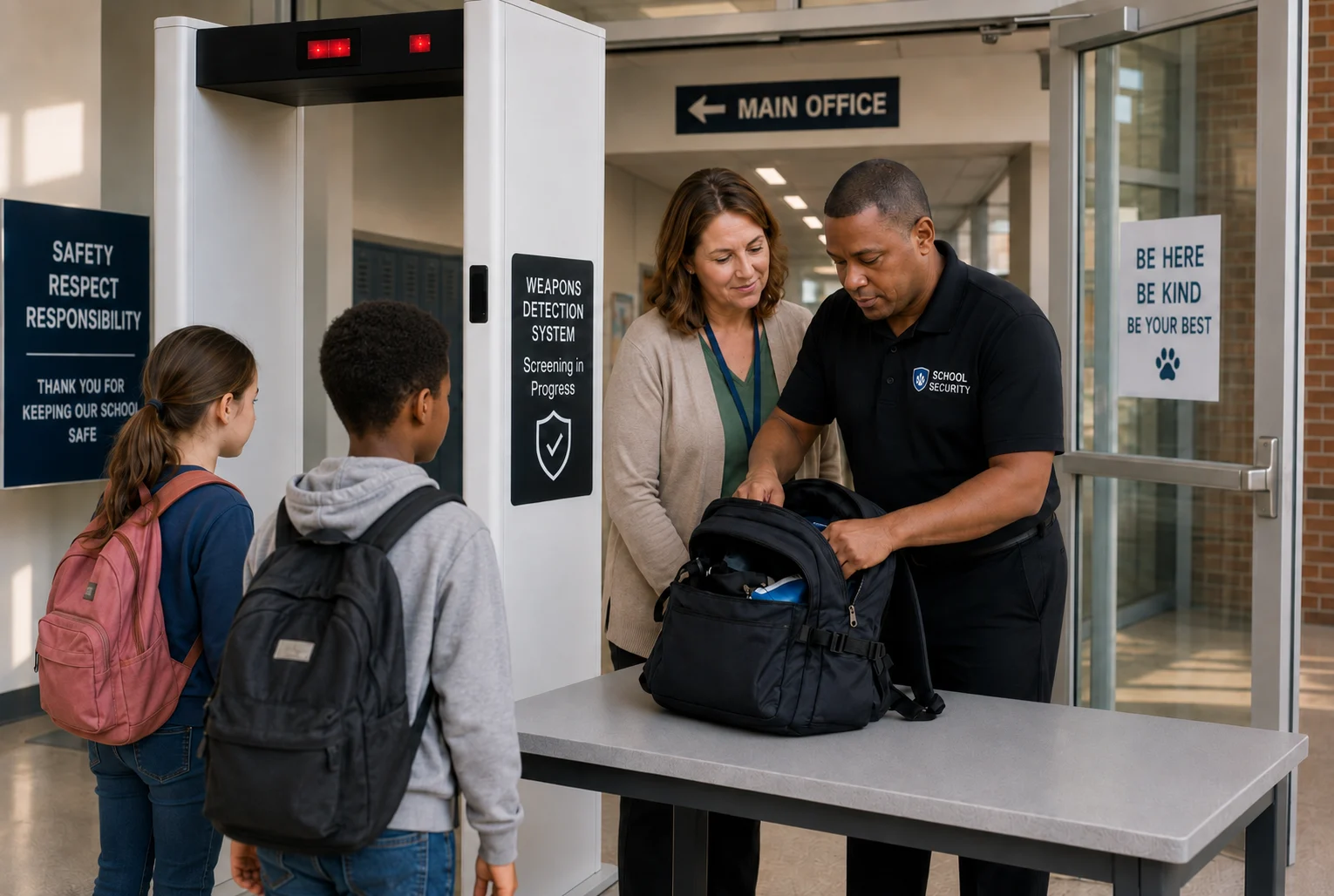
A gun was found in a Kammerer Middle School student's backpack before classes began Thursday. JCPS's weapons-detection system appears to have done exactly what it was designed to do. The harder question now is what happens after a student brings a gun to a JCPS school.
A Kammerer Middle School student was arrested Thursday morning after the school's weapons-detection system alerted staff to a backpack that was later found to contain a gun.
According to a letter from Principal Shannon Corrigan, the alert occurred before the school day began. A Risk Assessment Coordinator secured the backpack, escorted the student to a private location, and the weapon was discovered inside. JCPS Police took custody of the gun and arrested the student without further incident.
The school remained on its normal schedule.
Corrigan told families that the district's systems had worked “exactly as intended” and said the student would face discipline according to JCPS policy. (wdrb.com)
That makes one part of the Kammerer Middle School gun incident relatively straightforward:
The JCPS weapons-detection system appears to have worked.
What happens to the student next is considerably more complicated.
What is the JCPS weapons policy for students?
JCPS's own Student Relations department describes Level 4 behaviors as its most serious category of infractions and specifically identifies weapons-related incidents as an example.
Students referred for Level 4 incidents may go through JCPS Student Relations, where the district considers alternative placement and other interventions. If a student is assigned to an alternative school, JCPS says its Student Relations staff handles the transition and works to enroll the student within five days. (jefferson.kyschools.us)
That directly addresses one question appearing repeatedly in online discussion after the Kammerer incident:
Does JCPS still have alternative schools for students facing serious discipline?
Yes. Alternative-school placement remains part of the JCPS disciplinary system.
But when a student brings a gun to school, Kentucky law also comes into play.
What happens if a student brings a gun to school in Kentucky?
KRS 158.150 requires every Kentucky school board to have a policy requiring an expulsion of at least 12 months when the board determines that a student brought a weapon to school under the definition established in KRS 527.070.
The law also says the 12-month period cannot simply be shortened for an offense falling under that provision. A board may impose a longer expulsion. (apps.legislature.ky.gov)
So, can a student be expelled for bringing a gun to school in Kentucky?
Yes. Kentucky law establishes a 12-month expulsion standard when the requirements of the statute are met.
There is an important wrinkle, however.
The same statute allows a superintendent, under specified circumstances, to place a student in an appropriate alternative program or setting in lieu of expulsion. And when a student is expelled from the regular school setting, the district generally must continue providing educational services through an appropriate alternative setting unless the board makes the required safety finding that such a placement cannot appropriately be made. (apps.legislature.ky.gov)
So the choices are more complicated than simply “suspended” versus “kicked out of school.”
A student can be removed from his or her regular school while continuing to receive an education elsewhere.
Does a student expelled from JCPS still receive an education?
In many circumstances, yes.
Kentucky law generally requires a school district to continue providing educational services through an appropriate alternative program or setting after a student is removed from a regular school.
That can include an alternative school, another educational placement or another setting permitted under state law.
This is why questions such as “does JCPS still have alternative schools?” and “where do expelled JCPS students go?” are important when discussing serious disciplinary cases.
Expulsion from a regular school does not necessarily mean the end of a student's education.
How often are students actually expelled for bringing guns to Kentucky schools?
This is where the broader picture becomes particularly interesting.
A 2025 analysis from the Kentucky General Assembly's Office of Education Accountability examined statewide discipline data from the 2023-24 school year.
Researchers identified 27 recorded firearm incidents statewide.
Of those cases:
44.4% had a final recorded resolution of expulsion, in-district removal or an interim alternative educational setting.
40.7% resulted in an in-school removal or suspension.
14.8% were recorded as a local resolution.
The report specifically noted that firearms clearly meet Kentucky's statutory definition of an unlawful weapon and observed that fewer than half of the firearm cases in the data resulted in one of the removal categories analyzed by researchers. (apps.legislature.ky.gov)
That does not tell us what will happen in the Kammerer Middle School case.
It also does not establish that JCPS handled any previous firearm case improperly. The figures are statewide, come from the 2023-24 school year, and the researchers themselves noted limitations in how disciplinary resolutions are recorded and reported. (apps.legislature.ky.gov)
But the finding raises a legitimate question worth following locally:
What actually happens when a student brings a gun to a JCPS school?
A comparable public breakdown showing JCPS firearm incidents alongside their final disciplinary outcomes was not identified in the materials reviewed for this article.
That information would provide considerably more context than simply quoting the written JCPS weapons policy.
Do JCPS weapons detectors work?
Thursday's incident also provides a real-world test of another question JCPS parents have asked:
Do the weapons detectors used in JCPS middle and high schools actually work?
JCPS told families when it rolled out the technology that the Jefferson County Board of Education had approved weapons-detection systems for every district middle and high school. The district also cautioned that no system can guarantee a weapon will never enter a building. The technology is designed to alert trained staff to potentially dangerous objects so they can investigate. (jefferson.kyschools.us)
At Kammerer Middle School on Thursday, that process appears to have worked as designed.
The detector alerted.
Staff intervened.
The backpack was secured.
JCPS Police took possession of the gun.
And students proceeded with their school day.
That is an important part of this story — even while serious questions remain about how a middle-school student obtained a firearm in the first place.
What are JCPS parents saying about the Kammerer Middle School gun incident?
Comments shared with JCPS Insider following news of Thursday's arrest reflected several different reactions.
Some people argued that a student who brings a gun to school should face severe consequences.
Others asked whether JCPS alternative schools still exist or recalled stricter disciplinary practices from years past.
Several commenters focused simply on the age of the student, expressing disbelief that the incident happened at a middle school.
But another reaction deserves just as much attention.
A parent with a child at Kammerer expressed relief that the weapons-detection system caught the weapon.
That distinction matters.
There are really two separate questions coming out of the Kammerer Middle School incident:
Did the JCPS security system work?
And:
What discipline will a student face for bringing a gun to school?
Thursday's events give us considerably more information about the first question than the second.
Was the gun at Kammerer Middle School loaded?
That is one of several questions that remain unanswered.
Some unanswered questions concern the Kammerer Middle School gun incident itself:
Was the gun loaded?
What type of firearm was it?
Where did the gun come from?
Who owned the firearm?
How did the student obtain access to it?
Was there any evidence that the student intended to use it, or was the weapon simply being carried?
Those facts matter, particularly before assigning responsibility to the student's parents or anyone else.
There is currently no verified public information reviewed for this article establishing where the firearm came from or how the student obtained it.
What discipline will the Kammerer Middle School student face?
Other unanswered questions concern the JCPS disciplinary process and what happens next:
Will the Kammerer student be expelled?
Will JCPS consider an alternative-school placement?
What disciplinary process is now underway?
How has JCPS handled previous firearm cases?
How many guns have been found at JCPS schools in recent years?
How many JCPS students have been expelled for weapons?
How many students were instead placed in alternative schools?
What happens to a JCPS student after a Level 4 weapons violation?
Those are questions the district can potentially address through policy explanations and de-identified aggregate data without publicly identifying this student.
They are also the questions JCPS Insider intends to continue following.
Can JCPS tell parents what happens to the student?
There is a limit to how much information families should expect to receive about this individual student.
Kentucky law generally makes juvenile court records confidential, including records concerning arrests, petitions, adjudications and dispositions, subject to specific exceptions. (apps.legislature.ky.gov)
Federal student-privacy rules also treat student disciplinary files as education records. (studentprivacy.ed.gov)
That means the public may never receive a detailed account of this student's juvenile case or school disciplinary record.
But there is an important distinction between student-specific information and information about JCPS policy and outcomes.
Privacy rules do not prevent JCPS from explaining how its weapons policy works, how alternative placement works or providing appropriate aggregate data about previous incidents.
And that is where the next phase of this story should focus.
How many guns have been found in JCPS schools?
That may ultimately be one of the most useful questions for parents.
One incident can tell parents whether a security procedure worked on one particular morning.
Several years of data could tell them much more:
How many firearms have been discovered in JCPS schools?
How many were detected at the entrance?
How many students were expelled?
How many were transferred to alternative schools?
How many cases resulted in another disciplinary outcome?
And has the number of weapons found changed since JCPS installed weapons-detection systems across its middle and high schools?
Those numbers would give families a clearer picture of both school security and the consequences that follow a serious weapons violation.
A JCPS-specific breakdown of firearm incidents and final disciplinary outcomes was not identified in the public materials reviewed for this article.
What happens next after the Kammerer Middle School gun arrest?
There are two stories coming out of Kammerer Middle School.
The first is about JCPS school security.
A student arrived with a gun in a backpack. A weapons-detection system flagged it before classes began. Staff responded, JCPS Police took custody of the weapon and the school continued operating normally. (wdrb.com)
By the account released so far, that system worked.
The second story is about JCPS discipline and accountability.
Kentucky law establishes serious consequences for bringing a firearm to school. JCPS categorizes weapons-related incidents among its most serious behavioral violations. Yet statewide data show that the final outcomes recorded after firearm incidents have historically been more complicated than the phrase “mandatory 12-month expulsion” might suggest. (apps.legislature.ky.gov)
That makes the most important question going forward larger than the identity of one middle-school student:
What actually happens after a student brings a gun to a JCPS school?
The weapons-detection system has already had its test.
It passed.
Now the district's disciplinary process — and the transparency surrounding it — becomes the part worth watching.
Editor's note: Because this incident involves a juvenile, JCPS Insider is not identifying the student. Comments from ordinary Facebook users have been paraphrased rather than attributed by name. Community reaction is included as reaction only and is not being used to establish facts about the incident.