Manual gets most of Louisville’s magnet school attention. But JCPS has seven other magnet high schools, including career programs, STEM specialties, self directed learning, single gender academies and Traditional schools that may fit some students better.
Mention JCPS high school magnets in a Louisville parent group and the conversation has a way of becoming a Manual conversation.
The numbers explain some of that. In JCPS’s 2025 to 2026 Magnet and Program Applications report, duPont Manual recorded 1,152 application counts, about 45 percent of the 2,534 high school counts shown in the report. Central High Magnet Career Academy had 766, Butler Traditional 286, Western 163, Louisville Male 120 and J. Graham Brown School 47.
Two current JCPS magnet high schools, W.E.B. DuBois Academy and Grace James Academy of Excellence, do not appear in that report. The figures also are application counts, not acceptance rates and not a ranking of school quality.
JCPS Insider previously looked at which JCPS magnet schools received the most applications. This is a different question.
Before Louisville families enter another application season, what do the other seven magnet high schools offer that could make one of them a stronger fit for a particular child?
Central can make sense when a student already has a direction
Central is probably the clearest example of why parents should look at programs rather than name recognition.
The current JCPS Choices material lists pathways including Additive Manufacturing, Cyber Engineering, Dental Assisting, Management Entrepreneurship, Marketing, Navy JROTC, Patient Care Technician, Pre Law, Pre Med, Teaching and Learning and Veterinary Assistant. Central also offers AP Capstone, other AP courses and dual credit through the University of Louisville, Jefferson Community and Technical College and Morehead State University. JCPS says Early College opportunities are available through its medical programs.
That creates some unusually specific choices for a fourteen year old. A student who is already talking seriously about medicine, veterinary work, law, cybersecurity, business or teaching can enter high school with a pathway that connects to that interest rather than waiting until college to explore it.
Central is selective. JCPS says its admission process considers achievement test scores, grade point average, personal essays and teacher recommendations.
So its 766 application count should not be read as evidence that it is easier or harder to enter than Manual. The two schools use admissions criteria and offer very different programs.
Western is not just another general STEM school
Western High has a narrower identity.
JCPS describes Western as a STEM magnet with four principal areas of study: Computer Programming, Culinary Food Science, Digital Design and Game Development, and Public Health Discoveries and Data Science. Students in its magnet programs can pursue dual credit, AP classes and industry certifications.
The combination is unusual. Culinary Food Science connects commercial food preparation with science and technology. Game development brings together programming, animation and design. Public Health combines health and data rather than treating those as unrelated subjects.
Western also received National Magnet School Certification from Magnet Schools of America in September 2026, along with Manual and Grace James.
Its 163 application counts in the 2025 to 2026 JCPS report were far below Manual and Central. That tells parents something about application volume. It does not tell them how competitive a particular applicant will be or whether Western is the stronger academic fit.
Brown offers something harder to measure on an application chart
J. Graham Brown School is small.
JCPS lists just 278 students in grades nine through twelve. Its magnet is built around Self Directed Learning rather than a career specialty. Student voice, project based learning, goal setting, student led conferences, service learning and cross grade collaboration are embedded in the model.
Brown also offers AP coursework including AP Capstone, CLEP testing, college and dual credit classes as early as sophomore year, a Computer Programming pathway and the Ursa Innovation Lab, which includes equipment such as 3D printers, laser cutters, virtual reality equipment and podcasting tools.
That environment will not appeal to every student, which is part of the point.
JCPS says students are expected to demonstrate grade level academic performance and age appropriate social skills in Brown’s informal educational setting. Families should think about how comfortably their child works with independence and responsibility, not simply whether a small magnet sounds attractive.
Brown had only 47 application counts in the 2025 to 2026 report. But Brown applicants are directed by JCPS to the school for additional application materials, so that number should not be confused with automatic or easy admission.
Families trying to compare Brown with Manual or Male can also use the JCPS Insider school comparison tool.
DuBois now has a new campus and a distinctive aviation path
W.E.B. DuBois Academy entered this school year in a new home.
JCPS opened its new campus at 4929 Poplar Level Road in July. The district says the 62 million dollar, 185,000 square foot building brings DuBois middle and high school students together and was designed to serve more than 1,000 students in grades six through twelve.
DuBois is an all male academy with an Afrocentric curriculum and an emphasis on scholarship, leadership and service.
Its career offerings include Aerospace Engineering, Aircraft Maintenance Technician and Marketing. The aviation work covers areas such as aircraft design, aerodynamics, propulsion, aircraft systems and maintenance.
JCPS also says DuBois offers dual credit through a partnership with JCTC that could lead to a student earning an associate degree by graduation. That is a possible pathway, not a promise that students who attend DuBois routinely graduate with one.
JCPS Insider examined that distinction in its guide to associate degrees, Early College and dual credit opportunities across JCPS high schools.
Grace James gives girls a different kind of STEAM option
Grace James Academy of Excellence is a districtwide, all girls magnet built around an Afrocentric STEAM model.
The current Choices guide identifies specialized offerings in Health Science, Engineering and Design, and Computer Programming. JCPS also lists dual credit opportunities and college partnerships.
Its model reaches beyond scheduling a few STEM electives. JCPS describes hands on and blended learning, student voice, advocacy, project based learning and STEAM work incorporated across the curriculum.
Grace James was one of the JCPS programs earning National Magnet School Certification in September.
Butler and Male are a different kind of magnet choice
Butler Traditional and Louisville Male operate differently from Central, Manual and other criteria based magnets.
They are Traditional magnet high schools with geographic boundaries. JCPS says students already attending a Traditional Magnet middle school are automatically enrolled in the Traditional Magnet high school serving their home address. Students entering from outside that pipeline must apply, but Butler and Male do not require the extra application materials used by criteria based schools because admission uses a lottery.
The programs are substantial.
Butler offers honors and AP courses and dual credit opportunities through partners including UofL, JCTC and Morehead State. Current specialized programs include Allied Health, Automation Engineering, Informational Support and Services, Marketing, Network Services, Pre Law and Criminal Justice, Pre Nursing, and Teaching and Learning.
Male lists 24 AP courses, dual credit opportunities and pathways in areas including computer programming, engineering, biomedical sciences, business and teaching.
The bigger parent question is not whether either school is a substitute for Manual. It is whether the Traditional model, the available programs and the boundary rules fit the student and family.
Transportation changes this comparison more than it used to
For the 2026 to 2027 school year, JCPS says all students attending Central and Western and all students enrolled at Grace James and DuBois are eligible for district transportation.
Manual, Male and Butler do not have the same universal eligibility. JCPS limits regular transportation at those three schools to students who are directly certified for free and reduced lunch. Students whose IEP includes transportation remain eligible through Special Needs Transportation. Brown is not included on JCPS’s list of magnet high schools receiving universal transportation.
That can turn what looks like an academic decision into a family logistics decision very quickly.
These are the rules for the current school year, not a guarantee for 2027 to 2028. Families applying this fall should verify next year’s transportation policy before accepting a school based on an assumption that a bus will be available.
Applications open November 2
The JCPS application window for the 2027 to 2028 school year runs from November 2 through December 18, 2026. Applications are not processed on a first come, first served basis.
Families can select a first and second magnet choice. The application itself warns that second choice programs are usually filled with students who selected them first.
The district’s wait list rules make the practical consequence clearer. Second choice selections and late magnet applications are not included in the magnet wait list. JCPS says they are reviewed based on building capacity and program need. For middle and high schools, the district lottery wait list applies to Traditional magnets. At criteria based schools, a school may later contact a family if a student was rejected because the program was at capacity and a seat becomes available.
Put the school your child most wants first. Do not assume the second choice works like an equal backup.
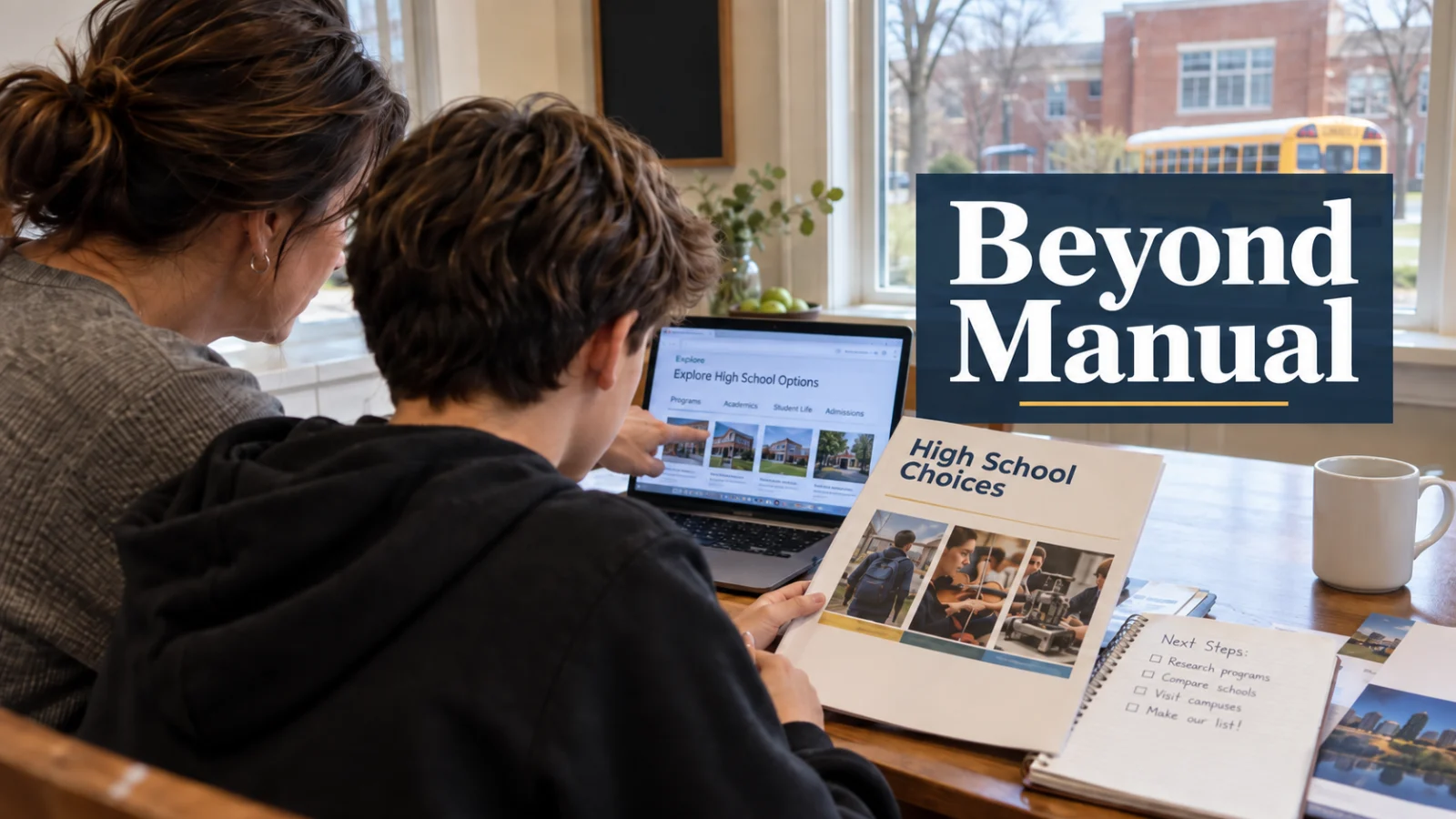
Before applying, families can use the district’s current High School Choices information and prospective student tour schedule. The Office of School Choice can be reached at (502) 485 6250.
Touring matters because a program name only tells you so much. Ask what classes actually ran this year, when students enter the specialized pathway, what additional application material is required, what a realistic dual credit schedule looks like and whether transportation will be available for 2027 to 2028.
Manual deserves the attention it gets.