
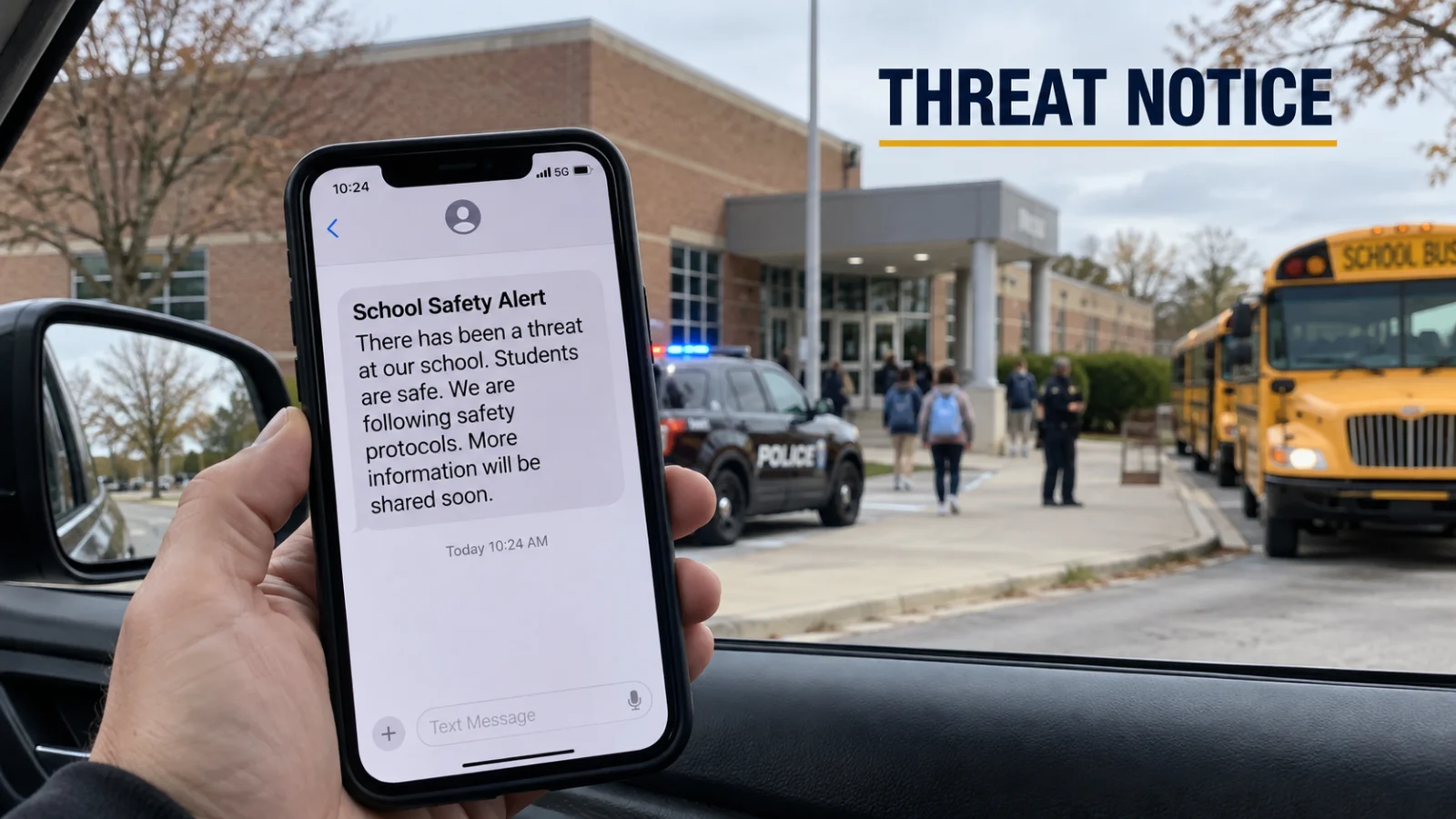
A JCPS threat message may say police were called and safety procedures were followed, then offer few details. District procedures show what can happen behind the scenes, when families may be notified, and why one school threat message can look very different from another.
A JCPS threat notice can be surprisingly short.
On May 11, 2026, Jefferson County Traditional Middle School Principal Brent Conner told families that administrators had learned of a discussion between one of their students and a student who did not attend JCTMS about a threat against the school. The notice, posted on the JCTMS live feed, said administrators immediately called JCPS Police and followed school safety procedures. It also said the student who made the threat would be disciplined under the Student Support and Behavior Intervention Handbook and could face criminal charges.
The message did not identify the student, describe the threat in detail or tell families exactly what those safety procedures were.
A review by JCPS Insider of current Kentucky law, JCPS family communication guidance and the district's publicly available safety manual found no fixed number of minutes in which every reported threat must produce a family notification. The public materials also do not set out one required list of facts that every initial threat message must contain.
A reported threat starts an assessment, not an automatic conclusion
A report that someone made a threat does not mean investigators have already decided the threat is credible.
Kentucky law requires each district superintendent to appoint a school safety coordinator. That coordinator must designate a threat assessment team at every school, with at least two staff members, to identify and respond to students whose behavior indicates a potential threat to school safety or security.
JCPS's own 2023 Safety and Emergency Procedures Manual says all schools must have a trained threat assessment team of two or more people. Its threat procedures tell staff to identify the people involved, gather contact information, preserve threatening messages, contact the JCPS Security and Investigations Unit and begin a threat assessment inquiry when appropriate.
The current Student Support and Behavior Intervention Handbook also gives mental health practitioners a role in threat assessment. JCPS says mobile assessments may be requested for students experiencing a crisis or showing thoughts or actions involving harm to themselves or others. Parent permission is required for students younger than 18.
JCPS Police may be working the incident at the same time. The department says it investigates criminal cases on district property and specifically lists bomb threats, death threats and possession of deadly weapons among the felonies it handles.
What happens next depends on what was reported and what investigators find.
A threat does not automatically mean a lockdown
Kentucky requires every public school to establish lockdown procedures and hold at least two lockdown practices each school year. At least one must take place within the first 30 instructional days and another during January. The law does not say every reported threat automatically requires a lockdown.
A person believed to be approaching a school with a weapon creates a different problem from administrators learning about a threatening conversation that occurred earlier.
The JCPS safety manual directs schools to increase their Threat Oriented Protective Posture based on the information available and the credibility of the threat. JCPS Security and Investigations can help make that decision.
Parents also should not expect a notice to reveal the school's complete security plan. Kentucky law allows the district school safety coordinator's recommended all hazards policies and procedures to be withheld from the normal state open records process.
JCPS procedures include notifying parents or targets
The JCPS Safety and Emergency Procedures Manual contains a specific reporting section for threats.
For an imminent or active risk, it lists local police. For moderate, high, imminent or active risks, it lists the district Security and Investigations Unit.
The next instruction says parents or targets should be notified as appropriate, with coordination through Communications. The manual also lists emergency electronic alerts through voice, text and email.
The manual was revised in 2023. It does not publish a universal family notification deadline or a standard checklist of information that every first message must contain.
JCPS's current family communication page likewise says email may be used for detailed emergency information and text messages may be used for emergencies. School and district websites, the JCPS app and social media are additional communication tools.
Recent JCPS notices show how the message can change
The May JCTMS letter is one example.
On September 11, 2025, Newcomer Academy Principal Gwen Snow posted a letter on the school's public live feed after someone not connected with Newcomer made a threat against one student.
Snow told families that the school had contacted the student's family, requested JCPS Police presence during dismissal and increased the security level of the building.
The JCTMS notice involved a threat against the school and said JCPS Police had been called immediately.
The Newcomer notice involved a threat against one student and told families about increased security and police presence during dismissal.
Neither identified the person accused of making the threat. Both told families something about what the school was doing in response.
FERPA does not require schools to say nothing
Student privacy is one reason families may not receive every detail.
Another student's disciplinary record, mental health information and other education records generally are not records the entire school community is entitled to receive.
But FERPA does not make everything involving a student confidential.
Federal regulations allow schools to disclose personally identifiable information from education records to appropriate parties when officials determine there is an articulable and significant threat to someone's health or safety and the information is needed to help protect that person.
Privacy law does not require silence during an emergency.
When a threat notice hits your phone, start with what is happening now
Read first for the current situation.
Is the school operating normally? Has dismissal changed? Are police on campus? Does the school say the concern has been investigated? Are parents being told to stay away from campus or take any action?
If your child has firsthand information, screenshots or messages, preserve the originals and get them to school officials or police rather than repeatedly forwarding them through parent chats.
JCPS gives its own staff similar instructions. If a threat arrives through social media or text, the 2023 safety manual directs staff to immediately capture a screenshot or photograph the device before the image is lost and document the source of the message.
Kentucky law also provides protection under the terroristic threatening statute for someone who innocently reports another person's threat when the person believes it to be true, reports it to an appropriate authority and identifies the source if known.
If your own child was threatened, ask about your child's safety. Ask whether additional supervision, a schedule change, a safety plan or another protective measure is appropriate. The JCPS threat procedures specifically include safety planning with the target among the possible responses.
If an incident also involves a search of your child's backpack or phone, JCPS Insider has a separate guide explaining when JCPS can search a student, backpack or phone.
If school discipline follows, the JCPS Insider Student Bill of Rights parent guide explains student rights, discipline procedures and appeals. That guide covers the 2026 to 2027 handbook approved by the Jefferson County Board of Education.
For suspicious activity on JCPS property, the district says to call 911 and 502 485 3121. The JCPS Police nonemergency number is 502 485 3111.
Parents should also make sure their cell phone number, email address and preferred language are current with their school and listed in Infinite Campus. JCPS says text messages are translated automatically according to the language selected in Infinite Campus, while translated emails are available when possible.