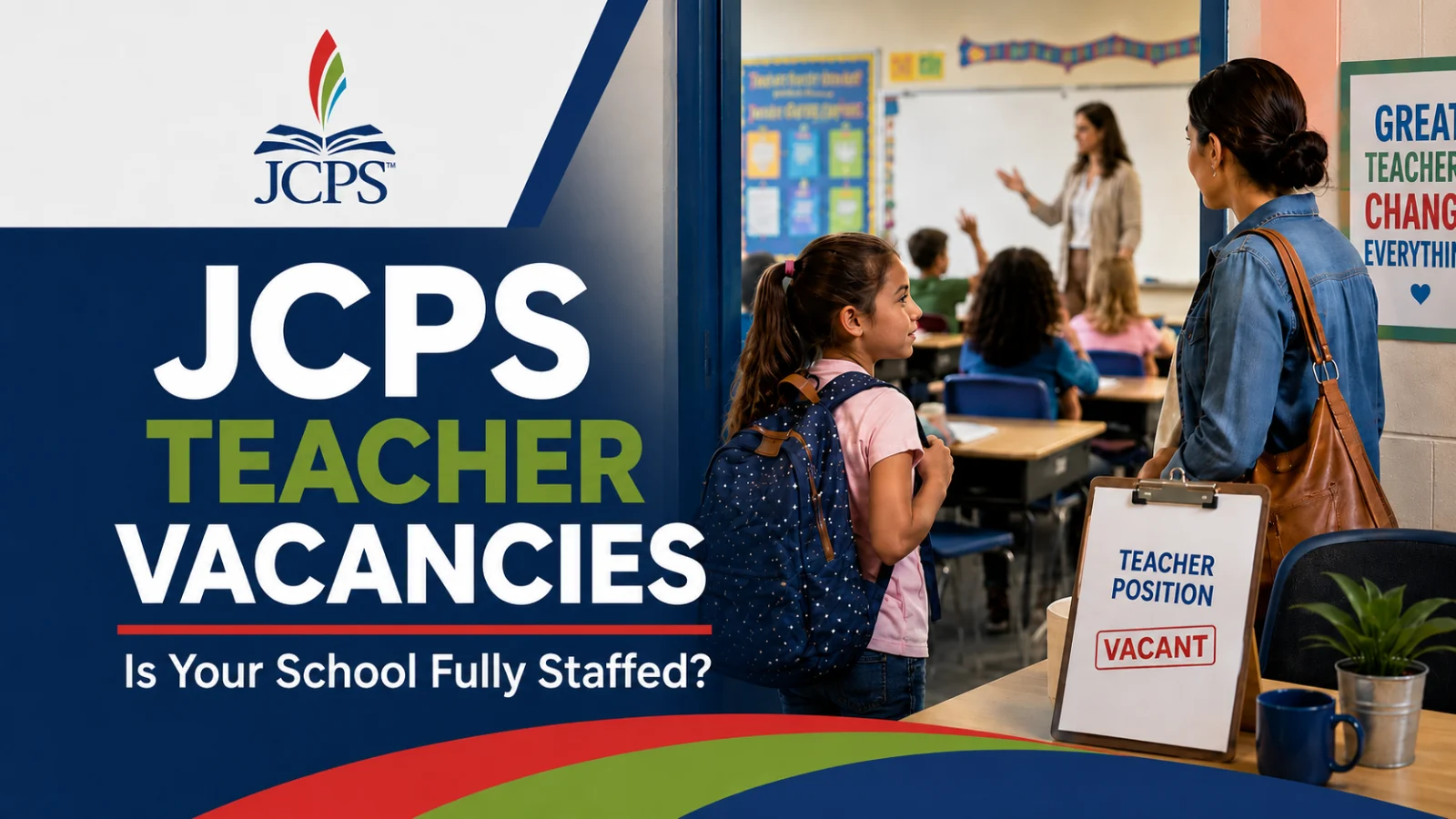
JCPS says it has around 170 teacher vacancies — a major improvement from last year. But parents still can't easily answer the question that matters most: How many are at my child's school?
If you're a JCPS parent, 170 teacher vacancies probably isn't the number you care about most.
You want to know about your child's school.
Does her elementary school have all of its teachers? Is his middle school math class being taught by a permanent teacher or a long-term substitute? Is your child's Exceptional Child Education classroom fully staffed? Did class sizes increase?
Those questions are much harder to answer.
On August 6, 2026, Superintendent Brian Yearwood said JCPS had around 170 teacher vacancies as students returned for the first day of school. (WDRB)
That's a substantial improvement from last year.
But one critical piece of information is missing:
Which schools have those vacancies?
170 vacancies is better than 360. It still doesn't tell a mom whether her child's classroom has a permanent teacher.
How Many Teacher Vacancies Does JCPS Have Right Now?
Even the districtwide number needs context.
On July 13, 2026, Yearwood told WDRB that JCPS had fewer than 150 teacher openings. By August 6, he put the figure at around 170 teacher vacancies. (WDRB, July 13) (WDRB, Aug. 6)
That doesn't necessarily mean JCPS suddenly lost more than 20 teachers. Hiring, resignations and transfers can happen quickly before school begins, and the district may have been using different snapshots or definitions.
That definition matters.
In a July 8, 2025 Human Resources report, JCPS defined a vacancy as a “posted position” and reported 362 classroom-teacher vacancies. (JCPS HR report)
A posted job does not automatically mean a classroom currently has no teacher.
That's why JCPS Insider is not counting jobs on the district hiring portal and labeling every one an empty classroom.
Until JCPS publishes a dated, school-level count of unfilled permanent classroom positions, parents are left guessing.
Which JCPS Schools Have Teacher Vacancies?
That's the number families need next.
JCPS publicly advertises vacancies and reports districtwide staffing information, but we could not locate a current public dashboard showing vacancies school by school.
That leaves open a basic question.
Are the roughly 170 vacancies spread across most of the district — or are they concentrated in a smaller number of schools?
Those are very different situations for students.
A districtwide number can improve dramatically while some schools still struggle to fill several positions.
ECE Staffing Deserves Special Attention
For families of students with disabilities, the lack of school-level information matters even more.
In JCPS's July 8, 2025 HR report, 93 of the district's 362 posted classroom-teacher vacancies were ECE teacher positions.
The same report showed 64 elementary vacancies, 63 middle school vacancies, 48 high school vacancies, 14 Early Childhood vacancies, 14 English Language Development vacancies and 29 itinerant vacancies.
JCPS also reported 40 vacant ECE instructional-assistant positions. (JCPS HR report)
Those are 2025 figures, not current 2026-27 numbers.
That's exactly the problem.
JCPS says the overall teacher shortage has improved substantially, but families cannot see whether ECE staffing improved at the same pace.
The district's current recruitment page continues to advertise instructional-assistant positions in special education, Early Childhood and elementary classrooms. (JCPS Recruitment)
That doesn't prove any particular student is missing required services.
But it does mean families with IEPs — and families of multilingual learners — have even less visibility than the average parent into whether specialized positions at their school are filled.
For those families, “JCPS has 170 vacancies” isn't enough.
They need to know what is happening at their school.
17 Schools Just Lost a Teacher-Retention Incentive
Another group deserves close attention.
On August 4, 2026, WDRB reported that teachers at 17 JCPS schools had learned just before the start of school that their schools were no longer eligible for Education Support Zone stipends — additional compensation intended in part to help recruit and retain educators in higher-need schools. (WDRB)
The affected elementary schools are Blake, Cane Run, Crums Lane, Greenwood, Hartstern, Indian Trail, Rangeland, Rutherford, Semple, Shacklette and Trunnell.
The other affected schools are Shelby Academy, Lyman T. Johnson Traditional Middle, Knight Middle, Marion C. Moore School, Doss High and Fairdale High.
Semple Elementary art teacher Kim Dykes described the loss this way:
“A $6,000 loss without any notice when we were expecting to have that money...” (WDRB)
JCPS said eligibility was tied to state school identification. The Jefferson County Teachers Association disputed the district's interpretation.
None of this proves those 17 schools are currently understaffed.
But it creates an obvious question:
Will removing thousands of dollars in additional compensation make recruitment or retention harder at any of these schools?
There is a simple way to find out.
Publish their vacancy numbers now.
Then compare them again in October and January.
JCPS Insider plans to do exactly that if school-level data becomes available.
Is the JCPS Teacher Shortage Getting Better?
Districtwide, yes.
JCPS reported 362 posted classroom-teacher vacancies on July 8, 2025. (JCPS HR report)
The Kentucky Auditor of Public Accounts reported in its June 30, 2026 special examination that approximately 222 teaching positions were vacant in 2025. Nearly half of school-based employees surveyed agreed that vacancies at their schools made their jobs harder. Administrators and HR staff also cited hiring delays as a barrier to securing qualified candidates. (Kentucky Auditor)
JCPS itself said in March 2025 that it had historically averaged approximately 300 unfilled teaching vacancies per year, with special education, multilingual learning and science among critical-needs areas. (JCPS)
So a current estimate of around 170 represents real progress.
JCPS deserves credit for that.
But districtwide improvement can still hide shortages inside individual schools.
Does a JCPS Teacher Vacancy Mean My Child Doesn't Have a Teacher?
Not necessarily.
Schools can use substitutes and other staffing arrangements while permanent positions are filled.
JCPS's FY2026-27 Tentative Budget, approved May 12, 2026, shows how significant that need may be.
The district budgeted $4.6 million for substitute teachers associated with vacant teacher positions in schools.
It also budgeted $4 million for long-term substitute incentive pay and $1 million for teachers awaiting EPSB certification approval. (JCPS FY27 Tentative Budget materials)
Those numbers matter because they show JCPS is planning for millions of dollars in staffing coverage connected to vacancies.
What families still don't know is where those arrangements are being used.
A districtwide substitute budget cannot tell a mom whether the adult teaching her child's class is the permanent teacher.
Are JCPS Class Sizes Getting Bigger?
Parents should watch this closely too.
The JCPS Board approved its 2026-27 School Allocation Standards on January 20, 2026.
Those standards generally allocate classroom teachers at approximately 24 students per teacher in elementary schools and 26 students per teacher in middle and high schools. (JCPS Board materials)
But these are staffing allocation formulas, not guaranteed classroom sizes.
JCPS's standards say actual class sizes can vary because of enrollment, scheduling, available space and school-level decisions. (JCPS School Allocation Standards)
That distinction matters when parents ask:
What is the average JCPS class size?
How many students are supposed to be in a JCPS classroom?
Did JCPS budget cuts make classes bigger?
The staffing formula cannot answer those questions.
Actual classroom enrollment can.
That's especially important after the FY27 tentative budget identified $115.761 million in recurring spending reductions, including $24.983 million in school-based flexible allocation reductions. (JCPS budget document)
Those cuts do not prove class sizes increased.
The district's actual classroom numbers would tell us whether they did.
What JCPS Should Publish
The solution doesn't require a complicated new website.
JCPS should publish a simple school-by-school staffing file showing:
each school's budgeted teaching positions
how many are filled
how many permanent positions remain vacant
how many long-term substitutes are covering vacancies
ECE teacher vacancies
ECE instructional-assistant vacancies
English Language Development vacancies
actual class sizes by grade or course
when the data was last updated
JCPS should also define exactly what it considers a vacancy.
No employee names or private personnel information are necessary.
JCPS already publishes detailed vacancy categories in HR reports. Extending that reporting to the school level is a modest next step, not a technical challenge.
How Can I Tell If My Child's JCPS School Is Short-Staffed?
Until those numbers are public, parents can ask their principal:
Does our school currently have any unfilled permanent classroom-teacher positions?
Are long-term substitutes covering any permanent vacancies?
Are all ECE teachers and ECE instructional-assistant positions filled?
Are all English Language Development positions filled?
What are this year's actual class sizes compared with last year?
Were any positions eliminated or left unfilled because of FY27 budget changes?
Those aren't accusations.
They're reasonable questions about the people educating and supporting our children.
What Happens Next
JCPS Insider plans to seek the information needed to build the school-level picture families currently cannot see.
If JCPS releases school-by-school vacancy data, we'll organize it so parents can look up individual schools rather than search through HR reports.
And we won't stop with an August snapshot.
We'll specifically track ECE staffing, long-term substitute use, actual class sizes and the 17 schools that lost teacher-retention stipends.
Then we'll compare those numbers later in the school year to see whether staffing improves or gets worse.
Because the real question isn't whether JCPS has fewer vacancies than last year.
It's whether your child's school has the teachers and support staff it needs.
JCPS has given us the district number. Now give families the number that actually matters to their kids.