
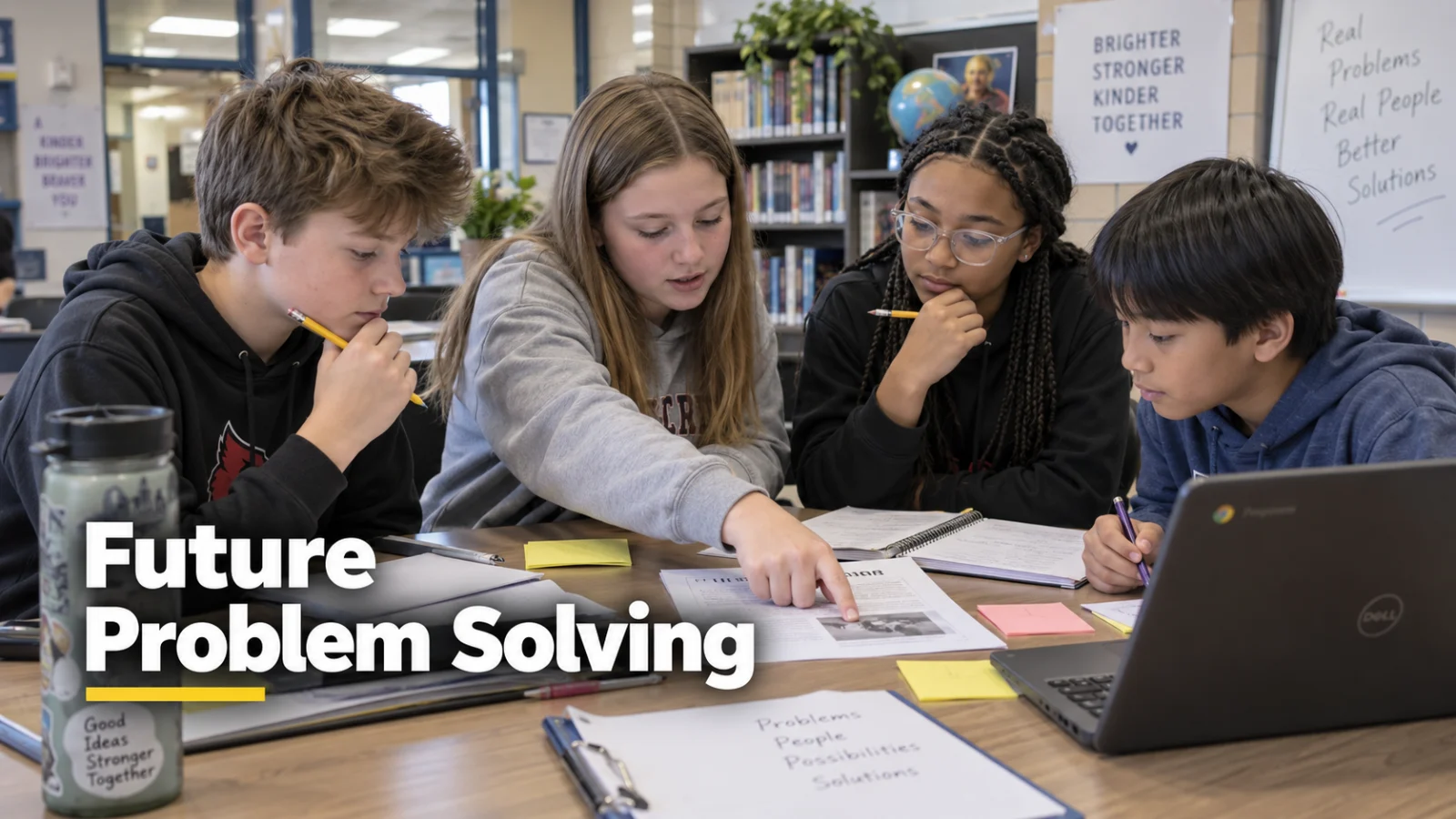
Future Problem Solving is one of the more unusual academic competitions available to JCPS students.
There are no buzzers. Students are not trying to memorize the most facts. They are given a hypothetical situation set in the future and asked to figure out what could go wrong, decide which problem deserves their attention, develop possible solutions and turn their thinking into a plan.
That makes Future Problem Solving a potentially good fit for a child who likes brainstorming, research, strategy, writing and questions that do not have one obvious correct answer.
There is one wrinkle parents should know before searching for it.
JCPS still uses the name Future Problem Solving, or FPS. The Kentucky Association for Academic Competition, which runs Governor's Cup, now calls the Governor's Cup event Strategic Problem Solving, or SPS. JCPS says its Office of Academic Competition coordinates Future Problem Solving team competitions, while KAAC's current Governor's Cup materials call the event Strategic Problem Solving.
So if your child's teacher says FPS and a Kentucky competition page says SPS, they may be talking about the same competition.
What do students actually do?
In Governor's Cup Strategic Problem Solving, four students work as a team. KAAC says they research announced topics, then use a five step process to respond to a Case Study, a hypothetical scenario set in the future. Their work ends in a detailed Strategic Plan that is scored by trained evaluators.
That is very different from Quick Recall.
A strong Quick Recall student may love knowing an answer before anyone else reaches the buzzer. Strategic Problem Solving asks students to understand a complicated situation, identify possible problems, weigh choices and build a plan together.
Students know the broad competition topic before the event, but they do not know the exact future scenario they will receive.
This year's topics
For 2026 to 2027, KAAC has announced three Strategic Problem Solving topics: Extreme Weather at district, Global Supply Chain at region and Cloning at state.
A team preparing for Extreme Weather, for example, might research infrastructure, emergency response, public health, food supplies, insurance, migration or technology. The point is not to predict the exact question. It is to know enough about the subject to recognize problems and possibilities when the competition scenario appears.
JCPS students can start in elementary school
Governor's Cup has three divisions. The elementary division is grade five and below. Middle Grades covers grades six through eight. High School covers grades nine through twelve.
Elementary teams can advance through district and regional competition. Middle and high school teams can advance through district, regional and state competition.
Some current JCPS school pages still advertise the activity.
Stopher Elementary lists Future Problem Solving among its student activities. Kammerer and Lassiter middle schools use the name Future Problem Solvers. Meyzeek Middle advertises Future Problem Solving, and J. Graham Brown School lists Future Problem Solving among its academic competitions or activities.
Those examples are not a districtwide roster.
JCPS tells families to check with their child's school about available activities and academic competitions. Its Office of Academic Competition coordinates Future Problem Solving team competitions across the district.
When does Future Problem Solving compete?
KAAC has already published the 2026 to 2027 Governor's Cup calendar.
The school registration deadline is November 1, 2026. Student entry opens December 12, and students must be entered by the morning of the district planning meeting.
For Strategic Problem Solving, the competition dates are:
Elementary
District competition: February 2, 2027
Regional competition: February 22, 2027
Middle Grades
District competition: January 12, 2027
Regional competition: February 8, 2027
State Finals: March 19 through March 22, 2027, at the Galt House in Louisville
High School
District competition: January 19, 2027
Regional competition: February 15, 2027
State Finals: March 19 through March 22, 2027, at the Galt House in Louisville
Do not use those dates as your child's signup deadline.
The school registration deadline belongs to the school, not the parent, and a JCPS team may recruit students, begin practices or hold tryouts well before competition. September is a much better time to ask than January.
There are other Strategic Problem Solving events too
KAAC also runs other events besides the four person Governor's Cup team.
Mission: Possible asks students to work on a real problem in a school, neighborhood, region, state or nation. Speakers Spotlight uses a current competition topic as the basis for a speech. KAAC currently includes those events in a school's annual dues. Ask the coach whether the school is also entering any writing or film events tied to the season topics.
The grade bands for those events are different from Governor's Cup. Junior is grades four through six, Middle Grades is seven through nine and High School is ten through twelve.
That does not mean every JCPS school enters every event.
Does Future Problem Solving cost anything?
KAAC says Strategic Problem Solving is included in a school's Governor's Cup membership.
For 2026 to 2027, the annual membership fee is $350 for the elementary division and $450 for the middle grades and high school divisions. Those are school membership fees, not a published charge to each participating student.
That still does not establish what a family might pay. A school could have local costs involving shirts, travel, meals or other expenses. Ask before assuming the activity is either completely free or expensive.
What if my child has an IEP or 504?
KAAC allows certain accommodations when they are supported by a student's IEP or 504.
Its current coach guidance says students may receive a reader, scribe or alternate test room based on documented needs. KAAC does not allow extended time. Other accommodations can be considered individually, and the coach is responsible for submitting the required accommodation form before competition.
If your child may need an accommodation, raise it with the coach early.
How do I find out whether my child's school has a team?
Start with the Academic Team coach, activity coordinator or front office.
Ask:
Does our school have Future Problem Solving or Strategic Problem Solving this year?
Which grades can participate?
Is there a tryout or selection process?
When does the team begin practicing?
Can students practice even if they do not earn a competition spot?
Are there any family fees, transportation issues or pickup requirements?
Does the school enter any of KAAC's other Strategic Problem Solving events?
The JCPS Insider Activities and Sports directory is another place to explore academic activities offered across the district.
Older Kentucky materials may still use the Future Problem Solving name or describe an older process. If a page and a coach appear to be using different terminology, ask the coach about Future Problem Solving or Strategic Problem Solving.