
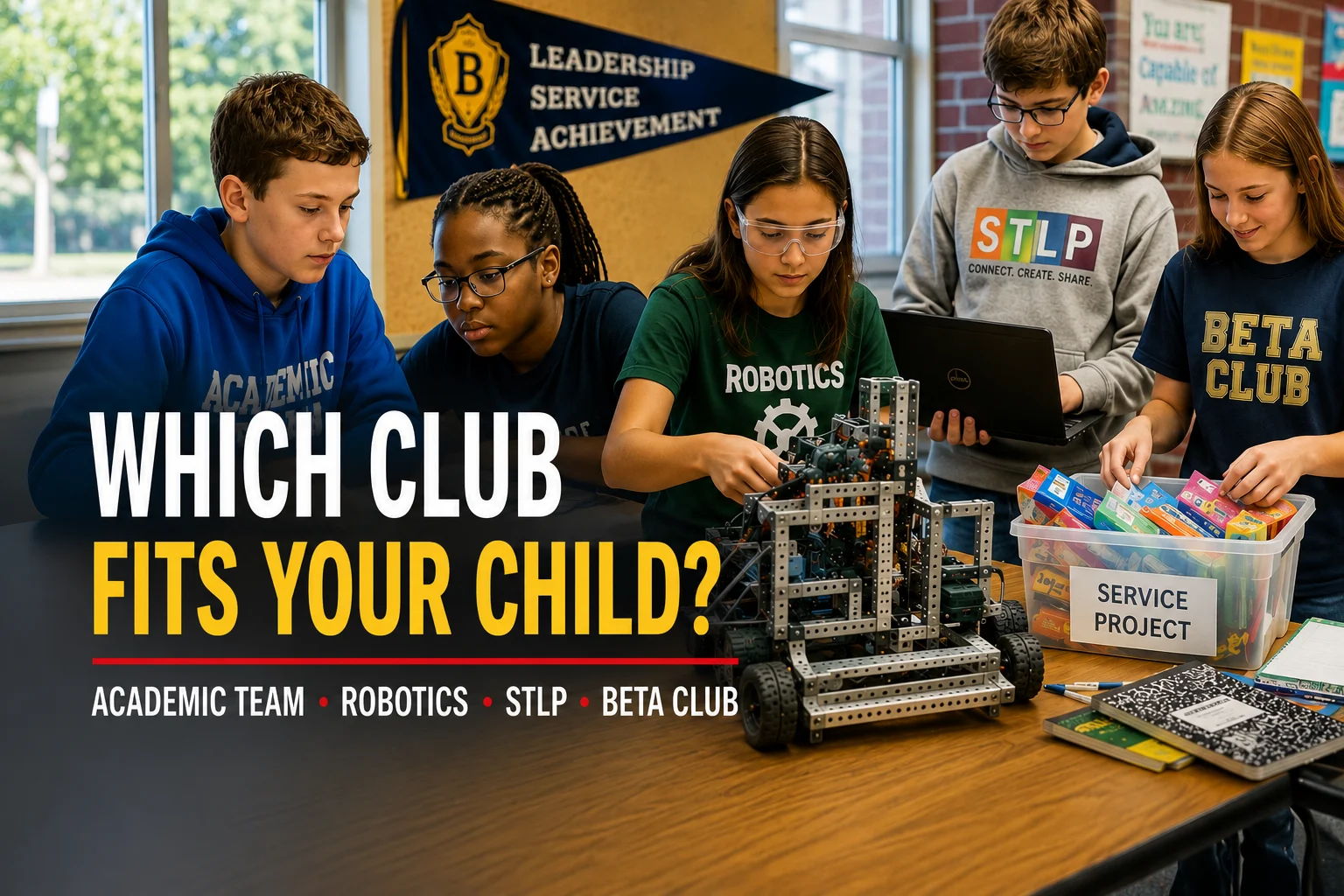
Academic Team, robotics, STLP and Beta Club can all attract strong students. That is about where the similarity ends.
One rewards the kid who loves knowing the answer before anyone else. Another is built around designing something, testing it and figuring out why it suddenly stopped working. STLP can send a student toward coding, video, digital art or a technology project. Beta puts much more weight on achievement, leadership and service.
For JCPS parents choosing among them, the better question is not which club sounds most impressive.
Watch what your child chooses to do when nobody is assigning the activity.
There is also a practical problem: your child's school may not offer all four.
The current JCPS Elementary School Choices page lists Academic Team, robotics, STLP and Beta Club at Norton Commons Elementary. Greathouse Shryock Traditional lists Academic Team, Quick Recall and STLP, but does not list robotics or Beta. Carter Traditional's Choices listing does not name any of the four. But Carter's own current Activities and Athletics page lists Quick Recall for students in grades three through five.
JCPS itself says information in the 2026 to 2027 printed Choices guide was correct at the time of printing and tells families to contact schools directly with questions.
So the menu matters almost as much as the child.
Academic Team rewards the kid who wants the question
If your child watches Jeopardy and starts answering before the contestants do, this is the obvious place to investigate.
Kentucky's Governor's Cup, run by the Kentucky Association for Academic Competition, includes Quick Recall, Strategic Problem Solving, Content Assessment and Written Composition. Students can compete in math, science, social studies, language arts, arts and humanities and other team events.
Quick Recall is what many parents picture first. A question starts. Students buzz. Somebody knows it.
But Academic Team is broader than buzzers.
A strong writer can compete in Composition. A student who likes working through a complicated problem with teammates may prefer Strategic Problem Solving. Content Assessment gives students another path that does not require beating someone to a buzzer.
For elementary families, KAAC defines its Elementary Division as grade five and below, although its own program materials describe elementary Governor's Cup as typically serving fourth and fifth graders. Do not assume a second or third grader can join simply because the school has an Academic Team. Ask the school which grades actually participate.
Academic Team tends to fit children who enjoy learning facts beyond the assignment, remember odd details and like competition. It can also reward a kid who becomes deeply knowledgeable in one subject.
And there is practice involved. Fast recall is a skill. So is recognizing the kind of question being asked.
Some kids love that.
Others will hate it.
Robotics comes with failure built into the experience
Robotics is different because knowing the right answer is not enough.
The robot still has to work.
A design that looked great on paper may be too slow. Code may behave differently than expected. A mechanism may fail five minutes before competition. Something that worked yesterday may simply refuse to cooperate today.
For some kids, that is the fun.
Competitive robotics also gives students more jobs than parents sometimes realize. The current VEX IQ rules identify student roles involving design, building, coding, strategy and the engineering notebook. Adults may teach and mentor, but the students are supposed to develop the ideas, build the robot, write the code, fix problems and compete.
That means the strongest programmer is not automatically the best driver. The child who loves building may not want to speak to judges. The student who sees strategy two moves ahead may be valuable even if another teammate built most of the machine.
Robotics can also begin earlier than Beta or a typical elementary Academic Team experience. There is no single JCPS grade rule for every robotics club. Norton Commons, for example, currently lists its Robotics Club for kindergarten through grade five. Other schools may organize teams differently.
The child who keeps taking apart a LEGO creation because version six could be better than version five is worth watching here.
So is the child who gets irritated when adults give away the solution.
STLP does not require your child to care about robots
This is where some parents miss a good fit.
Kentucky's Student Technology Leadership Program is open to students from kindergarten through grade twelve. It is not one competition with one type of student. STLP includes projects, Creative Digital Arts and technology challenges.
A student might code.
Another might produce video.
Another may work with digital photography, animation or storytelling.
Another team may identify a problem at school and build a technology project around solving it.
A student can clearly like technology but have little interest in spending months working on a competition robot.
There is also a current rule worth knowing if your child likes generative artificial intelligence. STLP does not allow AI generated content to be submitted in Creative Digital Arts competitions. AI can be used under specific conditions in other STLP competitions, including disclosure of how the tool was used.
If your child likes making things on a screen more than memorizing facts or building machines, ask about STLP before assuming the school's robotics club is the only technology option.
Beta is not just the club you join because you qualified
Beta is the odd one out here.
National Beta is organized around achievement, character, leadership and service. Elementary Beta covers grades four and five. Junior Beta covers grades six through eight. Senior Beta covers grades nine through twelve.
Membership is also not automatic.
National Beta requires students to perform at or above grade level, but individual schools can establish additional requirements and determine how students are selected. That is why one JCPS parent's description of qualifying for Beta may not match what happens at another school.
The national organization does not require one fixed number of service hours. Local clubs can set their own expectations.
And there is a cost. Current national membership fees are $16 for Elementary Beta, $24 for Junior Beta and $32 for Senior Beta. The fee is paid once per division, although local clubs can charge additional fees.
What can Beta look like inside JCPS?
JCPS reported in March that Norton Commons Elementary had 115 fourth and fifth grade Beta members. The school said its Betas complete more than 1,600 service hours each year. At the 2026 Kentucky Elementary Beta State Convention, 70 Norton Commons students competed in 46 events, earning eight individual awards and three team awards. The club also won the Grand Champion State Service Project Award for activity bags donated to children's hospitals.
That is a much better picture of Beta than simply calling it an academic honor club.
A child can have the grades to qualify and still dislike the actual experience.
If your child enjoys service, being involved around school and taking on responsibility, Beta deserves a look. If the attraction is mainly adding another accomplishment to a future résumé, ask what the local club actually expects before saying yes.
Your school may make part of the decision for you
JCPS does not appear to publish one continuously updated districtwide directory showing which schools currently offer these four activities, which grades can participate, who the sponsor is, what tryouts are required and how many students each program can accept.
The Choices guides are useful, but they are not a substitute for checking with the school.
And access is uneven.
Some schools list all four. Others list one or two. Some have a large collection of extracurricular programs but not these particular choices.
That changes the first question.
Instead of asking, "Which one should my child join?" start with, "Which of these actually exists at my child's school this year?"
Call or email the school office and ask for the current club list or the name of the sponsor. If a sponsor is already listed on the school's website or school communication app, go directly to that person. If the Choices guide and a current school page do not match, check with the school or sponsor before assuming either list is complete.
Ask now, not after the team is already practicing
August is not too early.
Jefferson County Traditional Middle was already advertising Academic Team tryouts on its school live feed in August for the new school year. KAAC's statewide deadline for schools to register for the 2026 to 2027 Governor's Cup season is November 1, but individual schools can organize teams and hold tryouts much earlier.
Before your child commits, ask:
Which grades can participate?
Is there a tryout, application or academic requirement?
How often does the club meet?
Are practices before school or after school?
Are there Saturday or evening competitions?
What does it cost?
Are there additional competition, travel or uniform expenses?
Does the school provide transportation to events?
What happens if more students want to join than the club can accommodate?
Can my child watch one practice before deciding?
That last question can save everybody some trouble.
Ten minutes watching Quick Recall may be enough for a child to decide that the buzzer is either the greatest invention ever made or something they never want to hear again.
The same goes for a robotics practice.
And if the first choice does not work?
Try another one.
The kid who never touches the Quick Recall buzzer may turn out to be the one who cannot stop rebuilding the robot.