
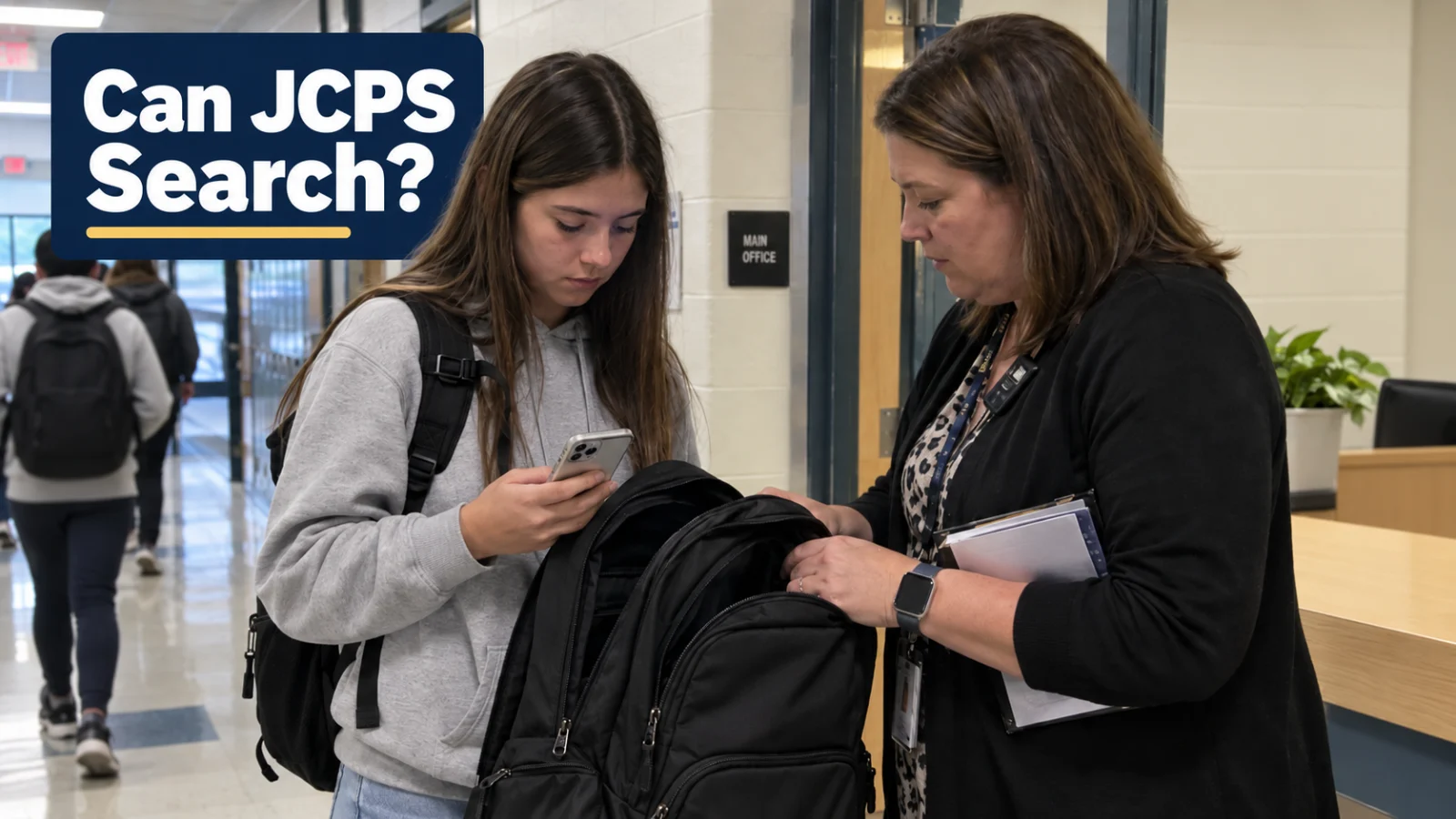
Yes, JCPS can search a student or a student’s belongings in some situations. But the district does not have a blanket right to search a backpack or examine the contents of a personal phone simply because the child is at school.
Under the current JCPS Student Support and Behavior Intervention Handbook, school officials need reasonable grounds to believe a search of a student’s outer clothing, pockets or personal belongings will uncover evidence that the student violated the handbook or the law. The Jefferson County Board of Education received the 2026 to 2027 handbook for first reading on April 21 and approved it on May 12, 2026.
Public school administrators generally do not need a warrant or probable cause before conducting a student search. Under the United States Supreme Court’s standard in New Jersey v. T.L.O., the search must be justified when it begins, and its scope must be reasonably related to the circumstances that justified it.
A backpack can be searched, but JCPS needs a reason
JCPS specifically includes backpacks among the personal effects covered by its search procedure.
The handbook says a student’s outer clothing, pockets or personal effects may be searched when there are reasonable grounds to believe the search will uncover evidence of a handbook or law violation. A search of a student’s person or personal effects generally may be conducted only by the principal or a designated administrator at the school the student attends.
JCPS also puts limits on how a personal search is conducted. In general, officials are supposed to direct the student to do things such as empty pockets, unzip a coat or raise a pant leg, with no direct physical contact or only incidental contact. A pat down involving direct physical contact is reserved for an immediate threat to the health or safety of the student or others.
When a student’s person is searched, the handbook says the employee conducting the search must be the same sex as the student, a witness of the same sex must be present and another student should not be present. Those restrictions do not apply when an imminent threat requires immediate action to prevent harm. The Student Bill of Rights describes a personal search as one involving personal belongings or outer garments that would not require the student to disrobe.
There is an off site exception. If an immediate health or safety threat occurs away from school and an administrator is not reasonably available, the adult responsible for the students, such as a bus driver, coach or sponsor, may conduct a search. The handbook gives suspected illegal drugs or a weapon as examples.
A student who fails to cooperate with a school employee when requested can face additional disciplinary action under the handbook.
JCPS does not have to call you first
JCPS’s published search procedure does not require advance parent permission, and the federal rule governing searches by school officials does not make a parent call a prerequisite to an otherwise reasonable search. Parents should not assume the school has to reach them before opening a backpack or directing a student to empty their pockets.
Taking a phone is not the same as reading what is inside it
The JCPS Student Bill of Rights specifically lists a cell phone among the personal belongings that may be searched under the district’s search rules.
JCPS also has separate rules allowing administrators to confiscate phones. The current handbook says a confiscated device generally must be returned to the parent, student or guardian by the end of the school day. If a phone is confiscated because it was allegedly used in one of the disruptive ways identified in the policy, it may be kept until the investigation is finished.
But confiscating the physical device does not automatically authorize school officials to search everything stored on it.
In G.C. v. Owensboro Public Schools, a student was caught texting in class. His teacher confiscated the phone, and an assistant principal later read four text messages. The Sixth Circuit Court of Appeals, whose decisions govern federal courts in Kentucky, found that officials had not shown reasonable suspicion to justify searching the phone’s contents.
The court rejected the idea that violating a school cell phone rule automatically gives officials broad authority to search the device. It said officials need reasonable suspicion that the search will uncover evidence of additional wrongdoing or possible harm, and any search must be tailored to the nature of the suspected problem.
If the suspected misconduct itself involves the phone, such as an alleged threatening message, cheating or privacy violation, the facts can support a search for particular evidence. What officials knew before opening the phone, and what parts of the phone they then examined, still matter.
Lockers and JCPS technology get less privacy
JCPS treats school property differently from a privately owned backpack or phone.
The handbook says lockers, desks, network systems, technology resources and accounts owned or supplied by JCPS are jointly held by the school and student. Administrators have the right to conduct general inspections of that property on a regular basis, and students are told not to expect privacy for items or information left there.
An individual locker, desk, technology resource or district account also may be searched when reasonable grounds exist to believe it contains evidence of a handbook or law violation. The Student Bill of Rights separately lists automobiles among the places or belongings that may be searched.
Weapons screening follows a broader procedure
Appendix D of the current handbook allows trained administrators or their designees to use stationary or mobile weapons detectors.
A detector may be used on an individual student or the student’s belongings when there is reasonable suspicion that the student is concealing a weapon. Appendix D also allows weapons detector screening of all students or their personal belongings as they enter a premises.
Parents reading only the Student Bill of Rights may notice that its shorter summary mentions a handheld metal detector used when there is reasonable suspicion that a student has a weapon. The Bill of Rights identifies that passage as a summary of the district search procedure. Appendix D contains the fuller weapons detector rules.
The Student Bill of Rights also says the Police Detection Canine Team may conduct random and unannounced searches of general school areas, including lockers and parking lots.
If police get involved, write down who did what
The Supreme Court’s T.L.O. decision dealt with searches conducted by school authorities acting on their own. The Court expressly said it was not deciding the rules for searches conducted by school officials together with, or at the request of, law enforcement.
If an SRO or another police officer participates in a search, ask who initiated it, who directed it and what the officer actually did. Those facts can matter if the search is later challenged.
What parents should ask after a search
If your child tells you they were searched, start by getting the facts.
What rule, safety concern or law did the school believe might have been violated?
What information did administrators have before the search began?
What exactly was searched, including whether a phone was only confiscated or its contents were opened?
Who conducted the search, and if the student’s person was searched, was the required witness present?
Was an SRO or another police officer involved, and what did that officer do?
What evidence was found, what consequence followed and is the school still holding any property?
JCPS provides an appeal process for students or parents who believe the handbook or Student Bill of Rights was applied unfairly or inequitably. Families are directed first to try to resolve the issue with the people involved, then may request an informal hearing with the principal or designee. The handbook says a decision can be expected within five school days, and a written decision may be requested.
There is one contact detail parents should be careful with. The 2026 to 2027 Student Bill of Rights still prints regional phone numbers that do not fully match the district’s current Academics Division contacts after the organizational realignment. The current Academics Division page lists separate contacts for two elementary regions, middle schools, high schools and the Enhanced Support Zone. The high school office number, 502 485 7350, still matches. Rather than relying on the printed middle or elementary numbers, use the current Academics Division page. If you are unsure which regional contact handles your child’s school, the Office of Student Relations can be reached at 502 485 3335.
If discipline follows a search and your child has an IEP or Section 504 plan, ask how the student’s disability protections apply. JCPS currently lists ECE Community Relations at 502 485 3346. The district says that office works with families who have questions about the special education process and community resources. For Section 504 questions, JCPS lists the district Section 504 supervisor at 502 485 6290.
This article provides general information about JCPS policy and student search law. It is not legal advice.