JCPS actually has a written limit for how far students can be assigned from a regular bus stop.
The current Transportation Services Policy says bus stops are one half mile or less for elementary students and one mile or less for middle and high school students.
So if your third grader's stop is four tenths of a mile away, the distance itself falls within JCPS policy.
That may not be the end of the conversation.
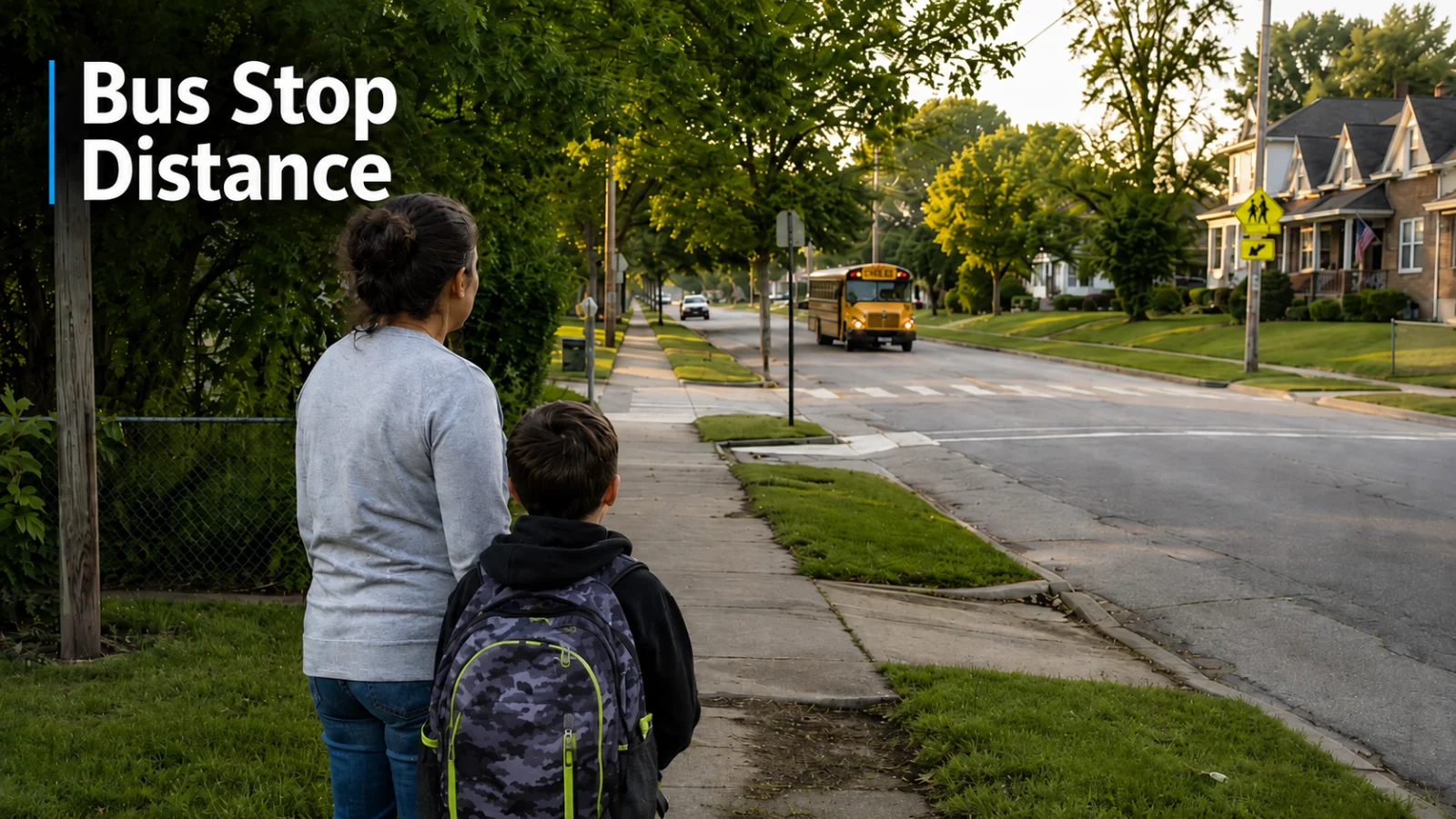
Four tenths of a mile through a subdivision with sidewalks is one thing. Four tenths of a mile along a busy road with no sidewalk, poor visibility or a difficult crossing is something else.
JCPS has encountered exactly those kinds of problems before.
The 2023 transportation mess exposed unsafe stops
The independent Prismatic Services audit of the district's 2023 transportation rollout included examples of bus stops auditors considered unsafe.
These examples came from the review of the 2023 routing rollout. They should not be read as a list of stops currently being used by JCPS.
WAVE reported that one first grader had been assigned a stop that required crossing Broadway to get to daycare. Another student was expected to walk about a mile along Shelbyville Road, including sections without sidewalks or crosswalks.
Those were extreme examples from an extraordinary year for JCPS transportation. But they show why parents sometimes look at an assigned stop, measure the distance and still have a reasonable question about the route their child is expected to take.
A mileage limit cannot tell you whether there is a sidewalk.
It cannot tell you what traffic looks like at 6:45 in the morning.
And it cannot tell you whether an eight year old has a safe place to cross the street.
The half mile rule comes from JCPS, not Kentucky law
Kentucky law does not say every elementary student is entitled to a bus stop within one half mile.
KRS 158.110 uses much broader language. It allows school boards to provide transportation when students do not live within a "reasonable walking distance" of the appropriate school and requires local boards to adopt transportation policies addressing the comfort, health and safety of students who are transported.
JCPS sets the more specific bus stop distances in its own Transportation Services Policy.
That is also why the distance from your home to school should not be confused with the distance to an assigned bus stop. They are different transportation questions.
What to do if you think the walk is unsafe
Start by walking the route your child would actually take.
Look for the things you would notice if your child were making that trip alone.
Where does the sidewalk end?
Which streets have to be crossed?
Is there a crosswalk or traffic signal?
Can drivers see a child waiting near the stop?
Is there enough room to walk away from traffic?
If something concerns you, take a few photos. Write down the street or intersection. Save the assigned stop information so you can describe exactly what JCPS has given your child.
JCPS currently directs families with route questions to their child's school or the Transportation Office at 502 485 3470. The district says families may be able to get information more quickly from their area bus compound after school begins.
The same JCPS page links families to Bus Teller, where parents can check transportation information and assigned stops. Bus Teller is also being used for the 2026 27 school year.
If the problem is safety, describe the problem.
A parent can say that the route has no sidewalk for a particular stretch, that a child must cross several lanes of traffic, or that visibility near the stop is poor.
That gives transportation staff a specific location to examine.
Not every student follows the regular bus stop rules
Some JCPS students receive transportation under different arrangements.
Transportation Services Policy 09.2261 identifies Special Needs Transportation for students whose IEP includes that service. The policy also includes Early Childhood Transportation and transportation options for some homeless students and children in foster care.
JCPS says children using Early Childhood Transportation must be met by a parent, guardian or another authorized person who is at least 16 years old. The district also says children in special needs programs who are scheduled to ride special buses will be contacted about their transportation arrangements.
Families dealing with transportation required by an IEP should work through the child's school and IEP team rather than assuming the regular bus stop distance settles the issue.
JCPS does not publicly explain one part of the rule
Policy 09.2261 gives the maximum bus stop distances, but the policy text does not explain exactly how JCPS measures them.
JCPS Insider could not find a current public explanation stating whether the district uses the actual pedestrian path a student would walk, roadway distance, mapping software or another measurement when deciding whether a stop is within the one half mile or one mile limit.
That could matter.
Two homes can appear equally close to a stop on a map while requiring very different walks once sidewalks, subdivisions, fences, major roads and legal crossing points are taken into account.
JCPS also does not appear to publish a clear timeline on its current transportation page telling parents how long a regular bus stop safety review should take.
Those are questions worth asking the district directly.
There is no reason for a parent to guess in the meantime. Check the assigned stop in Bus Teller, walk the route your child would actually use and document any specific safety problem you want JCPS to review.