
A color, or one proficiency percent, is not the Jefferson County Public Schools campus you are about to choose. The Kentucky Department of Education tells parents to read more than one indicator, and the 2026 school numbers were not public when this was checked on October 12, 2026.
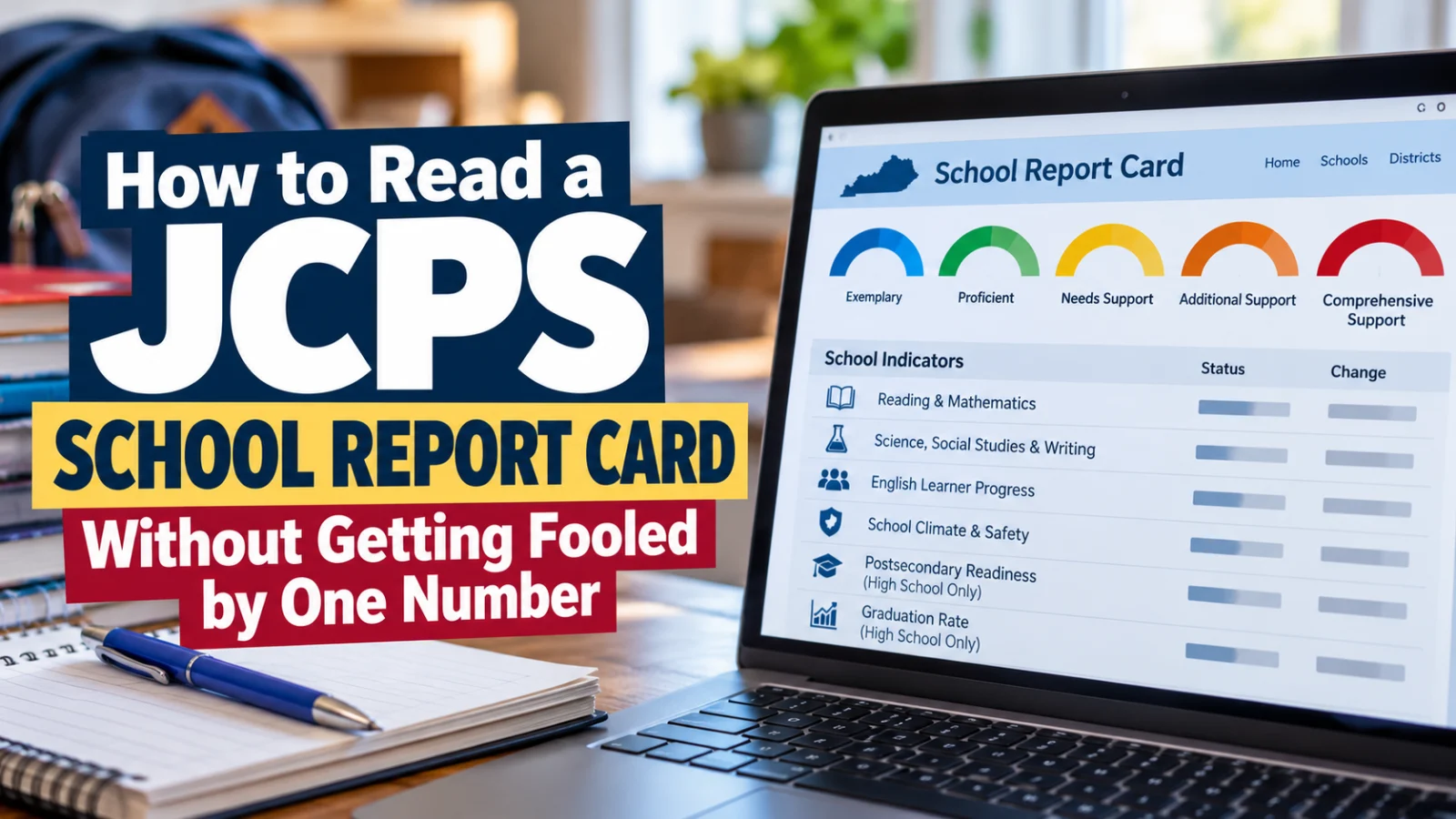
KDE's How to Prepare for Public Release document says each indicator is status plus change, and that the public face is a color. From highest to lowest, those colors are blue, green, yellow, orange, and red. KDE's October 10, 2022 report card changes said stars are no longer used. If a ranking site still shows stars, it is not reading the current Kentucky dial. JCPS's own 2026 elementary school profiles, the books families use to compare schools, print that same red to blue legend, not stars.
The School Report Card resources page, published September 28, 2026, still listed October 15, 2026 as a tentative public release when checked October 12, 2026, for the 2025 to 2026 card. Tentative means the day can move. Nothing below is a 2026 school score.
Read more than the color
Status, change, and more than one indicator.
Status is this year's result. Change is the difference from last year's result for that same indicator. The 2026 document says those two pieces get equal weight, for all students as a group and separately for individual groups. The color on the dial is the combination. A very high status with a decline can land in a lower color than a medium status that improved. KDE's Accountability at a Glance, marked July 2024, prints that grid. You do not need the grid memorized. You need the habit of reading both words under the dial.
The same 2026 document names six indicators. Reading and mathematics is one. Science, social studies, and writing are another. English learner progress and the school climate and safety survey apply across grade spans. Postsecondary readiness and graduation rate are high school only. KDE's assessment results page, published July 17, 2025, puts reading and mathematics at 51 percent of an elementary score, 46 percent in middle school, and 45 percent in high school. Climate and safety is a real indicator, and on the July 2024 weight table it is 4 percent. A pretty survey, or a rough one, will not rescue or ruin the color the way reading and math can.
Small grades, big swings
One student becomes a big slice when the count is small.
This is arithmetic, not a 2026 JCPS result. If 20 students are in the count, one student is 5 percentage points. If 10 students are in the count, one student is 10 points. A single child's performance level can make a grade look transformed, or collapsed, without the building having changed its program. Do not treat that swing as a ranking.
KDE's July 2024 glance sets a separate rule for accountability math. A demographic group needs at least 30 students in that indicator, at the elementary, middle, or high school level, before the group is included in the school calculation. Public reporting follows federal privacy rules. A missing group on the card can mean the group is too small to show. It does not mean the students scored zero, and it does not mean the school has no students in that group. Read the count beside the percent before you compare two schools on a thin slice.
The performance levels behind any percent are Novice, Apprentice, Proficient, and Distinguished. On the July 17, 2025 page, Novice is worth 0 points, Apprentice one half point, Proficient 1 point, and Distinguished 1.25 points. Two schools with the same proficient and distinguished percent can still differ if one has more Distinguished and the other has more Novice sitting under the line you did not read.
Why is growth not a prestige score?
Because Kentucky's main indicators do not measure the same children moving up a grade.
KDE's accountability overview draws the line in plain terms. Individual student growth tracks a student from one year to the next. Change tracks the school's outcomes from one year to the next. The roster turns over. A strong change can be a different group of students, a different grade size, or both. The overview says individual student growth was not in the exclusive list of state indicators in KRS 158.6455. The growth that does exist sits inside English learner progress, using the English language proficiency exam. That is a required federal piece for students learning English. It is not a schoolwide growth trophy, and it is not a reason to call a blue school the one that grew every child.
A high color is also not a promise about the coming year. Status is a snapshot of the students who tested. Change is a comparison with the prior snapshot. Neither one is the course grade your child brings home, and neither one is a 2026 list of most improved JCPS schools. That list does not exist until KDE posts the numbers, and it did not exist on October 12.
Grade 11 reading and math are easy to misfile on a high school card. The KSA page, updated July 15, 2026, says 2025 to 2026 reading and mathematics did not include grade 11, and KDE's 2024 to 2025 briefing packet says the reading and mathematics indicator uses KSA results from grades 3 through 8 and grade 10. KDE's 2025 to 2026 assessment FAQ treats that grade 11 reading and math test as the SAT junior state administration. The rest of the KSA subjects are not the SAT.
What should you write down before you rank two schools?
The year, the reading and math status, the change, and one group.
Start at reportcard.kyschools.us. If the year on the screen is still 2024 to 2025, you are not looking at the new release. KDE's tentative date is October 15, 2026, and the resources page still used that word when checked October 12, 2026. When a 2025 to 2026 card is actually up, write four lines for each school you care about: reading and math status, reading and math change, the Novice share under that indicator, and the same indicator for one student group you actually need to see. Add the graduation rate only if the school has a graduating class. Add attendance as context. KDE's Attendance Matters page, published September 24, 2026, defines chronic absenteeism as missing 10 percent or more of the year for any reason. The July 28, 2026 attendance data standard says that measure joins the accountability system in 2026 to 2027, not as the owner of this fall's color.
Then open Campus Parent for your own child, because a Kentucky Summative Assessment score is not a course grade. If a color and a report card grade tell different stories, believe the grade for the child and the KDE year label for the school. Ask the school if a group is blank and you need to know whether the count was under 30. The state line for assessment questions, 502 564 4394 and dacinfo@education.ky.gov, is for district coordinators. It is not the desk that changes your child's class grade.