
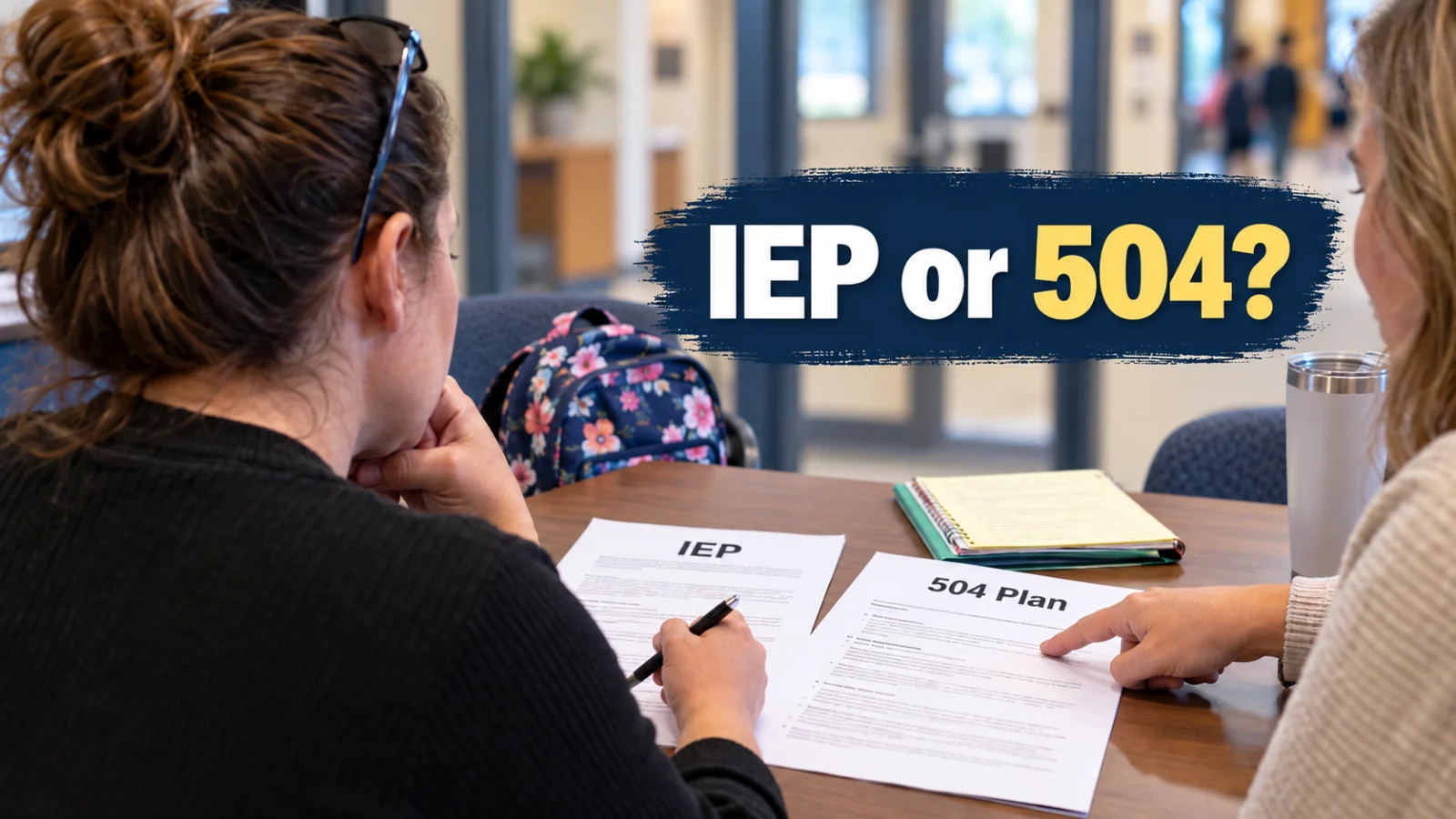
An IEP and a 504 plan are not two levels of the same thing.
An Individualized Education Program, or IEP, is for a student who qualifies for special education under the federal Individuals with Disabilities Education Act and needs special education and related services. A Section 504 plan comes from a different federal law and can protect a student whose disability substantially limits a major life activity, including a student who does not qualify for special education under IDEA.
There is one naming quirk Kentucky parents may notice. Federal IDEA regulations use Individualized Education Program. Kentucky regulations use Individual Education Program. Both refer to an IEP under IDEA.
Parents do not have to know which law applies before raising a concern. They can tell the school what they are seeing and ask for an evaluation.
A student with ADHD, anxiety, a chronic health condition, a learning disability or another impairment could potentially qualify under either system. The answer depends on how the disability affects that student and what the student needs at school.
What is the difference between an IEP and a 504 plan?
Under IDEA, special education includes specially designed instruction provided to meet the unique needs of a child with a disability. An IEP describes the student's current academic and functional performance, measurable goals, special education and related services, accommodations and other supports the student will receive.
In Kentucky, those decisions are made through the Admissions and Release Committee, usually called the ARC. Parents are members of their child's ARC along with school personnel involved in teaching, evaluating and supporting the student.
Section 504 uses a different and broader disability standard. JCPS says a student can qualify when an evaluation determines that the student has a physical or mental impairment that substantially limits one or more major life activities.
Learning is only one of those activities. Federal guidance also identifies activities such as concentrating, thinking, reading, walking, seeing and communicating, along with major bodily functions.
That is why a student can be found ineligible for an IEP and still potentially qualify under Section 504.
A 504 plan can provide more than accommodations
One of the most common explanations parents hear is that an IEP provides services while a 504 plan provides accommodations.
That is too simple.
An IEP can include accommodations. Section 504 can also require regular or special education and related aids and services when a student needs them. Federal civil rights guidance says the education and services must be designed to meet the student's individual educational needs as adequately as the needs of students without disabilities are met.
Students who qualify under IDEA are also protected by Section 504. Federal guidance recognizes implementation of an appropriate IDEA IEP as one way a school district can meet its Section 504 obligation to provide an appropriate education.
What matters is whether the student meets IDEA eligibility requirements and needs specially designed instruction, or instead needs protection, accommodations, aids or services through Section 504.
Can a child have good grades and still qualify for a 504 plan?
Yes.
The U.S. Department of Education specifically says a public school may need to evaluate a student under Section 504 even when the student earns good grades. Academic success does not prove that a disability is not substantially limiting a major life activity.
A child could be earning strong grades while spending far more time than classmates completing work, receiving substantial help outside school or struggling with concentration, reading, writing or another area affected by a disability.
Grades are evidence. They are not the whole evaluation.
Does a diagnosis automatically qualify a student?
No.
JCPS currently says there is no condition or label that automatically qualifies a student under Section 504. A medical diagnosis can alert the school that a referral may need to be considered, but it does not guarantee eligibility.
Federal guidance says the same thing. A medical diagnosis by itself does not automatically mean a student qualifies for Section 504 services. Eligibility must be decided individually based on whether an impairment substantially limits a major life activity and what the student needs.
A medical diagnosis is not always required either. Schools are expected to draw from multiple sources of information when evaluating a student rather than treating one document or test as the entire answer.
What if your child does not qualify for an IEP?
An IEP denial does not automatically create a 504 plan.
It also does not necessarily end the disability evaluation question.
JCPS specifically lists a student who has been evaluated under IDEA and found ineligible as one situation that can indicate a possible Section 504 issue. Because the two laws use different eligibility standards, some students who do not qualify for special education may still qualify for protection or services under Section 504.
If an IDEA evaluation ends without eligibility, a parent can ask whether Section 504 was considered and whether a 504 referral is appropriate.
How do JCPS parents request an evaluation?
JCPS publishes separate referral paths for special education and Section 504.
As of Sept. 6, 2026, the district's referrals page labels the special education form Referral for Multi Disciplinary Evaluation and the other form Section 504 Referral Form. The page also provides information about Child Find.
JCPS special education and Section 504 referrals
JCPS lists 502 485 3170 for Child Find. The district asks families to use that number when a child may have a disability and is not receiving the help needed to be successful.
For Section 504, JCPS says a referral can be initiated by a parent, teacher or administrator. Parents can start by contacting the Section 504 chairperson at their child's school.
JCPS currently lists 502 485 6290 for its Section 504 office and ece.504@jefferson.kyschools.us for assistance.
Put the request in writing. You do not need to write a legal argument. Describe what you are seeing, explain why you believe a disability may be involved and ask for an evaluation.
Keep a copy.
Kentucky gives JCPS 60 school days for the initial IDEA process
Kentucky's timeline starts after the district receives parental consent for an initial evaluation.
Within 60 school days, the child must be evaluated. If the student is found eligible, specially designed instruction and related services must be provided in accordance with the IEP within that same period. The ARC meeting to develop the IEP must occur within 30 days of the eligibility determination and still fit inside the overall 60 school day period. Kentucky regulations provide limited exceptions.
Sixty school days is not 60 calendar days.
Weekends, holidays and school breaks can make the actual calendar span considerably longer.
Section 504 does not impose the same fixed federal evaluation deadline. Federal civil rights guidance says an unreasonable delay can violate Section 504, and OCR has looked to IDEA and state evaluation timelines as guidance when determining what is reasonable.
That makes the dates on your referral, consent forms and school communications worth keeping.
An IEP still has to be carried out when JCPS has staffing problems
Getting an IEP on paper is one issue. Receiving what the IEP requires is another.
On Aug. 4, JCPS Insider reviewed the district's Frontline hiring system and found 34 advertised Exceptional Child Education teaching positions two days before students returned Aug. 6.
Sixteen were positions serving students with learning and behavior disabilities. Another 18 were for students with moderate to severe disabilities.
Those 34 advertisements did not prove that 34 classrooms opened without teachers. A vacancy can be covered temporarily by another teacher, a substitute or another staffing arrangement. Nor did the postings prove that students missed services required by their IEPs.
But ECE hiring continued after school started. JCPS Insider found later postings connected with Luhr, Klondike, Wilkerson and Hartstern elementary schools.
Read the JCPS Insider investigation into special education teacher vacancies
Kentucky regulations require an IEP to be implemented and require the accommodations, modifications and supports in the plan to be provided. An open job posting does not change what is written in a student's IEP.
If your child already has an IEP, look at the services listed in it. Check how often each service is supposed to occur and how long it should last.
If something appears to be missing, ask who has been providing the service and how the school documents that it occurred.
What if you disagree with JCPS?
For an IDEA issue, parents can ask for an ARC meeting.
JCPS currently lists 502 485 6270 for its Exceptional Child Education Office.
Kentucky also provides formal special education dispute options including mediation, a formal written complaint and a due process hearing. KDE makes clear that its IDEA complaint process addresses alleged violations of special education law and is not the complaint process for Section 504 civil rights concerns.
Kentucky special education dispute resolution information
For a Section 504 concern, JCPS says parents should first contact the Section 504 chairperson at the child's school and ask the team to reconvene. If the concern remains unresolved, the district directs families to its Section 504 office at 502 485 6290.
Families who believe disability discrimination has violated Section 504 can also file a civil rights complaint with the U.S. Department of Education's Office for Civil Rights.
If your child already has an IEP or 504 plan, keep the written plan nearby and compare what it requires with what your child is actually receiving.