
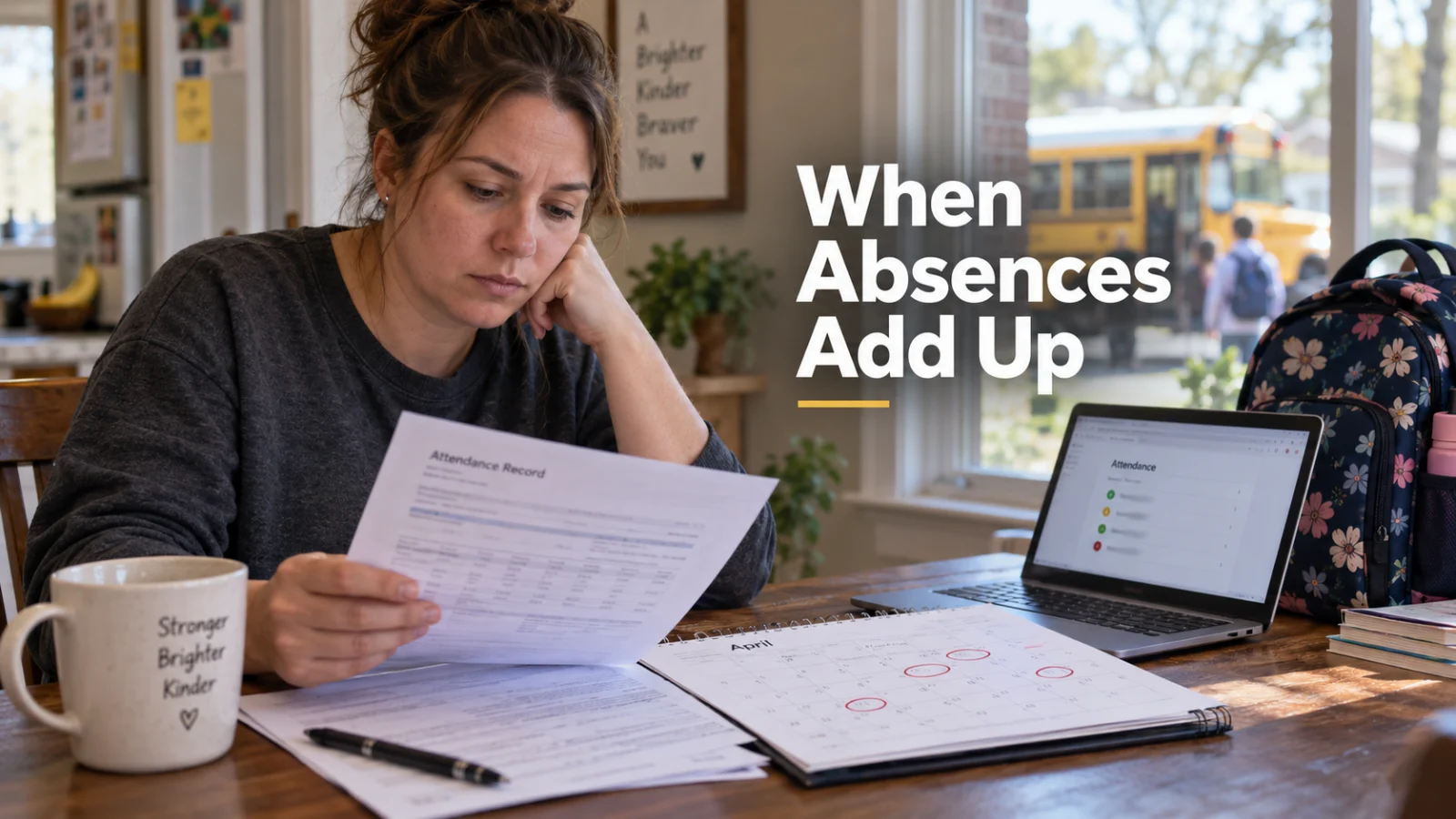
A JCPS student is considered chronically absent when the student's attendance falls to 90 percent or less of expected instructional time.
That is not the same as reaching 18 absences.
The Kentucky Department of Education calculates chronic absenteeism using the percentage of instructional time a student was present. KDE divides a student's full time equivalent present minutes by full time equivalent instructional minutes and rounds the result to the nearest whole percent. Excused and unexcused absences can both count.
That percentage can become significant surprisingly early.
In a simple example using full school days, a student who attends nine of the first 10 days has a 90 percent attendance rate. A student who attends 54 of 60 days is also at 90 percent. KDE's aggregate chronic absenteeism report begins including students after they have been enrolled at least 10 days.
The official calculation uses instructional minutes, so partial days can matter too. A pattern of late arrivals, early checkouts or partial absences can affect the calculation even when the student has not missed many complete school days.
Because chronic absenteeism is a percentage, the number can also change during the year. A student who falls to the threshold early can improve the attendance percentage by attending consistently afterward.
Chronic absenteeism is not the same as truancy
This is where JCPS attendance rules get confusing.
According to the JCPS attendance page, ordinary excused absences do not count toward truancy, but they are included in chronic absenteeism calculations. A child can have legitimate, properly documented absences and still be chronically absent.
Truancy is based on unexcused attendance problems.
Under KRS 159.150, a student is truant after three or more days absent without a valid excuse or after being tardy without a valid excuse on three or more days. A student who has been reported as truant two or more times is considered a habitual truant. The attendance record used for that determination is cumulative throughout the school year.
So changing an absence from unexcused to excused can matter. It may remove that absence from the truancy count even though the missed instructional time can still affect chronic absenteeism.
Simply reaching the chronic absenteeism threshold does not by itself trigger a county attorney referral or automatically put a student into the court system.
What JCPS can do after the third and sixth unexcused absences
The JCPS Student Support and Behavior Intervention Handbook publishes a more specific intervention process for students accumulating unexcused absences.
After the third unexcused absence, local school staff may send a parent or guardian a letter stating that the student is truant.
After the sixth unexcused absence, the school may hold a parent conference. It may also electronically notify the Pupil Personnel Department through the JCPS Student Attendance Reporting System, known as SARS, and record the interventions already attempted by the school.
Once a student has six or more unexcused absences, JCPS lists additional possible steps. Those can include a formal district review, a home visit by Pupil Personnel staff or a school social worker, a Parent Engagement Meeting with community agencies and a final notice delivered in person or by certified mail.
Pupil Personnel staff or a school social worker may also file an educational neglect report with Child Protective Services. Separately, if absences continue to accumulate, an assistant director of Pupil Personnel may refer the student to Family Court.
Those are possible interventions. The handbook does not say every student with six unexcused absences will go through every step.
Six total absences and six unexcused absences can therefore put a family in very different situations.
At 15 unexcused days, Kentucky law creates another threshold
KRS 159.140 establishes a separate requirement when certain students reach 15 unexcused days during the school year.
For a child in kindergarten through grade 5, the director of pupil personnel must report the matter to the county attorney when a parent or guardian has allowed the child to accumulate 15 or more unexcused days in violation of compulsory attendance law.
For a minor in grades 6 through 12, the requirement applies when the student is a habitual truant and has accumulated 15 or more unexcused days.
The county attorney then determines what court intervention, if any, is appropriate. Reaching 15 unexcused days does not mean a court has already ruled against a student or parent.
Kentucky's new SOAR program begins at five unexcused days, but only at participating schools
Kentucky added another truancy intervention for the 2026 to 27 school year.
Senate Bill 170, enacted as Acts Chapter 69, created the Supporting Opportunities for Accountability and Restoration Program, known as SOAR. The four year pilot began August 1, 2026, and the law requires at least 10 public school districts to be selected by the Chief Justice of the Kentucky Supreme Court. At least one school in each selected district must participate.
At a participating school, a student in grades 6 through 12 who has five or more unexcused days during a school term must participate in SOAR along with a parent, guardian or other person exercising custodial control or supervision.
Each participating school establishes a RISE team. The team meets with the student and family, identifies barriers to attendance, develops an improvement plan and helps connect the family with resources.
The rule does not automatically apply to every Kentucky school.
JCPS Insider reviewed current public JCPS, Kentucky Court of Justice and Kentucky legislative materials on September 7, 2026, and did not find a public announcement showing that JCPS, or a particular JCPS school, has been selected for the SOAR pilot.
Until that is confirmed, JCPS families should not assume the five day SOAR requirement applies districtwide. The regular JCPS attendance interventions and Kentucky truancy rules still apply regardless of whether a school is participating in SOAR.
What to check in Campus Parent
JCPS tells guardians to monitor attendance through Campus Parent and contact the child's school if there is a question about the record. Schools record and maintain individual student attendance information.
If absences are adding up, check:
Whether each absence is marked excused, unexcused or excused exempt.
Whether notes or other documentation you submitted were actually entered.
How many unexcused days and unexcused tardies appear on the record.
Whether repeated late arrivals or early checkouts are adding missed instructional time.
JCPS distinguishes ordinary excused absences from absences coded as excused exempt. The district says those exempt codes do not count against student attendance. Examples include a late bus, certain military related absences, qualifying General Assembly page programs and an approved Educational Enhancement Opportunity.
An Educational Enhancement Opportunity therefore does not work like an ordinary excused illness day. JCPS says the completed and signed form must be on file before the opportunity.
For illness absences, JCPS says students generally have up to 10 days that can be excused under the district's illness rules. Parents or guardians can request an extension of parent notes beyond 10 days with physician approval.
If an attendance code looks wrong, start with the school rather than waiting for it to change on its own.
Families who need additional help with attendance barriers can contact the JCPS Pupil Personnel Department at 502 485 3338.
For more on parent notes, tardies, vacations and Educational Enhancement Opportunities, see the JCPS Insider 2026 to 27 attendance guide.