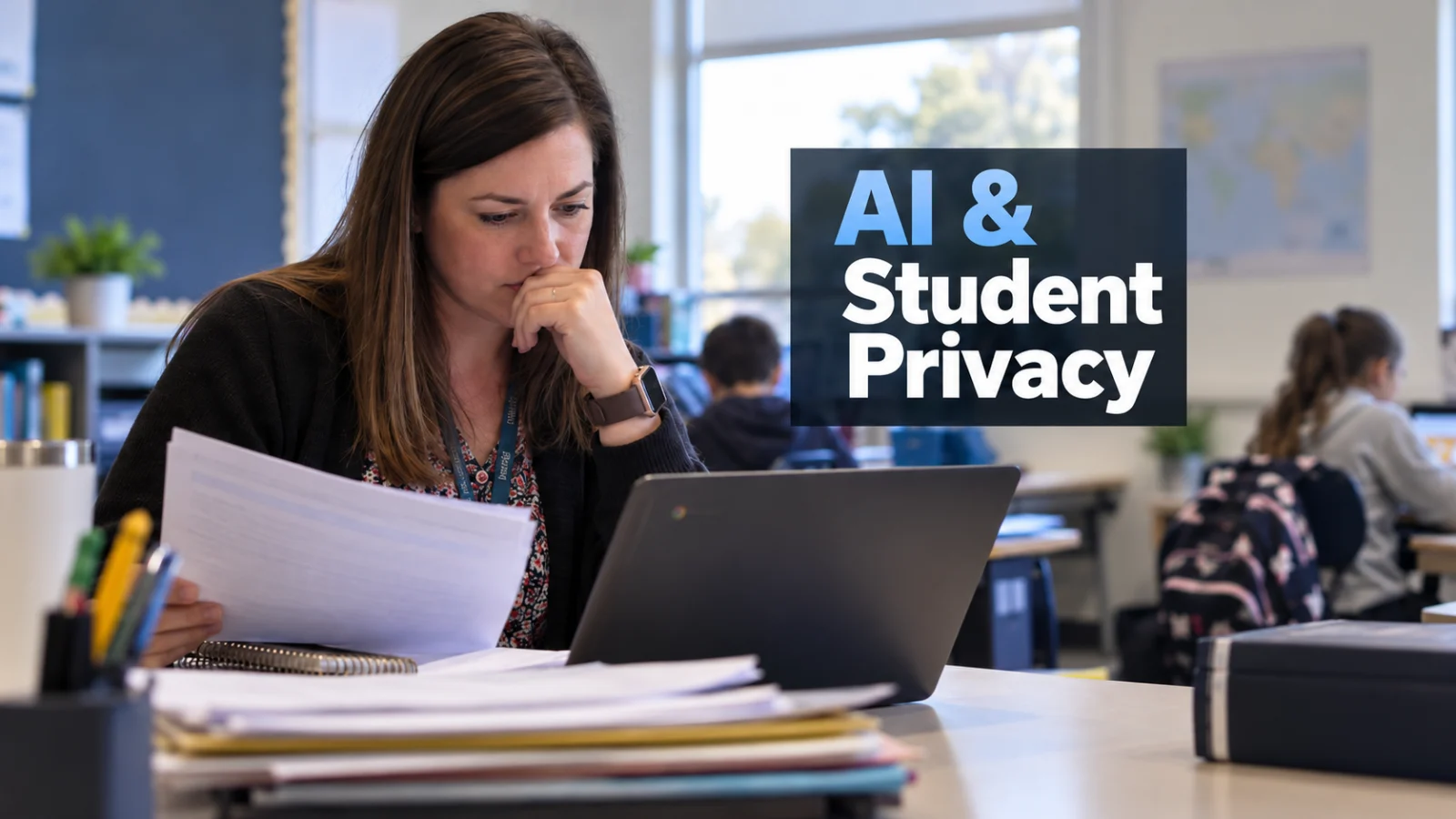
JCPS teachers can use generative AI. What they should not do is feed it identifiable information about your child.
The district says so directly on its public page, Generative AI in JCPS: A Commitment to Responsible Innovation. Under a section titled Anonymization & Consent, JCPS says, “Even in approved platforms, Personally Identifiable Information (PII) should not be shared to guarantee individual privacy.” It then says that when individualized data analysis is required, “data must be anonymized or pseudonymized.”
That gives parents a fairly clear starting point. A tool can be approved by JCPS and still be the wrong place for a teacher to enter a student's name, student number or other information that identifies one child.
JCPS is already well into its use of AI. In February 2026, the district said more than 500 teachers and staff attended Google Palooza, a professional learning event held with Google for Education and Forward Edge that included training with Gemini.
A month later, WDRB reported that teachers were using AI tools within Google Classroom to generate quizzes, address common student misconceptions and build lesson plans. The report also showed how quickly the privacy question can become less tidy than the district rule sounds on paper.
A name is not the only thing that can identify a student
Federal student privacy law looks beyond names.
Under the Family Educational Rights and Privacy Act, commonly called FERPA, personally identifiable information can include a student's name, family members' names, address, student number and other direct identifiers. It also includes indirect identifiers and information that, alone or combined with other information, could allow a reasonable person in the school community to identify a student with reasonable certainty.
That last part is easy to overlook.
Removing a child's name does not automatically make a prompt anonymous.
Imagine a teacher removes the student's name but includes the student's grade, school, unusual disability, a distinctive disciplinary incident and several details about the child's academic performance. Depending on the circumstances, the combination could still point to one student.
The same concern can apply to an IEP, 504 information, grades, attendance records, discipline information, health information, parent contact information, student work or screenshots from school systems when the information identifies the child.
JCPS has also publicly demonstrated the gray area
The March WDRB story included an example worth looking at closely.
William Pierce, whom WDRB identified as JCPS's executive administrator of educational technology and media services, demonstrated how teachers could tell the AI about the needs of a particular class so it could adjust a lesson. One example he gave was, “Seven are visually impaired.”
That statement by itself does not necessarily identify any student. A classwide count can be anonymous.
But it shows the question teachers have to answer before adding more detail.
How much can be said about those seven students before a description becomes specific enough to identify one or more of them?
JCPS's published guidance does not prohibit teachers from telling AI that a class has certain instructional needs. It says personally identifiable information should not be shared and individualized data should be anonymized or pseudonymized.
So a prompt such as “I have several students who need enlarged visual materials” is a different privacy question from a prompt that includes names, individual disability records or enough personal details to reveal which students are being described.
What a safer AI prompt can look like
Many classroom uses of AI do not require a child's identity at all.
A teacher looking for ways to help a student who is struggling with fractions can describe the academic problem and ask for instructional strategies without entering the student's name, identification number, parent information or educational history.
A teacher analyzing class performance can also use totals, patterns or neutral codes rather than a roster containing student names.
Pseudonymized information is not necessarily the same thing as anonymous information. A teacher might replace a student's name with a code while keeping the key connecting that code to the student somewhere else. JCPS specifically allows for anonymized or pseudonymized data when individualized analysis is required.
Kentucky's current statewide AI guidance points teachers in the same general direction. The Kentucky Department of Education says personal or confidential information should never be put into openly available AI tools such as public chatbots and virtual assistants.
Gemini's school protections do not answer every JCPS question
There is another distinction parents should know.
Using Gemini through a school Google Workspace account is not the same as typing information into an ordinary consumer chatbot.
Google says users accessing Gemini through Google Workspace for Education receive enterprise data protections. Their chats and uploaded files are not reviewed by human reviewers or used to improve Google's generative AI models.
Those are meaningful protections.
They do not, however, erase the separate JCPS instruction about what a teacher should put into a generative AI system. Google can have strong contractual and technical protections while JCPS still tells employees not to share identifiable student information in prompts.
Federal law also allows some sharing with school technology vendors under controlled circumstances. The U.S. Department of Education says a company may receive information from education records under FERPA's school official exception when specific requirements are met, including that the company performs an institutional service, remains under the school's direct control over the information and does not use or redisclose the data for unauthorized purposes. The department tells teachers to check with their district before using an online service that collects student information.
Kentucky law adds restrictions for cloud computing providers serving schools, including limits on advertising, commercial use and certain processing of student data.
That is why an approved district system and a teacher's personal AI account should not be treated as interchangeable.
Google's newest Classroom connection raises a new question
The next privacy question may not involve a teacher copying anything into a chat box.
On June 25, 2026, Google announced a connected Classroom app in Gemini. Google says the feature can securely use existing assignments, grades and classroom materials to analyze student progress and draft tailored activities. Google also says the data stays secure and is never used to train AI models.
That creates a question JCPS's public AI page does not clearly answer.
JCPS says personally identifiable information should not be shared even in approved generative AI platforms. Google's new feature is designed to connect Gemini directly with Classroom information that can include grades, assignments and information about individual student progress.
Those two statements are not necessarily in conflict. A district managed connection operating under a contract and administrative controls may be treated differently from a teacher manually entering information into a prompt.
But JCPS's public guidance does not explain that distinction.
As of September 7, 2026, JCPS Insider could not find a public district document confirming whether the connected Classroom app in Gemini is enabled for JCPS educators or explaining what student information JCPS permits Gemini to access through that connection.
Four questions parents can ask
A teacher saying that AI was used is not, by itself, evidence that anything improper happened. AI can help create lessons, quizzes and instructional materials without identifying a student.
If AI is being used with information about your child, four questions can usually get to the issue quickly:
Which AI platform is being used, and is it approved by JCPS?
Is the teacher entering my child's name, student number, grades, disability information, health information, behavior information, parent contact information or identifiable student work?
If individual student information is being analyzed, what is removed or replaced before the information reaches the AI system?
Does the AI system connect directly to Google Classroom, Infinite Campus or another JCPS system containing student information, and what information can it access?
If the answers are vague or a parent believes identifiable student information is being entered into an unapproved AI service, the simplest first step is the school principal. Parents can also call the JCPS Call Center at 502 313 4357, or 313 HELP, or email jcps.help@jefferson.kyschools.us. JCPS identifies that number as its Call Center, while the district's Information Technology division separately oversees Google Workspace for Education, Infinite Campus and other digital systems.
The harder privacy question is no longer whether JCPS teachers use AI. They do.
It is how much an AI system can know about an individual student before personalization becomes identification. JCPS has published a rule for what teachers should put into AI. As the technology begins pulling information directly from classroom systems, the district now has another part of that rule to explain.