If your child tells you they are being bullied at school, one of the most useful things you can do after dealing with any immediate safety concern is put the facts in writing.
Not a furious three page email. Not a vague message saying, “My child is being bullied and nobody is doing anything.”
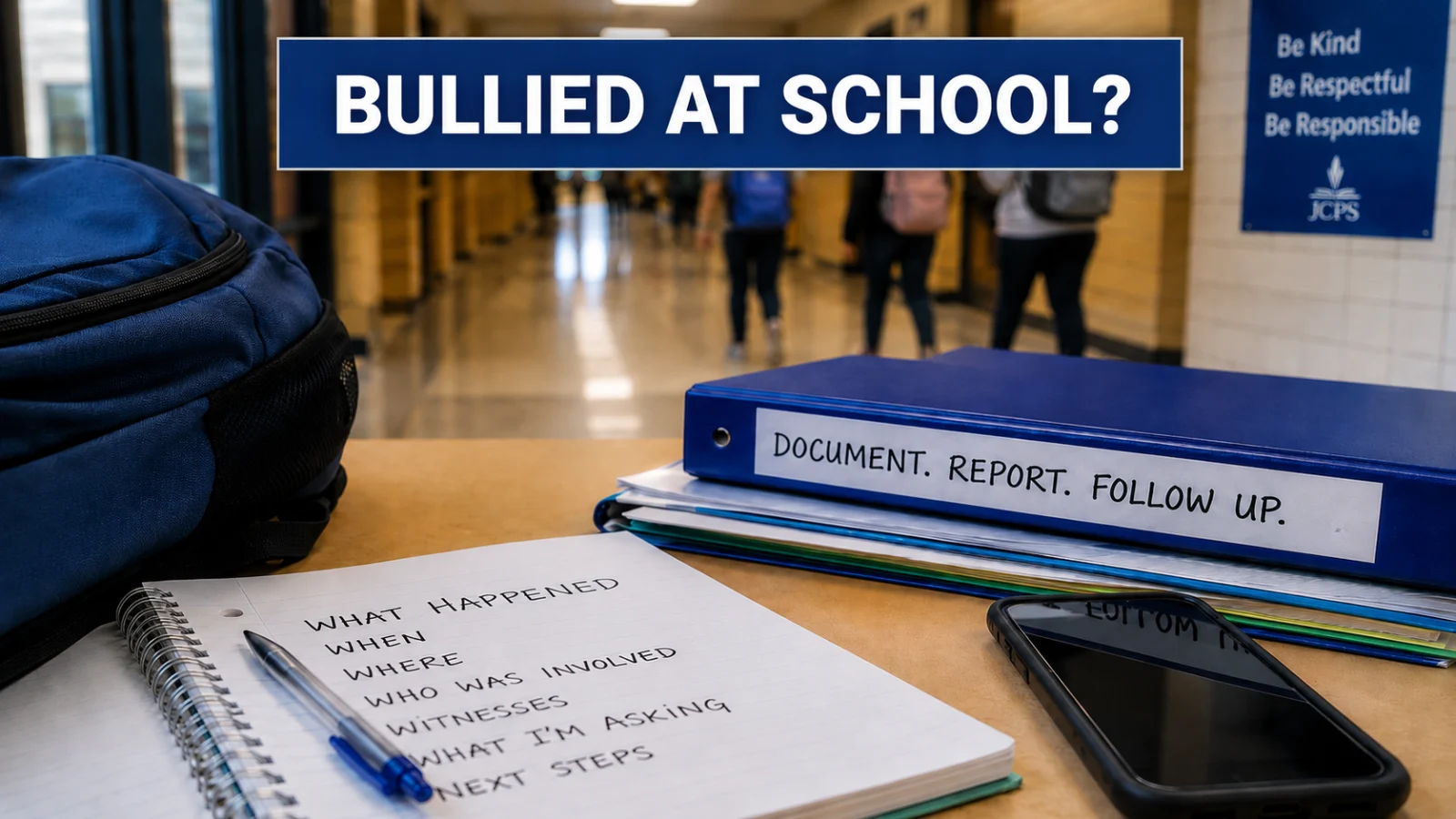
Write down what happened, when it happened, where it happened, who knew about it and what you are asking the school to do next.
That creates something a teacher, counselor, principal or district administrator can actually investigate. It also creates a record if the problem continues.
JCPS currently gives parents several ways to report suspected bullying. The district's Bullying Prevention department tells reporters to begin with the classroom teacher, then communicate the concern to a school administrator, request a face to face meeting with the school and, if necessary, submit a Tipline report by phone or online. JCPS also identifies the school counselor as a support contact for families dealing with bullying concerns.
Another section of the district's Student Support and Behavior Intervention Handbook tells parents to report concerns involving a student's emotional or physical safety to the building principal and, if that is unsuccessful, contact the assistant superintendent supporting the school. It separately directs bullying and harassment concerns to the JCPS Hotline.
Those routes point in the same general direction: tell the school, document the problem and move the concern higher if it is not being resolved.
First, describe what happened instead of arguing over the word bullying
Kentucky's legal definition of bullying is more specific than the way the word is sometimes used in everyday conversation.
Under KRS 158.148, bullying is unwanted verbal, physical or social behavior among students that involves a real or perceived power imbalance and is repeated or has the potential to be repeated. It must occur on school property, on school transportation, at a school sponsored event or disrupt the education process.
That distinction can matter, but parents should not get trapped in a debate over terminology.
A single shove, threat, sexual comment or other serious incident might not fit every part of Kentucky's bullying definition. That does not make the conduct harmless or mean the school has nothing to address. JCPS separately identifies conduct such as intimidation, harassment, threatening behavior, stalking and harassing communications in its behavior rules.
Instead of writing, “You need to admit this is bullying,” document the conduct.
What happened?
That is the part the school can investigate.
What to put in your email
A useful written report does not need to sound like it came from an attorney. It needs enough detail that another person can understand the problem without calling you simply to figure out what you are talking about.
Include these things when you know them:
Your child's name, grade and school. If the incident happened on a bus, at an activity or somewhere other than the regular classroom, say that too.
Dates, approximate times and locations. Write “during seventh period on August 24 near the gym” rather than “this keeps happening at school.”
Exactly what happened. Describe the words, messages, physical contact or other conduct as specifically as your child can recall it. Separate what your child personally experienced from something another student reportedly witnessed.
Whether this has happened before. If the same student or group has targeted your child repeatedly, give the dates you know. If there appears to be a power imbalance, explain the facts that make you think so rather than simply using the phrase.
Witnesses and evidence. Include the names of possible witnesses if your child knows them. Save screenshots, messages, photographs and other evidence. If a school or bus camera may have recorded the incident, ask promptly that any relevant footage be preserved.
Earlier reports. Note when your child or you previously told a teacher, counselor, administrator or other employee. Include the date and, if possible, how the report was made.
What has changed for your child. If your child is avoiding the bus, cafeteria, restroom, a class, an activity or school itself because of what is happening, say so. Those details can show the practical effect of the conduct rather than merely describing the incident in isolation.
What you want next. Ask the school to confirm receipt, investigate the reported conduct, address any immediate safety concern, protect your child from retaliation and tell you who will be your point of contact.
Kentucky law requires district discipline codes to contain procedures for identifying, documenting and reporting bullying, procedures for investigating and responding to complaints, and a method for protecting people who report bullying from retaliation. JCPS also prohibits retaliation against students who report violations or participate in investigations.
A parent email can be this simple
Subject: Bullying concern involving [child's name] at [school]
Principal [Name],
I am writing to report a concern involving my child, [name], who is in [grade].
On [date], at approximately [time or part of the school day], [brief factual description of what occurred]. My child reports that [student or students, if known] were involved and that [witnesses, if known] may have seen what happened.
This is not the first concern. Similar incidents occurred on [dates or approximate dates]. I previously reported the matter to [person] on [date].
I am asking the school to investigate these incidents and let me know what steps will be taken to protect my child while the matter is reviewed. Please also preserve any available camera footage or other records related to the incidents.
Please confirm that you received this report and let me know who I should contact for follow up.
Thank you,
[Parent name]
You do not need to include every rumor circulating among students. In fact, that can make a complaint harder to sort through.
Stick to what your child experienced, what you personally know and what can potentially be checked.
Who should you contact next in JCPS?
JCPS's published Bullying Prevention protocol begins at the school.
The district tells reporters to communicate the concern to the classroom teacher, then a school administrator and request a face to face meeting with the school before moving to a Tipline report. JCPS also identifies school counselors as a resource for students and families who need additional support.
For a serious or repeated problem, there is little reason to rely only on a verbal conversation. Send the written report to the principal so there is a clear record of what the school was told.
JCPS's separate guidance for concerns involving a student's emotional or physical safety tells parents to contact the building principal and, if that is unsuccessful, the assistant superintendent supporting the school.
If the concern remains unresolved, JCPS operates a Compliance Hotline online and at 888 393 6780. The phone line is available 24 hours a day.
The hotline can accept anonymous reports in some circumstances, although JCPS warns that anonymity can make an investigation more difficult and that contact information may be required for certain types of complaints.
After a report is submitted, JCPS says the reporter receives a Case ID and Access Code to follow the case.
Student related reports are provided to the assistant superintendent's office and the school principal. If the principal is the subject of the report, JCPS says it goes to the assistant superintendent's office.
The hotline says resolutions may be obtained within five business days in most circumstances, although some reviews and investigations can take longer.
Parents can also reach the JCPS Call Center at 502 313 4357.
Harassment or discrimination can require a different route
Some situations involve more than the district's general bullying rules.
JCPS's Office of Compliance and Investigations handles allegations involving discrimination and harassment and can be reached at 502 485 3341. The district also provides procedures for student discrimination complaints and matters involving Title IX.
Federal civil rights protections can also apply when harassment is connected to race, color, national origin, sex or disability and becomes serious enough to interfere with a student's ability to participate in school.
The U.S. Department of Education's Office for Civil Rights is not a general appeals office for every bullying dispute. It investigates discrimination within the federal civil rights laws it enforces. Federal guidance says a person ordinarily has 180 days from the last alleged act of discrimination to file an OCR complaint, and families are not required to complete a school district's grievance process before filing with OCR.
Do not expect the school to tell you everything about the other student
This is one of the more frustrating parts of the process for parents.
You can ask what the school found regarding your child's complaint, what is being done to keep your child safe, whether the reported conduct has stopped and what you should do if another incident occurs.
You may not receive the details of another student's discipline.
Federal student privacy rules generally prevent a school from freely disclosing information from another student's disciplinary record. That does not prevent the school from talking to you about your own child's safety or explaining measures that directly affect your child.
So if the answer is simply, “We cannot discuss another student's discipline,” change the question.
Ask what the school is doing to protect your child.
Ask who your child should go to immediately if the conduct happens again.
Ask whether the school considers the complaint resolved and why.
And if the behavior continues, put the new incident in writing too.
JCPS's hotline recommends that families communicate with the school principal before submitting a student related report. The district's reporting system then sends those reports to the principal and the assistant superintendent's office for review, unless the principal is the subject of the complaint.
A short, factual paper trail gives those people something concrete to review. That is usually far more useful than having five separate conversations that nobody remembers exactly the same way.