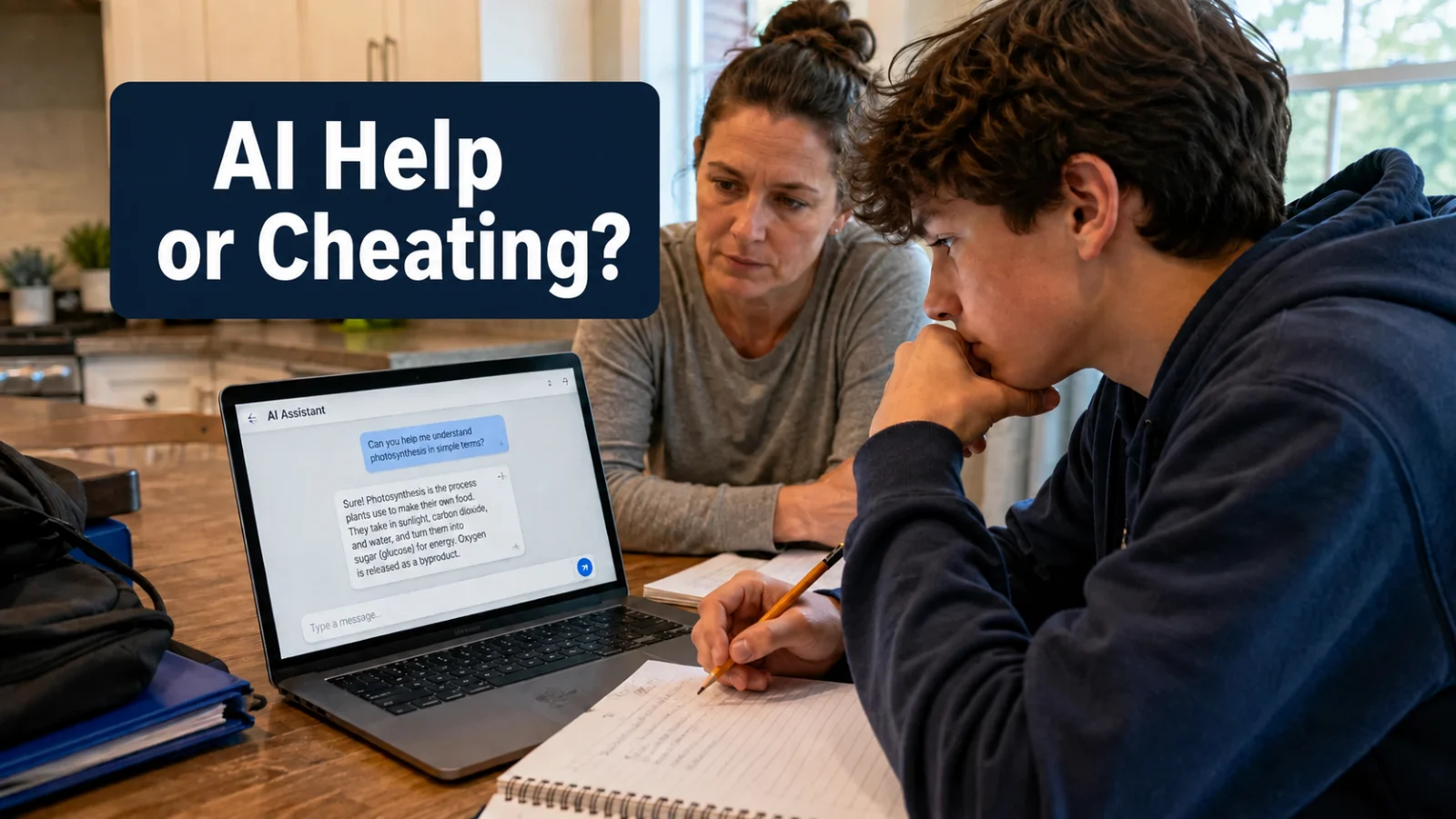
Yes, a JCPS student can use artificial intelligence as a learning tool in some situations.
That does not mean ChatGPT gets a free pass on homework.
JCPS is preparing for more artificial intelligence in education, but the district's rollout has been more cautious on the student side than parents might assume.
JCPS says its approach to generative AI is gradual, with pilot programs, teacher training, privacy protections and approved tools. The district says AI should enhance learning rather than replace the thinking students are supposed to do themselves.
JCPS teachers and staff already have access to Google's Gemini through the district's Google Workspace environment. The district's Technical Learning Center says all JCPS staff can access Gemini. In March, WDRB reported that district officials were still deciding how students themselves would use AI inside Google Classroom.
Google has since expanded Gemini in Classroom to students of all ages. But that does not automatically switch the feature on for every student. Google says the new student tools are available to students who have already been granted the necessary access by their school administrator. If Gemini in Classroom was turned off for students, it remains off.
JCPS has not publicly confirmed that it has activated those student features for the 2026 to 2027 school year.
So a teacher using Gemini to build a lesson does not mean a student automatically has permission to use ChatGPT to complete it.
JCPS also does not publish a simple district rule saying students may use a certain amount of AI on homework.
There is no 20 percent rule. There is no districtwide guarantee that brainstorming with AI is acceptable on every assignment. JCPS Insider could not find a rule requiring every teacher to handle ChatGPT exactly the same way.
The assignment directions matter.
Before your child uses AI, read the assignment or syllabus. If the instructions are unclear, ask the teacher before the work is turned in. If there is no time to get an answer, completing the assignment without AI is safer than guessing what the teacher will allow.
JCPS already has a rule that can cover AI cheating
The current JCPS Student Support and Behavior Intervention Handbook does not have to mention ChatGPT by name.
JCPS defines cheating and academic dishonesty as including deceiving, tricking, defrauding or otherwise taking an unfair or unethical advantage to benefit someone's grade, academic standing or status.
For students in grades four through twelve, cheating and academic dishonesty are classified as a Level 1 behavior that results in an academic consequence. JCPS does not list one automatic penalty, such as requiring a zero in every case.
But the definition gives schools a straightforward way to address undisclosed AI work.
If an essay is supposed to show what a student can write, having ChatGPT write it and submitting the result as the student's own can fall within that academic dishonesty rule.
Changing a few words afterward does not change who did the work.
Did AI help with the learning, or do the learning?
That may be the easiest test for a parent.
There is a big difference between asking ChatGPT to explain why dividing fractions works and asking it to complete ten fraction problems that will be turned in the next morning.
The same goes for English class.
A student could ask AI to explain the difference between a thesis statement and a topic sentence. That resembles tutoring.
Asking ChatGPT to write the five paragraph essay is something else.
Kentucky leaves much of this to local school districts. The Kentucky Department of Education says districts can choose whether conversational AI products such as ChatGPT are blocked when students use Kentucky school internet service or school computers. KDE also advises against entering personal or confidential information into openly available AI systems.
KDE points Kentucky districts to Guidance for the Use of AI in the K through 12 Classroom, an April 2025 report from the Southern Regional Education Board.
The SREB report specifically says AI can help students during the planning stages of academic work, including brainstorming and outlining. It describes AI as a possible starting point that can help students generate ideas, explore different approaches and organize their own thoughts.
The report also warns about students using AI to circumvent learning and thinking and about advanced AI tools being misused to gain an unfair advantage.
That leaves plenty of room for uses that look more like tutoring.
Ask AI to explain something from class in a different way
Create practice questions before a test
Ask for hints without requesting the final answer
Brainstorm topics for a paper
Ask questions about a concept the student is struggling to understand
Have AI quiz the student
Ask for feedback on a draft the student already wrote
Ask AI to identify confusing sentences without having it rewrite the paper
A student can even tell ChatGPT not to provide the answer and instead ask questions that help the student work through the problem.
Other uses are much harder to defend.
Paste an assignment into ChatGPT and submit the response
Have AI write an essay, book analysis or discussion response
Photograph a worksheet and ask AI to complete it
Ask AI to answer questions about a chapter the student never read
Have AI rewrite its own work so it sounds like a middle school or high school student
Turn in AI generated facts or citations without checking the original sources
Use AI after the teacher specifically prohibited it
Hide AI use when the teacher required students to disclose it
Kentucky's Student Technology Leadership Program offers a useful example of how educators are drawing the line. AI can be used as a support tool in many STLP competitions, including for brainstorming and organizing research, but students must disclose how it was used and remain responsible for the final work. Some creative competitions prohibit AI generated content entirely.
Those are STLP competition rules, not a districtwide JCPS homework policy. But the principle is easy to recognize: assistance is different from replacing the student's work.
What about ChatGPT at home?
School approved AI and a personal ChatGPT account are not the same thing.
JCPS says generative AI platforms used within the district should be approved and securely vetted. The district also warns against putting personally identifiable information into AI systems and emphasizes student privacy and data security.
JCPS's public technology materials currently identify Gemini as available to teachers and staff. They do not identify personal ChatGPT accounts as an approved JCPS student platform. JCPS Insider could not confirm from public district materials that students are authorized to use personal ChatGPT accounts through JCPS systems.
Using ChatGPT on a family computer at home is a different access situation.
ChatGPT has its own age rules
OpenAI says ChatGPT is not intended for children younger than 13. Users ages 13 through 17 need permission from a parent or legal guardian. If ChatGPT is used in an educational setting with a child younger than 13, OpenAI says the actual interaction with ChatGPT must be conducted by an adult.
OpenAI began rolling out ChatGPT for Teens on August 18, 2026, for users identified as ages 13 through 17.
The teen experience includes Study Mode, which is designed to use questions and guided steps to help students understand material. It also includes homework reminders that can recognize when a teenager appears to be trying to shortcut an assignment and redirect the student toward working through the problem.
It is not foolproof. OpenAI says Study Mode can still sometimes provide a direct answer.
Parents can link their account to a teenager's account and manage settings such as Study Mode, study hours and quiet hours. Linking the accounts does not allow the parent to read the teenager's conversations or monitor the chats in real time.
Five questions to ask before the homework is submitted
You probably don't need to interrogate your child about every ChatGPT conversation.
But if AI helped with an assignment, ask:
What part did you do yourself?
What did ChatGPT do?
Did your teacher say AI was allowed?
Could you explain this answer without ChatGPT sitting beside you?
Did you check the facts and sources yourself?
That fourth question catches a lot.
If a student turns in a polished paragraph about the causes of the Civil War but cannot explain what the paragraph means, the assignment is no longer measuring that student's understanding.
Let AI help your child learn when the teacher permits it.
Don't let it become the student.