
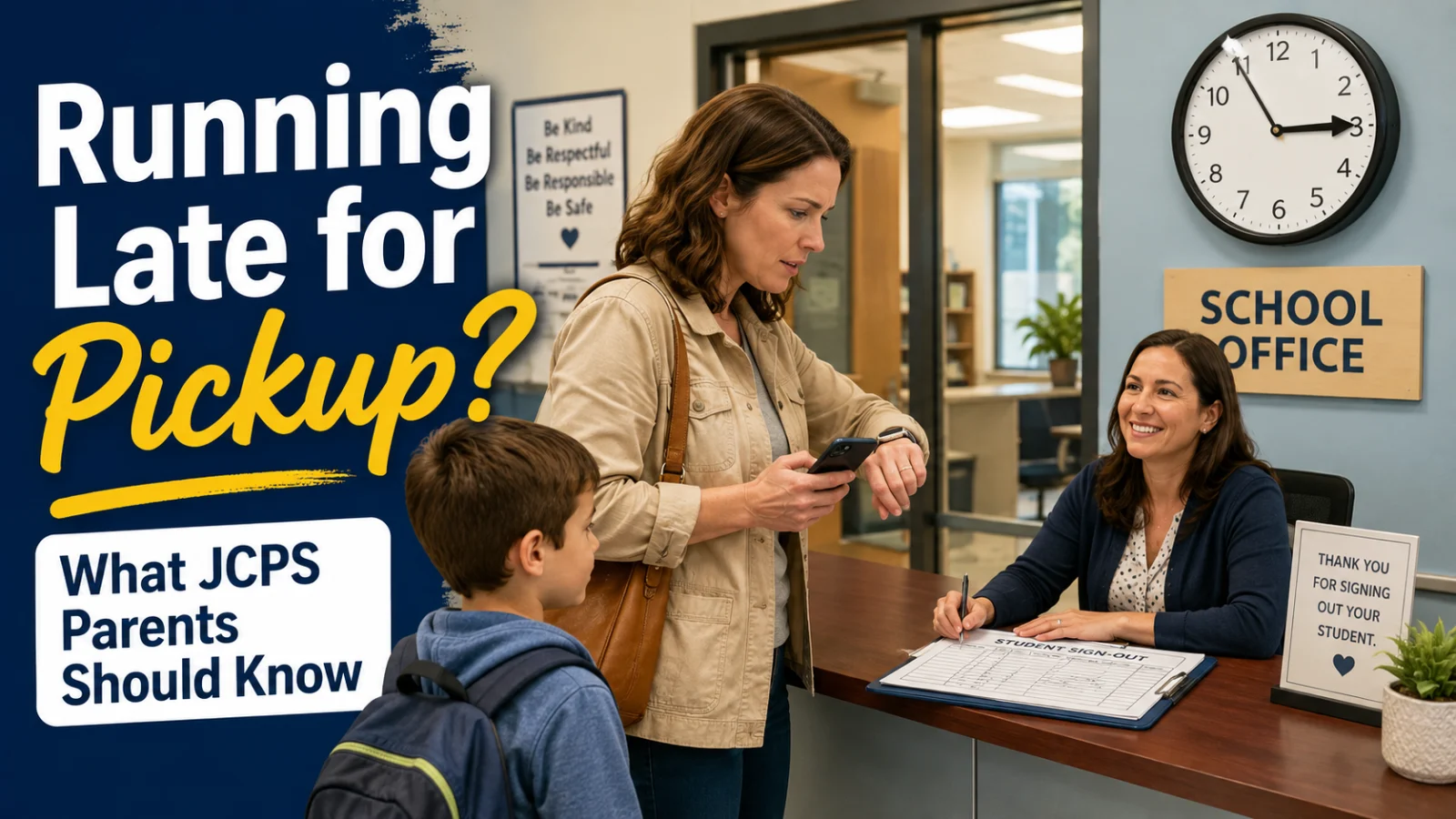
You look at the clock and realize you have a problem.
You need to pick your child up early, but dismissal is getting close. Maybe an appointment ran long. Maybe work kept you later than expected. Maybe Louisville traffic turned a 15-minute drive into 30.
Then you remember the rule at your child's school: no early checkouts during the final part of the school day.
So what happens if you're five or ten minutes too late?
Can you still sign your child out?
Quick Answer
It all depends.
There is no single JCPS early checkout cutoff used by every school. Individual schools publish different early-dismissal and transportation procedures. If you're running late, call the front office before you arrive, acknowledge the school's cutoff and ask what options are still available.
Building a good relationship with your school's office staff can make those conversations easier, but it does not override school policy and does not guarantee an exception.
That's an important distinction.
This isn't a guide to demanding special treatment or finding a loophole in JCPS dismissal procedures.
It's about putting yourself in the best possible position when real life gets in the way.
There Is No Universal JCPS "20-Minute Rule"
Parents sometimes talk about a JCPS "20-minute rule" or "30-minute rule" as though every school stops early pickup at the same point before dismissal.
Current JCPS school pages show otherwise.
Different schools use different cutoff times and procedures:
Bloom Elementary All early dismissals must take place before 2 p.m. because of the school's dismissal process. Bloom Back to School
Hawthorne Elementary The school's August 9, 2026 reminder states there are no early dismissals after 2:50 p.m. Hawthorne Notice
Crosby Middle School Students needing an early sign-out should be picked up before 3 p.m. Students are not dismissed from 3 to 3:20 p.m. Crosby Early Sign-Out Notice
W.E.B. DuBois Academy The school says the front office is closed from 1:30 to 2:30 p.m. and transportation changes are not accepted after 1:30 p.m. DuBois Transportation/Early Dismissal Changes
Bloom's current page ties its before-2-p.m. requirement directly to its dismissal process. Hawthorne's August 9 notice expressly says there are no early dismissals after 2:50. Crosby Principal Clay Ryan's August 5 back-to-school notice tells families to complete early sign-outs before 3 p.m. and says students will not be dismissed between 3 and 3:20.
DuBois illustrates another reason parents need to check the rules at their particular school: its published page says the front office closes from 1:30 to 2:30 p.m. and will not accept transportation changes after 1:30.
So instead of asking:
"What time does JCPS early checkout end?"
Ask:
"What time does early checkout end at my child's school?"
The answer may be very different depending on where your child attends.
Why Do Schools Stop Early Checkouts Before Dismissal?
From a parent's perspective, the policy can feel frustrating.
If your child's school dismisses at 3:20 and you're standing in the office at 3:05, why can't someone simply call the classroom and send your child down?
Because those final minutes can be among the busiest and most tightly coordinated parts of the school day.
Students may already be moving into separate groups for:
Buses
Car riders
Walkers
Daycare transportation
After-school programs
Athletics or extracurricular activities
At the same time, office staff may be handling transportation changes, parent phone calls, buses arriving, identification checks and students moving to designated dismissal areas.
Crosby's published policy is a good example: the school doesn't merely suggest parents avoid late pickups. It establishes a specific 20-minute period—from 3 to 3:20 p.m.—during which students will not be dismissed early.
Bloom similarly says its early-dismissal cutoff exists because of its dismissal process and requires same-day transportation changes to be submitted by 1:50 p.m.
These rules aren't necessarily designed to make things difficult for parents.
They're designed to keep the movement of hundreds of children predictable and safe.
Schools can establish reasonable procedures for how students are released during a busy dismissal window. Being a child's parent doesn't necessarily mean a staff member can abandon that procedure and retrieve the student immediately once dismissal has begun.
So What Can You Do If You're Running Late?
This is the part parents probably care about most.
Call ahead.
Don't race across town assuming someone will make an exception.
Don't wait until you're standing at the front desk after the cutoff.
And don't begin the conversation by telling the secretary why the rule shouldn't apply to you.
Call as soon as you realize you're going to be close.
What to Say
"Hi, I'm on my way to pick up Sarah. I know early checkout ends at 3:00, and I'm running a few minutes behind. I should be there around 3:05. Is there any way I'll still be able to sign her out, or will dismissal already be underway?"
That simple approach does several things.
You're acknowledging the school's procedure.
You're providing your expected arrival time.
You're giving the office advance notice.
And most importantly, you're asking what is possible instead of demanding an exception.
If the answer is yes, great.
If the answer is no, you know that before arriving angry and frustrated.
This Is Where Relationships Can Help
There is another step parents can take—but it needs to happen long before the day they're running late.
Get to know your child's school.
Volunteer at a school event when you can.
Help with the book fair.
Attend PTA or PTSA meetings.
Go to school functions.
Introduce yourself to the people in the front office.
Say hello when you're in the building.
You don't need to spend 20 hours a month volunteering, and you're not trying to become best friends with the attendance clerk.
You're simply becoming a familiar, involved member of the school community.
Bloom's own parent information emphasizes building strong relationships between school staff and families and encourages parents to volunteer in areas such as lunch duty, classroom story time, recess and PTA activities.
Those relationships matter because eventually almost every family needs help with something.
Maybe you're confused about attendance.
Maybe transportation changes unexpectedly.
Maybe another authorized person needs to pick up your child.
Maybe a form didn't make it home.
Or maybe you're seven minutes behind schedule and need to know whether your child can still be checked out.
Knowing the people in the office doesn't change the policy. It can change the quality of the conversation.
Relationships Are Not a Coupon for Special Treatment
This point matters.
Don't volunteer at the fall festival thinking:
"I helped for three hours, so the office owes me one."
They don't.
A staff member may have no authority to make an exception.
Your child's dismissal group may already have left the classroom.
The principal may have established a firm cutoff.
The office itself may effectively shut down normal checkout operations while employees take dismissal positions.
That's why the benefit of being involved isn't that the rules suddenly disappear.
It's that when something unusual happens, you're communicating with people with whom you've already established a respectful relationship.
That's very different from appearing after the deadline and beginning your first substantial conversation with:
"I'm the parent. Go get my child."
What If the School Says No?
Then the best response is usually:
"Okay. What do you need me to do now, and where should I pick my child up?"
If your child is normally a bus rider, tell the office.
If you're supposed to enter the car-rider line, ask where to go.
If your child has already been moved to a dismissal location, follow the school's instructions for retrieving them.
And if there is a genuine emergency, clearly tell the office what's happening and ask what options are available.
There's a difference between:
"I'm going to be late for another appointment."
and:
"There's a family emergency and I need my child immediately."
Schools may handle exceptional circumstances differently, but parents shouldn't label an inconvenience an emergency simply to get around a cutoff.
Sometimes the answer really will be:
You'll have to wait until normal dismissal.
It's inconvenient, but starting an argument at the front desk is unlikely to make a tightly controlled dismissal process move faster.
Bring Your ID—and Make Sure Pickup Information Is Current
There's another detail parents shouldn't overlook.
Identification and authorization matter.
JCPS schools can have specific pickup-verification procedures. Field Elementary, for example, tells families that anyone picking up a child must be able to present picture identification so school staff can verify the person's identity.
Klondike Lane Elementary recently reminded families that anyone picking up a student must bring both a valid photo ID and the student's numbered pickup placard, and said students cannot be released without the required identification and placard.
The Phoenix School of Discovery's off-site pickup procedures provide another example: the pickup person must present valid photo identification and be listed in the student's household information in Infinite Campus.
The exact procedure can vary by school and circumstance, so don't assume that because office employees recognize you, identification won't be required.
Bring your photo ID and make sure the people authorized to pick up your child are correctly listed with the school.
A good relationship should never be expected to replace a student-safety requirement.
Early Checkout Is Also an Attendance Issue
An early pickup isn't only a dismissal issue.
JCPS district attendance guidance requires students who leave the building during any portion of the school day to sign out on an Exit Log.
That means an early departure is part of the school's attendance process—not simply an informal arrangement between a parent and the front office.
Parents can use Infinite Campus Parent Portal to monitor their child's attendance, along with grades, assignments and schedules.
If your child leaves early regularly—for medical appointments, therapy or another recurring reason—it's worth checking the attendance record and asking the school's attendance clerk how those departures are being recorded.
Occasionally leaving a little early is one thing.
Repeatedly removing a student from the final portion of the school day also means repeatedly missing instructional time.
Know How Your School Handles Transportation Changes
Don't assume calling the office at the last minute is always the official procedure.
Some schools use forms or other communication systems.
Bloom, for example, tells parents that students will be dismissed according to the transportation plan on file unless a change is submitted through its designated Google form by 1:50 p.m.
JCPS also provides families access to Infinite Campus Parent Portal for attendance and student information, while individual schools may use additional approved communication tools.
The important thing is to learn your school's system before you need it.
Save This: The JCPS Early Pickup Checklist
Before you find yourself watching the clock from the other side of Louisville, take five minutes and get answers to these questions:
Early Checkout Checklist
What time does early checkout end at my child's school?
Is that cutoff firm once dismissal begins?
How do I submit a same-day transportation change?
Who should I call if I'm going to be close to the cutoff?
What identification is required?
Who is currently authorized to pick up my child?
What happens if my child has already entered the bus or car-rider dismissal process?
How are early departures handled for attendance purposes?
What should I do differently in a genuine emergency?
Then save the school's front-office number in your phone.
That's much easier than searching for it while you're already running behind.
The Wrong Approach vs. the Better Approach
Imagine early checkout ends at 3 p.m.
It's 3:04.
The wrong approach:
"I'm his parent. That's my child. You can't tell me I can't take him. Just call the classroom."
Now the interaction has become a confrontation over a rule that was already in place.
The better approach:
Call before arriving.
"I know the cutoff is 3:00. I'm running a few minutes late. Is there anything we can do, or do I need to follow normal dismissal today?"
One approach tells school employees that their procedure doesn't matter.
The other recognizes that you're asking them for help.
And if there is any flexibility available, which conversation do you think gives you the better chance of finding it?
The JCPS Insider Takeaway
Here's the real parent hack:
Don't try to beat your school's JCPS early checkout policy. Put yourself in the best position possible when life gets in the way.
Know the cutoff.
Know the school's dismissal procedure.
Keep your pickup information current.
Bring your ID.
Call before you arrive if you're running late.
Ask instead of demand.
And build relationships with the front office before the day you desperately need something from them.
None of that guarantees an exception.
You may still be told no.
At some schools, the cutoff is firm. At others, the front office may already be tied up with dismissal. Staff members may simply not have the authority or ability to retrieve your child once the process has started.
But there's a big difference between asking for help from people you've treated respectfully all year and walking in after the deadline ready for a fight.
The goal isn't to become the parent who gets to ignore the rules.
It's to become the parent who knows how the school works, knows the people who work there and knows how to handle the situation when something doesn't go according to plan.
JCPS school dismissal procedures can change during the school year. The examples above were verified against current JCPS school pages in August 2026. Parents should always confirm their own school's current early-dismissal and pickup procedures.