
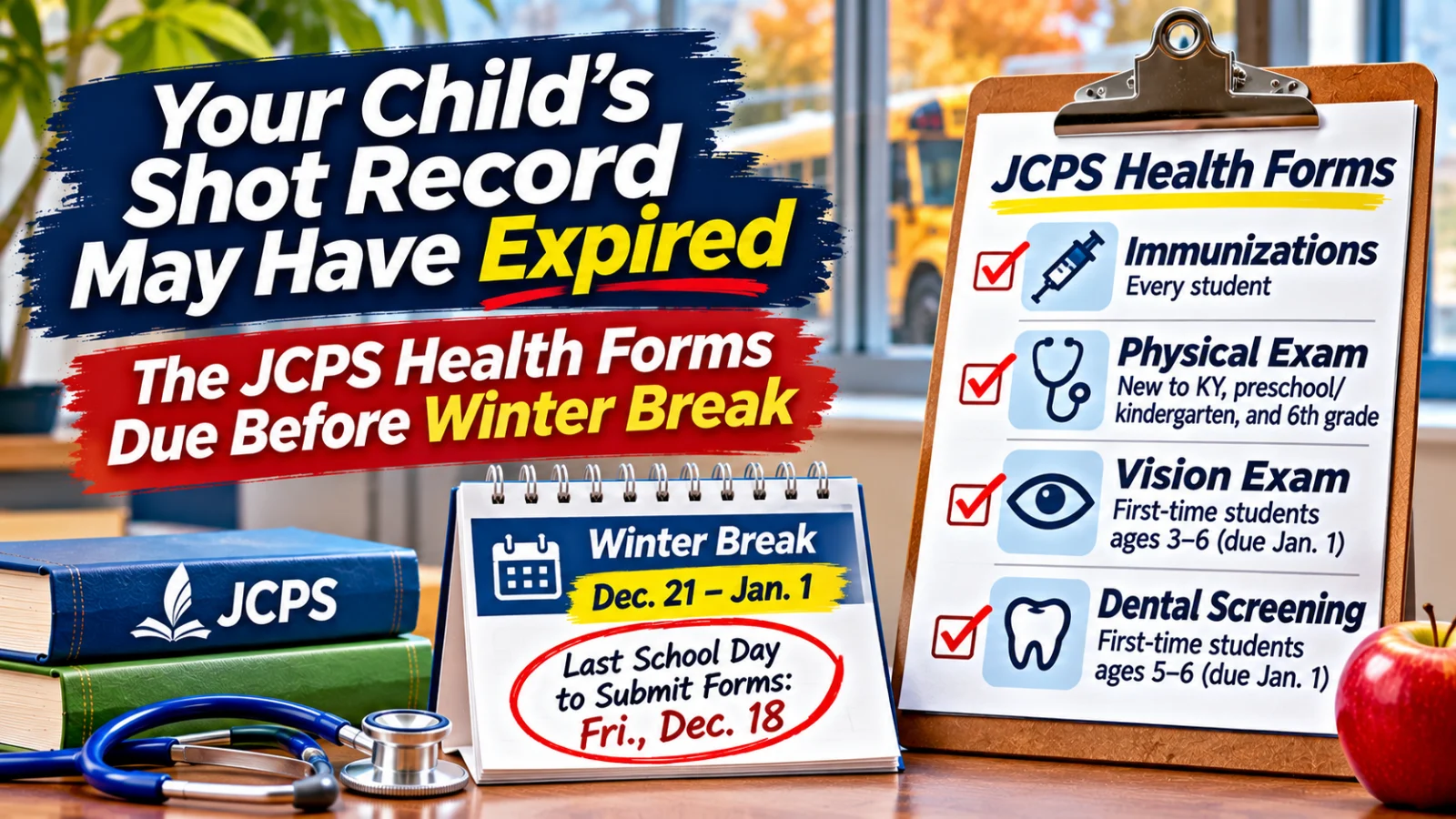
Every Jefferson County Public Schools student must have a current Kentucky immunization certificate on file at school "within two weeks of starting classes," JCPS said in its August 18, 2026 announcement, "JCPS reminds families of free health services available districtwide." Children entering a Kentucky school for the first time at ages 3 through 6 also need an eye doctor's exam form on file by January 1. Five and six year olds entering for the first time need a dental screening form by the same date.
That January 1 date falls during winter break this year. The JCPS 2026 to 2027 calendar runs winter break from December 21 through January 1, so the last school day to hand a form to the nurse is Friday, December 18.
Which health forms does JCPS require, and for which students?
There are four, and the August announcement lists all of them.
Immunization certificate. Every student, every grade, a current one on file within two weeks of starting classes.
Physical exam. Students new to Kentucky schools, children starting preschool or kindergarten for the first time, and all students entering sixth grade. It goes on the Kentucky Preventive Health Care Form.
Vision exam. Children entering a Kentucky school for the first time at ages 3 through 6, on the Kentucky Vision Examination form, by January 1.
Dental screening. Five and six year olds entering a Kentucky school for the first time, on the Kentucky Dental Screening or Examination form, by January 1.
The state rules behind that list are 702 KAR 1:160, which sets the school health exams, and 902 KAR 2:060, which sets the vaccine schedule.
Why doesn't the school physical cover the eye exam?
Because state law requires an eye doctor. KRS 156.160(1)(i) calls for "a vision examination by an optometrist or ophthalmologist," with proof due "no later than January 1 of the first year" a child age 3, 4, 5 or 6 enrolls in a public school, public preschool or Head Start. JCPS puts it plainly: "the vision screening included in a standard school physical does not satisfy this requirement."
The state form is the Kentucky Eye Examination Form for School Entry, KDESHS004. Under 702 KAR 1:160, an electronic medical record with the same information also counts.
The dental rule is looser about who can do it. KRS 156.160(1)(j) lets a dentist, dental hygienist, physician, registered nurse, advanced practice registered nurse or physician assistant do the screening. If anyone other than a dentist spots possible dental disease, the law says the child "shall be referred to a licensed dentist." JCPS says families without dental insurance "can contact their school nurse to arrange a screening at school." The state form is the Kentucky Dental Screening/Examination Form for School Entry.
Why does a shot record expire?
Because the certificate is dated to your child's next required dose. Under 902 KAR 2:060, the Commonwealth of Kentucky Certificate of Immunization Status, known as the EPID 230, must certify that the child "is current for immunizations until a specified date," with a statement that it "shall not be valid after the specified date."
The regulation has schools review certificates at kindergarten entry, seventh grade entry, eleventh grade entry, and whenever a student transfers in from another state, another country or another Kentucky school. Two birthdays tend to trigger a new certificate:
Age 11. The schedule for 11 and 12 year olds adds one dose of Tdap and one dose of MenACWY, the meningococcal vaccine.
Age 16. Students 16 and older need two doses of MenACWY, or one if that dose came at 16 or later.
When a school finds a certificate is no longer valid, the regulation gives the parent 14 days to bring in an updated one. A child who is behind but has started every required series can get a certificate marked "Provisional Status." That version expires 14 days after the next dose comes due and can't last more than a year.
Did Kentucky change school vaccine rules after the CDC's schedule changes?
No. The state Department for Public Health's school immunization FAQ, revised January 2026, says "Kentucky's school and child care immunization requirements remain in effect and have not changed." It says CDC guidance "does not automatically change state law" and that "no vaccines were removed" in the federal update.
The state's answer for a family following the federal schedule instead: "Students must meet Kentucky's immunization requirements to enroll in and attend school." The FAQ says that also applies to sports and school sponsored extracurricular activities.
One 2026 bill tried to change the list. House Bill 466 would have removed hepatitis B from the required vaccines and barred the state from adding new ones without the General Assembly's approval. Its last recorded action was a referral to the House Health Services committee on January 29, 2026. Hepatitis B is still on the schedule, three doses for most school age children.
Where can you get a copy of the shot record?
From your child's doctor, the local health department, or the state registry. The state's EPID 230 FAQ says a certificate needs a provider's signature "unless it is printed directly" from the Kentucky Immunization Registry.
Parents can print an official school certificate for a child under 18 from the Kentucky Immunization Registry's public site. The search only works when the name, birth date and the phone or email you gave the doctor's office match the registry exactly. The registry's help desk is 502 564 0038, weekdays 8 a.m. to 4 p.m.
There's a catch. The registry page says Kentucky providers aren't required to report shots to it, and its most complete data goes back to 2005. If a dose is missing, the printout may show your child as behind. Ask the doctor who gave the shot for a signed certificate instead.
What about medical and religious exemptions?
Kentucky allows both under KRS 214.036.
A medical exemption goes on the regular certificate. Under 902 KAR 2:060, a provider marks the EPID 230 for a child with a temporary or permanent medical reason not to get a vaccine.
A religious exemption uses a different form, the EPID 230A. The state FAQ says it must be the original, notarized, and turned in at enrollment. A photocopy isn't acceptable, the FAQ says. If your child has ever had any vaccine, including at birth, you turn in the EPID 230 as well. The FAQ says a county clerk can notarize the form and online notarization is allowed. The form doesn't expire.
The FAQ doesn't say what happens to an exempt child during an outbreak. Our measles explainer covers exclusion after an exposure.
Does JCPS post its own versions of these forms?
It posts files under the same names, but we couldn't open them to compare. The district's School Health Requirements library, checked November 4, has folders for Nurse Office Consent, Immunization Schedules, Immunization Forms, Physical Exams, Athletic (Sports) Physicals and Dental Screening or Exam.
Inside, the Immunization Forms folder holds a "Religious Exemption" file in English and Spanish. The Physical Exams folder holds a Word file named "PhysicalForm," and the Dental folder holds a file named "Dental."
The state rules name the state forms. The physical goes on the Preventive Student Health Care Examination Form, KDESHS002, "or an electronic medical record" with the same data, according to 702 KAR 1:160. If your doctor's office uses its own printout, ask whether it includes everything on the state form.
One JCPS form isn't on the state list at all: the Nurse Office Consent. The district's Health Services page asks families to return it every year so a child "can be seen and cared for," including for vision and hearing screenings.
Can JCPS do the physical or the shots for free?
Yes, for students who need it. The August announcement says district nurse practitioners can give vaccines and do physicals at school at no cost to the family. JCPS also runs two clinics, open Monday through Friday during the school year:
CB Young Service Center, 3001 Crittenden Drive.
South Central Neighborhood Place, 4255 Hazelwood Avenue.
The district's screenings page lists the middle and high school clinic packets to fill out and bring.
The sixth grade physical is the one families forget. Under 702 KAR 1:160, it must happen "within one (1) year prior to entry into the sixth grade," so a fifth grader's checkup next summer can count. The regulation lets a school board extend the deadline by up to two months. It also lets a district require a third exam before ninth grade, but JCPS's August list doesn't include one. A sports physical is separate. Our athletics guide covers that form.
Find the date printed on your child's certificate tonight. If it has passed, or your child is new this year and between 3 and 6, call the school nurse or the JCPS Health and Wellness Office at 502 485 3387 and get the forms in by December 18. If you can't make December 18, call anyway before break. The January 1 date doesn't move, and the nurse or that office can tell you how to get the form to the school.