
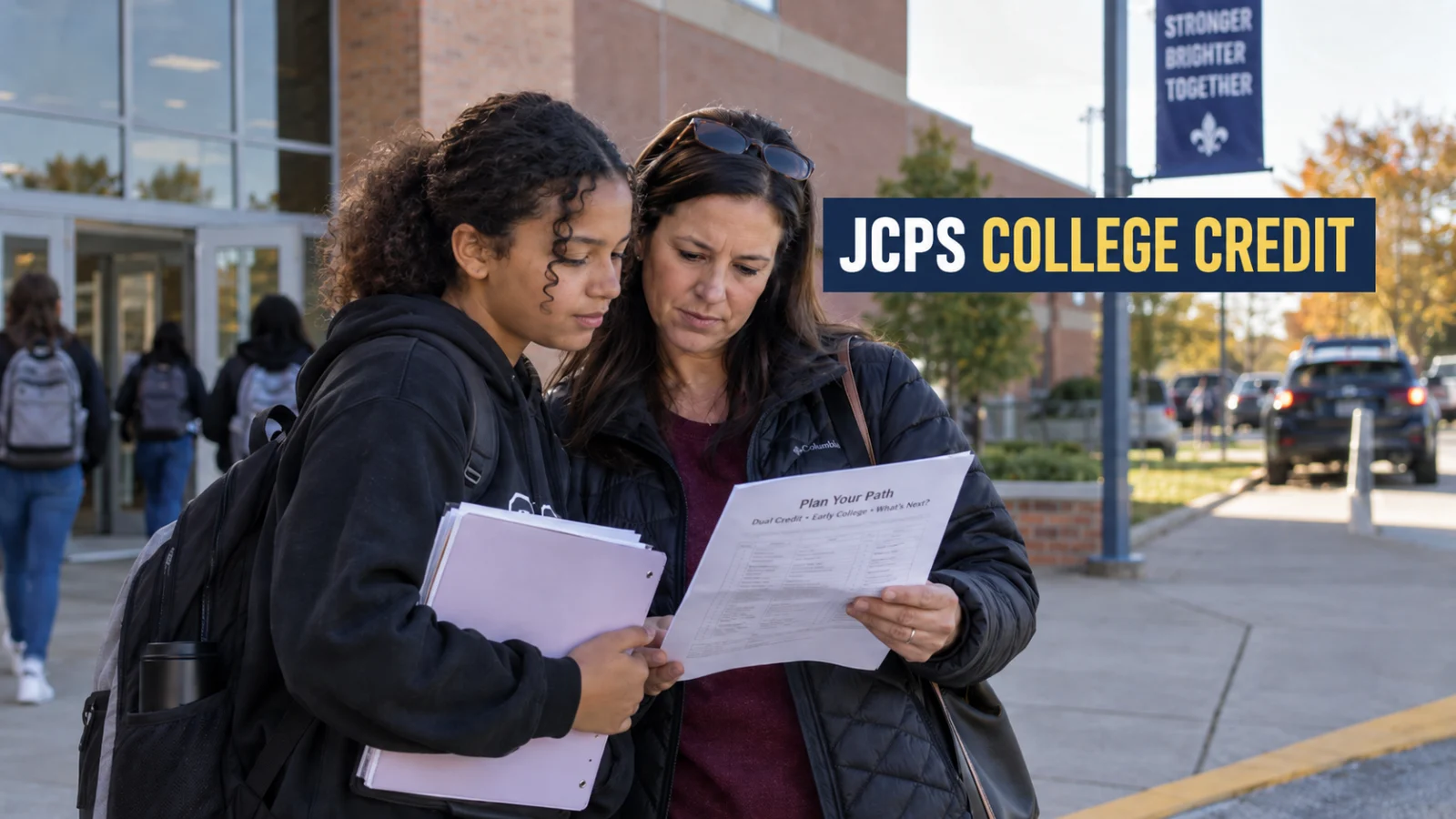
A JCPS student can graduate with far more than a high school diploma, but the size of that head start depends heavily on the school and program.
The clearest opportunity is at W.E.B. DuBois Academy. JCPS says its partnership with Jefferson Community and Technical College could allow a student to earn an associate degree by graduation. DuBois and Central High also advertise Early College opportunities. Waggener says students can earn up to 30 college credit hours, while Eastern and Butler advertise unusually large dual credit course catalogs.
Dual credit is available much more widely across JCPS.
The problem for parents is that JCPS does not publish one simple comparison showing how many college credits a student can realistically earn at each high school. A school offering a few dual credit classes and a school offering a pathway toward 30 or even 60 credits can both advertise themselves as offering dual credit.
Those are very different opportunities.
DuBois is the clearest path toward an associate degree
The current JCPS High School Choices information says W.E.B. DuBois Academy offers dual credit through JCTC that could lead to students earning an associate degree upon graduation. It also advertises Early College opportunities for students who complete and pass required Career and Technical Education coursework by the end of sophomore year.
JCPS is careful with the wording. It says the program could lead to an associate degree. It does not say every student in the program will earn one.
DuBois graduated its first senior class in May 2025. JCPS said that class included 63 students, but the district's graduation announcement did not report how many, if any, completed an associate degree. JCPS Insider could not independently verify an associate degree completion count from the public material reviewed.
An Associate in Arts or Associate in Science degree at JCTC is not simply a pile of college credits. Students complete a structured 60 credit hour program with specific requirements. JCTC says students who complete the full program can enter Kentucky public universities with junior standing under the state's transfer framework.
That makes planning critical. Sixty credits that do not satisfy the right degree requirements are not automatically an associate degree.
DuBois is a magnet school, so families interested in this pathway need to consider it during the JCPS school choice process rather than assuming it will be available at their assigned high school.
Central has Early College through its medical programs
Central High School Magnet Career Academy also uses the term Early College in its current JCPS profile.
Central offers dual credit through the University of Louisville, JCTC and Morehead State University. JCPS specifically says the school offers Early College opportunities through its medical programs.
The district does not make the same associate degree claim for Central that it makes for DuBois.
A student interested in Central's medical programs should ask the school exactly which college courses are built into the pathway, how many credits can be completed before graduation and what credential or degree those credits are designed to support.
Waggener gives parents something most schools do not: a credit total
Waggener's College Now Program is one of the easier JCPS programs to understand because the district publishes an actual number.
The current High School Choices guide says students can earn up to 30 college credit hours through dual credit before graduating. Waggener partners with Western Kentucky University, UofL, UK, JCTC and Campbellsville University.
Waggener also allows some students to start early. Its school page says ninth graders with the required 3.0 GPA can take an online College and Career Exploration course through WKU and earn their first college credit hour as freshmen.
There is a small inconsistency parents should know about. The current JCPS Choices guide says up to 30 hours, while Waggener's school page says more than 30 hours and still references course offerings for the 2024 to 2025 school year. Until the school updates that page, the 30 hour figure in the current district guide is the cleaner number to use when comparing schools.
Thirty carefully selected college credits can still be a substantial head start. But whether all 30 apply to a student's eventual degree depends on the college and major.
Eastern and Butler advertise large dual credit catalogs
Eastern and Butler are worth separating from schools that merely say dual credit is available.
According to the current JCPS High School Choices guide, Eastern advertises more than 50 dual credit courses along with more than 20 Advanced Placement courses.
The same JCPS guide says Butler Traditional offers 20 dual credit courses through UofL, Bellarmine University, Morehead State University and JCTC.
Those are course counts, not credit totals.
A student cannot assume that attending Eastern means taking 50 college courses or that every Butler student can fit all 20 into a four year high school schedule. Course eligibility, prerequisites, scheduling and the student's academic plan determine what can actually be completed.
Western, Brown, Manual, Male and other schools also offer college credit
The opportunity extends well beyond those four schools.
Western's magnet programs offer dual credit, and its Distinguished STEM Scholars program gives students access to higher education while taking college level courses at Western. Its college partners include UofL, JCTC, Bluegrass Community and Technical College and Bellarmine University.
J. Graham Brown says students can take college and dual credit classes through local and online universities as early as sophomore year. duPont Manual offers college credit classes through UofL and other college partners. Louisville Male advertises dual credit through UofL, JCTC and Bellarmine. Grace James Academy says dual credit classes are offered at all levels.
There is an even broader option through the Academies of Louisville. JCPS says students at its 15 Academy high schools have opportunities to earn college credit and industry credentials as part of the Academy experience.
Those schools are Atherton, Ballard, Doss, Eastern, Fairdale, Fern Creek, Iroquois, Jeffersontown, Marion C. Moore, Pleasure Ridge Park, Seneca, Shawnee, Southern, Valley and Waggener.
JCPS does not publish a standard maximum number of college credits for every Academy school, so the opportunity can vary considerably by pathway.
Future teachers have another route to as many as 48 credits
JCPS also has a specialized option that is easy to miss.
The Growing Our Own Teachers apprenticeship offers participating high school juniors classroom experience, mentorship and up to 48 college credit hours toward a teaching degree, according to JCPS.
This is not a program thousands of students simply sign up for.
JCPS launched the program in 2025 with nine rising juniors selected for the first group. The district described it as part of an effort to create a pipeline of future teachers.
That makes it a small and selective opportunity, but 48 potential college credits makes it one families should know about if a student is already seriously considering teaching.
Dual credit is real college work, and the grade follows the student
Dual credit creates an actual college record.
JCTC says grades from its dual credit courses become part of the student's permanent postsecondary transcript. Grades, withdrawals and the number of courses attempted can also affect future financial aid and scholarship eligibility.
Admission is not automatic simply because a high school offers the class.
For general education dual credit at a Kentucky public college, state rules require at least a 2.5 unweighted high school GPA plus any course prerequisites. JCTC also has placement requirements for some courses. Career and technical courses have their own prerequisite rules.
JCTC warns students to choose courses that fit their intended college and career path. A college may accept a course as college credit without applying it to the specific degree a student eventually wants.
A student trying to earn as many credits as possible can therefore make less progress than a student who takes fewer courses but chooses them as part of a planned degree pathway.
Kentucky will pay for some dual credit, but the rules changed
This is an area where parents should use current information.
For the 2026 to 2027 school year, Kentucky's Dual Credit Scholarship is available to eligible students in grades 11 and 12 and covers one approved general education dual credit class.
The Work Ready Dual Credit Scholarship is different. Students in grades 9 through 12 can receive funding for as many as two approved Career and Technical Education dual credit courses per school year when the courses are part of an approved career pathway.
Participating colleges have agreed to charge no more than $99 per credit hour for dual credit during the 2026 to 2027 year, regardless of whether the student receives the scholarship. KHEAA also says participating colleges cannot add charges such as lab, special equipment, admission or application fees for dual credit students.
That number becomes more meaningful when you do the math. At the maximum tuition rate, an uncovered three credit course could cost $297.
Textbooks and some course materials can still cost extra. JCTC says some high schools provide books and materials while others do not, and students are responsible for textbook and digital content costs unless their school or district pays them.
Families should also be cautious with older school webpages.
As of September 6, 2026, Butler Traditional's live dual credit page still says Kentucky students are eligible for two general Dual Credit Scholarships and lists a discounted tuition rate of $91 per credit hour for the 2022 to 2023 school year. Those are not the current 2026 to 2027 rules. KHEAA's current scholarship information should be used for decisions this school year.
For the general Dual Credit Scholarship, the fall deadline is October 1, 2026, and the spring deadline is March 1, 2027. The Work Ready Dual Credit Scholarship request deadline is March 1, 2027.
Ask these five questions before choosing a school for college credit
A school's website saying “dual credit available” does not tell you enough.
Before making a high school decision, ask the counselor:
What is the maximum number of college credit hours a motivated student can realistically complete here before graduation?
Which college actually awards each credit?
Can those courses be planned toward an Associate in Arts, Associate in Science, Associate in Applied Science or a specific future bachelor's degree?
What grade can my child begin, and what GPA, placement or course prerequisites must be met?
After available scholarships are used, what would our family actually pay, including books or required course materials?
Those answers can make two schools that both advertise dual credit look very different.
Families considering DuBois, Central, Western or another JCPS magnet should also watch the school choice calendar. The application period for the 2027 to 2028 school year runs from November 2 through December 18, 2026. Applications are not processed on a first come first served basis. Families with questions can contact the JCPS Office of School Choice at 502 485 6250.