
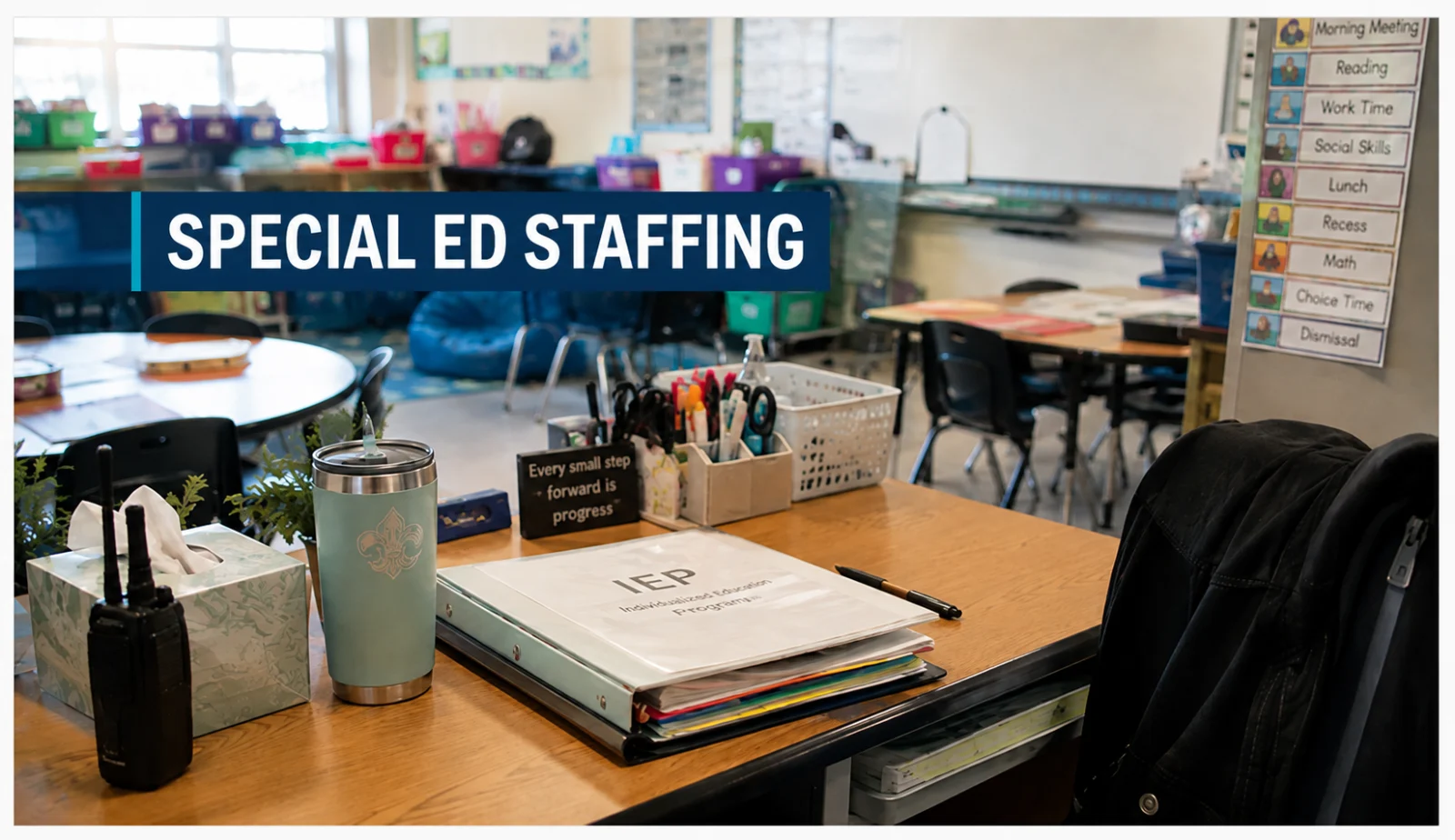
JCPS was still advertising 34 special education teacher positions two days before students returned to class.
A JCPS Insider review of the district's Frontline hiring system on Aug. 4 found 51 openings in the K through 12 teaching category. Sixteen were for teachers serving students with learning and behavior disabilities. Another 18 were for teachers serving students with moderate to severe disabilities.
Frontline timestamped that snapshot at 6:20 p.m. Aug. 4.
That is 34 advertised Exceptional Child Education teaching jobs heading into the first day of school.
It is not proof that 34 classrooms opened without teachers.
A posted vacancy can be covered temporarily by another teacher, a substitute, or another staffing arrangement. A candidate can also be moving through the hiring process while a posting remains visible.
The harder question is what happened to the students assigned to those positions, particularly whether students with Individual Education Programs received the services their plans required.
That answer is much harder to find.
Special education hiring continued after school started
The Aug. 4 snapshot was not simply a collection of summer postings that disappeared when school opened.
JCPS was still posting ECE teaching jobs after students returned Aug. 6.
A learning and behavior disabilities position split between Wilkerson Elementary and Hartstern Elementary carried an Aug. 13 posting date and an Aug. 28 closing date.
Kentucky's Educator Placement Service added a learning and behavior disabilities teacher opening at Luhr Elementary on Aug. 19. The listing carried a Sept. 1 deadline.
Klondike Elementary followed with another learning and behavior disabilities teacher posting on Aug. 21, with a Sept. 5 deadline.
JCPS Insider checked the state and district job listings again on Aug. 26.
Those dates show that at least part of the ECE hiring problem continued after classes began. The Luhr and Klondike listings entered the state or district hiring systems after students were already back in school.
JCPS's public ECE Enrollment by Race 25 to 26 dataset, dated Dec. 1, 2025, lists 13,825 ECE students districtwide. The district notes that the count excludes students served at certain provider locations and students parentally placed in private schools.
Special education vacancies can also be harder to fill quickly than an ordinary classroom opening. Kentucky regulations say the Education Professional Standards Board cannot issue an emergency teaching certificate for teaching exceptional children or interdisciplinary early childhood education.
A principal cannot solve every ECE vacancy by placing any available teacher in the job.
The districtwide vacancy number only tells part of the story
JCPS had 226 teacher vacancies as of July 16, according to a district staffing update reported by WAVE. That was 28 percent fewer than at roughly the same point the previous year.
The largest group was a broad K through 12 category containing 75 vacancies. That category included special education, arts positions, and other specialists, so it did not reveal the ECE total by itself.
District staff said they were prioritizing vacancies with the greatest immediate effect on instruction, safety, and transportation and working with school leaders to fill positions more quickly.
Who is teaching those students today?
Superintendent Brian Yearwood gave a broad answer before school started. He told WDRB in July that classes without a permanent teacher are typically staffed by a substitute.
At Whitney Young at Engelhard Elementary, there is a documented example of exactly that.
WDRB reported Aug. 19 that Audrey Sharber was serving as the lead teacher in an emotional and behavioral disorders classroom because JCPS had not filled the permanent teaching position. Sharber was in her second year leading that classroom as a long term substitute.
JCPS Insider checked Frontline on Aug. 26. The EBD teaching position at Whitney Young at Engelhard was still listed, with an Aug. 29 closing date.
JCPS Insider could not locate a current districtwide, school by school account showing how the rest of the vacant ECE teaching positions are being covered or whether students assigned to those positions have missed services required by their IEPs.
A vacancy count alone cannot tell parents what is happening inside a particular classroom.
An open teaching job does not change the IEP
Federal special education requirements continue even when a district is having trouble hiring.
Under the federal Individuals with Disabilities Education Act regulations, every eligible student must have an IEP in effect at the beginning of the school year. Teachers and other providers responsible for carrying out the plan must have access to it and must be informed of the accommodations, modifications, supports, and services they are responsible for providing.
A child could have a temporary teacher and still receive everything required by the IEP.
The concern starts when a staffing arrangement results in specialized instruction, related services, accommodations, or other required support not being provided.
Kentucky also limits special education class sizes and teacher caseloads. Under 707 KAR 1:350, if caseload for special classes or class size for resource classes exceeds the state maximum for 30 days, the district must submit a waiver request to the Kentucky Department of Education.
That can limit how schools combine groups or move students around while trying to cover vacancies.
What should you ask if your child receives ECE services?
Start with the IEP.
Look at the services listed in the plan, including how often they are supposed to occur and how long they are supposed to last.
Then ask the school a direct question:
Has my child received all of the special education services and minutes listed in the IEP since Aug. 6?
If the answer is unclear, ask who has been providing the service and how the school documents that it occurred.
You can also ask whether the person handling the assignment is the permanent ECE teacher, another certified teacher, or someone temporarily covering the position.
If you believe services have been missed, you can request an Admissions and Release Committee meeting. In Kentucky, the ARC is the team that develops and reviews a student's IEP.
JCPS's ECE Parent Resources page lists Katie Cooper, Ph.D., as the district's ECE Community Relations supervisor and lists 502 485 3346 as her contact number. The district says she works with families who have questions about the special education process and community resources.
Parents can also use the Kentucky Department of Education's special education dispute process if they believe IDEA requirements have been violated.
KDE says a formal IDEA complaint should not simply challenge a district's decision about employing or assigning a teacher because those decisions are generally under local district authority. A complaint can address an alleged violation of IDEA.
How serious is the shortage?
Serious enough that parents should pay attention.
Thirty four advertised ECE teacher openings on Aug. 4 is not a small gap, and positions appearing at Luhr, Klondike, Wilkerson, and Hartstern after opening day show that the hiring challenge did not disappear once school began.
But the public records do not support saying that 34 special education classrooms opened with nobody teaching them.
The missing piece is what happened after those jobs went unfilled.
JCPS publishes vacancies. It reports broad staffing numbers. It provides families with information about ECE programs and special education rights.
It does not appear to publish a current school by school picture showing how each vacant ECE teaching position is being covered or whether every affected student's IEP services are being delivered.
Until that information is available, the seriousness of the problem has to be measured one child and one IEP at a time.