
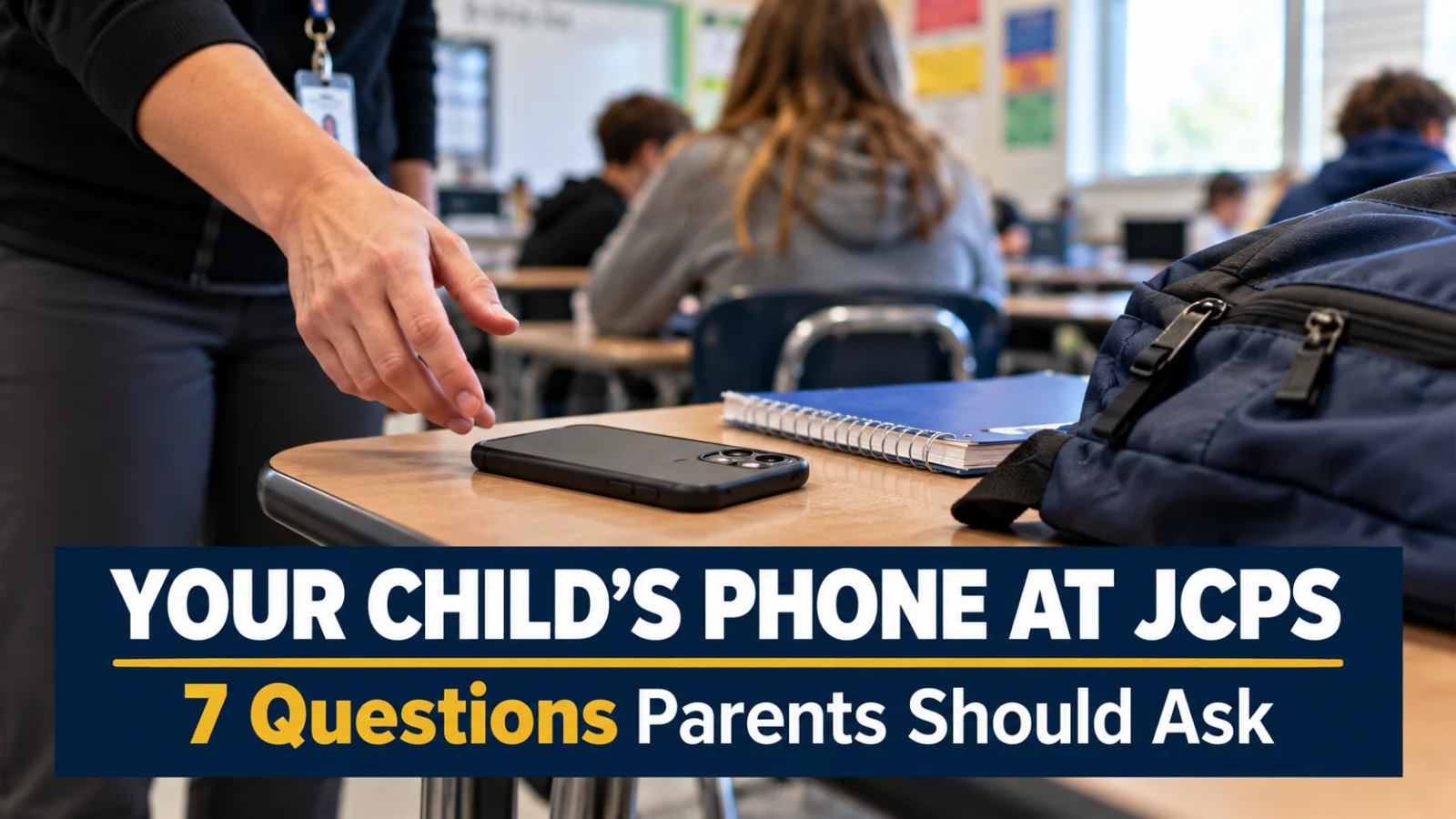
The phone rule names an administrator, not a teacher. Printed page 33 of the 2026 to 2027 Student Support and Behavior Intervention Handbook says a telecommunication device, including the SIM card, battery, and all other parts, could be confiscated by an administrator. The same page says administrators have the right to confiscate a phone when a student violates Condition 1, the disruptive use rule for time outside the instructional school day, and that in those situations the phone will be returned at the conclusion of the investigation.
A different sentence on that page says the device shall be returned to the parent, student, or guardian by the end of that school day. Reading the messages, photos, or apps falls under a separate search rule in Appendix D, not under the confiscation sentences.
The Jefferson County Board of Education approved this handbook on May 12, 2026, with the consent calendar. Item W was the 2026 to 2027 handbook. The board's minutes record that vote as Order 2026 77. JCPS posts the handbook from its Student Support and Behavior Intervention Handbook page. The quotations here are from the 2026 to 2027 PDF, whose document properties list July 28, 2026, as the creation date.
Can a teacher take the phone?
Printed page 33 says the device "could be confiscated by an administrator" and that "Administrators have the right to confiscate a phone when a student violates Condition 1, above."
Appendix D, printed page 45, is a different sentence. "Items that may be used to disrupt or interfere with the educational process may be temporarily removed from the student's possession by a staff member." They "may be returned to the student by the staff member or through the principal's office." A teacher is a staff member. The handbook does not say every visible phone meets that test, and it does not forbid a teacher to hold a phone until an administrator arrives. That sentence also has no clock, and it does not say the staff member may open the phone.
What use does printed page 33 forbid?
During the school day, the handbook forbids use, activation, and display, with a short list of exceptions.
"Students shall not use/activate and/or display a personal telecommunication device on school property during the entirety of the school day, except during an emergency." A student may be authorized to use a cell phone under the Individuals with Disabilities Education Act, the Americans with Disabilities Act, the Rehabilitation Act of 1973, or with "Written authorization from a licensed medical provider for the use of a cell phone to monitor or respond to a medical condition."
The page lists "cellular telephones, smart watches, personal tablets, pagers, walkie-talkies, headphones, MP3 players, and video gaming systems" and cites KRS 158.165. That list is the handbook expanding on the statute, which names only "a paging device and a cellular telephone" as examples under a broader definition. Outside the instructional school day, students "shall be permitted to possess and use" the devices if they follow four conditions. Condition 1 bars disruptive use, including cheating, a violation of another person's confidentiality or privacy, profane or obscene use, illegal activity, and sexually explicit messages, photographs, or images.
"Individual schools may set policies that define the progressive consequences for each offense." Ask for your school's written phone rules.
Does Kentucky law match that page?
The statute sets a floor. Page 33 is stricter, and it leaves out a teacher exception the statute includes.
KRS 158.165 took effect June 27, 2025. It says a district policy shall, at a minimum, prohibit use of a personal telecommunications device during instructional time, "except during an emergency, if directed to do so by a teacher for an instructional purpose, or if authorized by a teacher." Discipline is whatever board policy provides. Devices a student is authorized to use under the three disability laws above are outside that definition. The statute does not mention the handbook's separate line for written medical authorization.
Page 33 does not include the teacher direction or teacher authorization exception. It covers the entirety of the school day, not only instructional time. It also expands on the statute's definition, which covers any device that summons or delivers a communication, "including but not limited to a paging device and a cellular telephone." The statute text opened October 13, 2026, does not name smart watches, tablets, headphones, or gaming systems; the handbook adds them. JCPS has not reconciled the teacher exception with page 33.
When does the handbook say the phone comes back?
It prints two return lines and does not say which one controls.
One sentence says a confiscated device "shall be returned to the parent/student/guardian by the end of that school day." The next says administrators may confiscate a phone for a Condition 1 violation, and "the phone will be returned at the conclusion of the investigation."
Condition 1 is the disruptive use list for time outside the instructional school day. The handbook does not say that investigation hold covers a phone that was only displayed during class. It also does not say the end of day sentence is the only rule for a during day confiscation. None of these sentences requires a parent call within a set number of minutes.
Can the school read what is on the phone?
Not under the confiscation sentences. Opening the phone is a search.
Printed page 35 points to Appendix D on page 44. No student's outer clothing, pockets, or personal effects shall be searched unless there are reasonable grounds to believe the search will reveal evidence of a handbook violation or a law violation. A search of the student's person needs the express authority of the principal or designee. A search of the person or personal effects shall be conducted by the principal or the designated administrator at the student's school.
The Student Bill of Rights on printed page 50 is marked as a summary of that procedure. It uses "reasonable suspicion" that the student has something that violates school rules or endangers others. It says a personal search includes accessories and names a cell phone with a purse, wallet, backpack, notebooks, and gym bag. Appendix D says "reasonable grounds." The bill of rights says "reasonable suspicion." The handbook never says those are the same test.
The handbook does not say a student must unlock a phone. It does not set a parent notification clock for a contents search. It does not print a warrant requirement. Insider's September 14, 2026 guide covers the rest of the search procedure, including backpacks: Can JCPS Search Your Child, Their Backpack or Their Phone?
Which behavior code fits a phone on a desk?
Having it out and making a recording are different codes.
"Violation of personal electronic/telecommunication device policy" is the page 33 rule. On the charts for preschool through grade 3, grades 4 to 5, and grades 6 to 12, printed pages 24, 25, and 26, it is marked at Level 1 and Level 2.
Printed page 22 says Level 1 behaviors are minor classroom disruptions, and it names device violations as an example. Level 2 behaviors always involve school administration.
"Inappropriate use of a mobile device," printed page 30, is "Use of a mobile or hand-held device to make, transmit, or distribute any inappropriate recording, picture, or image without the consent of the person(s) recorded, or that violates their personal expectations of privacy, the SSBIH, or the law." That code is Level 1 and Level 2 on the preschool through grade 3 chart. On the grades 4 to 5 and grades 6 to 12 charts it is also marked at Level 3.
Ask which code was written down.
What should a parent put in writing?
Ask for the answers in writing the same day, and keep the reply with the date.
Who has the phone, and was it taken by a teacher or by an administrator?
Was it only held, or were messages, photos, or apps opened? If they were opened, what was looked at?
Which return sentence applies, the end of that school day or the end of a Condition 1 investigation?
Which Behavior Code and level is this?
If the phone was searched, what reasonable grounds or reasonable suspicion were written down first, and who did the search?
Does your child have an IEP, a 504 plan, or the written medical authorization page 33 names?
Will anything be entered as discipline, and can you have the referral or the written charge?
If you believe the handbook or the Student Bill of Rights was applied unfairly, printed page 50 says to discuss it with the people involved, then request an informal hearing with the principal or designee. A decision can be expected within five school days, and a written decision may be requested. A suspension appeal has to be in writing.