
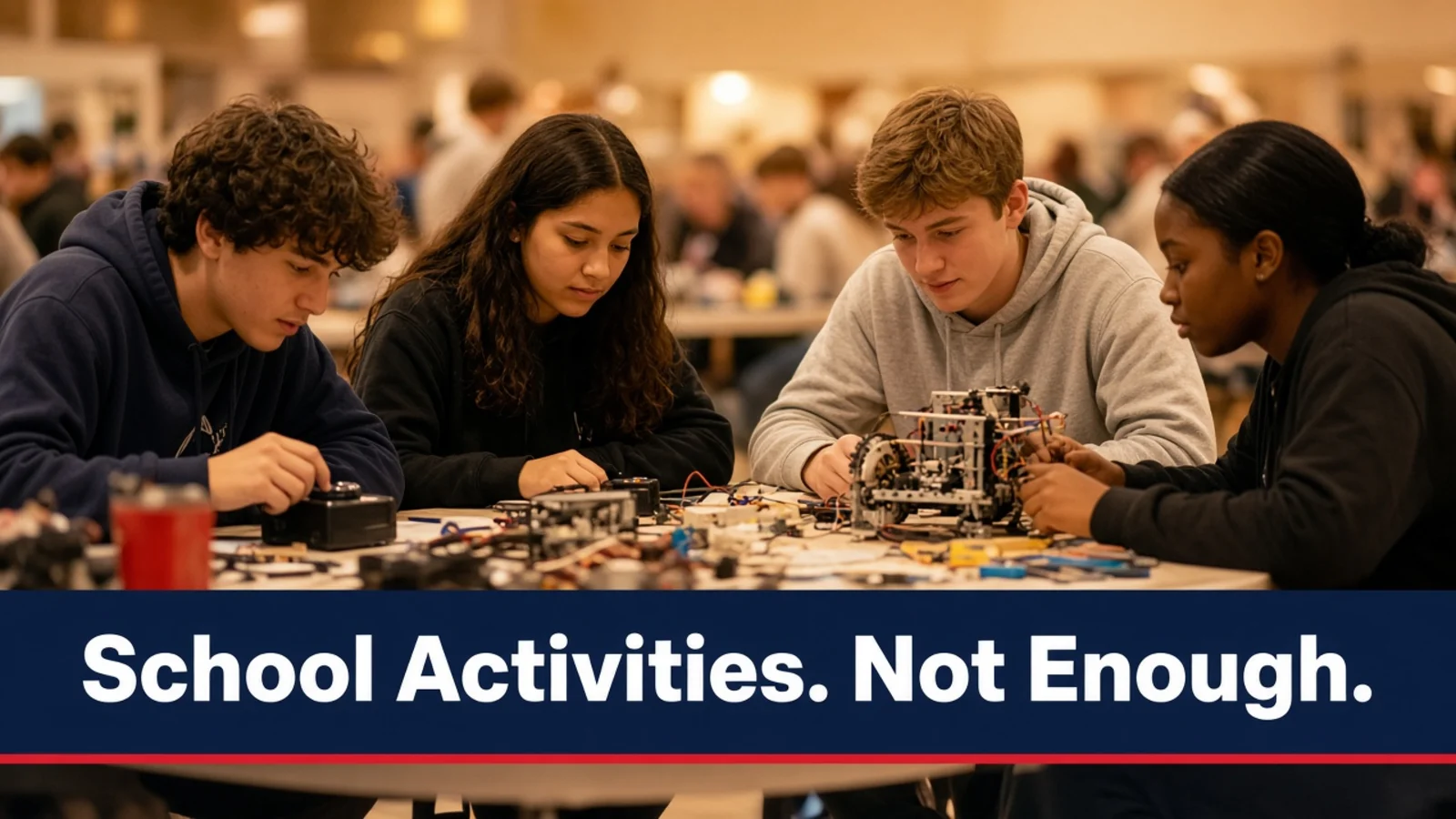
Membership alone barely helps a college application. Placement, years of commitment, and a named role do far more for Jefferson County Public Schools students.
That is the plain answer Louisville parents keep hunting for when a ninth grader joins Academic Team, STLP, robotics, Beta, chess, KUNA, KYA, MATHCOUNTS, or Science Olympiad and someone at the kitchen table asks whether it “counts.” Colleges still start with the transcript. College Board’s BigFuture guidance says admissions readers look for strong core courses, harder work over time, and the most rigorous classes a school actually offers. Read that way, lasting commitment usually matters more than a long club list. They are not a substitute for grades and course strength, and no club by itself gets a student into college.
This guide is for families building an honest activity record, including magnet applicants who will later face the same college file. For Manual’s activities survey and portal asks, see Insider’s Manual magnet comparison. For other JCPS magnet high school fits, see the beyond Manual guide.
Kentucky program names travel badly outside the state unless you translate them once and attach a result. “Academic Team member” means almost nothing to an out of state reader. “Quick Recall starter, Governor’s Cup regional” can stand alone.
JCPS does not publish one live districtwide roster of Academic Team, STLP, Beta, Science Olympiad, chess, or civics chapters. The same pattern Insider found in the robotics roster check holds here: offerings move with staffing and student interest, and the flyer is not proof the group is meeting this year. Ask the building.
What actually moves the needle on an activities list?
Three things usually move the needle: a clear role, a competitive or leadership result you can name, and time.
“Member, Academic Team” tells a reader almost nothing. “Quick Recall starter, Governor’s Cup regional, grades 10 to 12” tells a story. The same pattern holds for captain, officer, resolution sponsor, state qualifier, project lead, or multi year varsity style commitment. Depth beats a long list of clubs that never got oxygen.
Is Governor’s Cup the same as Governor’s Scholars?
No. Governor’s Cup and the Governor’s Scholars Program are different programs with similar sounding names.
Governor’s Cup is Kentucky’s statewide academic competition run by the Kentucky Association for Academic Competition. KAAC says Governor’s Cup includes Quick Recall, Strategic Problem Solving, written content assessments, and composition. High school students can advance through district, regional, and state levels. For the 2026 to 2027 season, KAAC lists high school district Quick Recall and assessment on Saturday, January 23, high school regional assessment and Quick Recall on Saturday, February 20, and State Finals March 19 to 22 at the Galt House in Louisville. Those January through March competition dates fall in 2027 after the November 1, 2026 school registration deadline and the December 12 student entry opening posted on the same KAAC page. KAAC contact: 502 223 0088, kaac@kaac.com.
The Governor’s Scholars Program is a separate five week summer residential program for outstanding Kentucky rising seniors. GSP says students must be nominated through their high schools, then compete statewide. Selection uses academics, activities, service, recommendations, and an original writing entry. Just over 1,000 scholars attend across three campuses. The 2026 to 2028 host campuses named by GSP are Centre College, Morehead State University, and Murray State University. Students selected attend without charge.
Governor’s Cup is a school year academic contest ladder. Governor’s Scholars is a selective summer leadership and academic residency. Do not merge them on a resume line.
What does Academic Team mean to an out of state reader?
Academic Team is the school based program many Kentucky families use as the umbrella for KAAC competition, especially Quick Recall and Governor’s Cup events.
Quick Recall is the quiz bowl style team event inside Governor’s Cup. Two teams answer tossup and bonus style academic questions. Written assessments cover subjects such as math, science, social studies, language arts, and arts and humanities. Composition and Strategic Problem Solving are separate scoring pieces. KAAC says each student may enter up to four of eight Governor’s Cup events, and a Quick Recall team needs at least four students.
For an out of state admissions reader, translate once: Academic Team / Quick Recall is Kentucky’s school academic competition program, and Governor’s Cup is the KAAC district to state tournament series built around Quick Recall, written tests, composition, and problem solving. The line starts to count with high school placement, not a name on a practice roster. Years on the team, a starter role, and district or higher placement are what make it honest.
What does robotics signal on a college application?
Robotics signals design, coding, building, troubleshooting, and team production under deadlines. The brand on the shirt matters less than the work the student can describe.
In JCPS, “robotics” can mean a club, a class lab, LEGO competition, VEX, or FIRST. Those are not the same program. Insider’s robotics roster check found that JCPS does not publish one live districtwide team list, that offerings change with staffing and interest, and that parents should ask which system the school uses, which grades can join, and whether the group actually competes. At the high school level, that same check found Butler Traditional High School listing a robotics club with state and national competition on its current club page. Central High Magnet Career Academy’s Louisville Centrons homepage still describes three VEX teams and one FIRST team, while the program’s VEX page says VEX was paused so the school could focus on FIRST. That is exactly why a public description is not proof of this year’s circuit. Ask the building. Do not invent a team that is not meeting.
Robotics can signal design, build, and iterate work when the student can describe a real role on the robot. For engineering minded readers outside Kentucky, a named role plus competition level carries more weight than the brand on the shirt.
What is STLP, and when does it help?
STLP is Kentucky’s Student Technology Leadership Program, run through the Kentucky Department of Education. KDE describes STLP as project based student technology work open to K through 12 students. Students design digital products, lead tech service in schools, and showcase work at local, regional, and state events. An admissions reader needs the acronym translated and a named project on the line. Membership alone does not carry the file. Confirm with the school’s STLP coach whether it runs as a class, club, or whole school model this year.
Does Beta Club help if my child is only a member?
Barely, if membership is the whole story. National Beta promotes achievement, character, leadership, and service for students in elementary through high school divisions, and Senior Beta covers grades 9 to 12. Local schools set academic standards, invite students, collect dues, and run service work. An out of state reader will skim past “Beta member.” Office plus service hours you can describe is what makes the line honest. Ask your child’s school sponsor for local GPA or behavior rules. Do not assume every JCPS high school runs Beta the same way.
How does chess read on a college file?
Chess reads as focused competitive skill when tournament results exist. A lunch club with no rated play is thinner. The Kentucky Chess Association runs the main scholastic calendar in Kentucky, roughly September through April, including regional Quad championships, State Grades and State Individual events, and a State Team Championship. Translate the line with a rating, place, or captain role if the student earned one. If the school has no club, KCA notes that a parent can still get students to individual events. Confirm current tournament dates on the KCA calendar rather than last year’s flyer.
What are KUNA and KYA, and do they help?
KYA and KUNA are Kentucky YMCA Youth Association civic programs for middle and high school students. They are not the same conference.
Kentucky Youth Assembly is a three day model state government conference. Students research and debate bills, and some serve in judicial, media, lobbyist, or executive roles. For 2026, KY YMCA lists multiple high school and middle school sessions in November and December at the Crowne Plaza Louisville Airport Expo Center, 830 Phillips Lane, Louisville.
Kentucky United Nations Assembly is a three day model international diplomacy conference. Students serve as ambassadors and may enter specialized areas such as Security Council, International Court of Justice, Secretariat, or Media Corps. KUNA 2027 high school sessions listed on the program page run from late February through mid March at the same Louisville conference site. KY YMCA office: 502 227 7028.
Spell out Kentucky YMCA Youth Assembly or Kentucky United Nations Assembly once, then name the role. Attendance alone is thin. Office, a bill or resolution, or an award is what makes the line honest. Fees, scholarships, and intent deadlines are school managed through the KY YMCA portal. Ask the school advisor early.
Does MATHCOUNTS still matter by high school?
MATHCOUNTS matters most as a middle grades competition record. The MATHCOUNTS Competition Series is for students in grades 6 to 8. Levels run school, chapter, state, and national. For 2026 to 2027, MATHCOUNTS lists chapter contests in February 2027, state contests in March 2027, and the national competition May 9 to 10, 2027. Keep a real chapter or state place on the history if earned, then add current high school math work. Do not pretend MATHCOUNTS is a high school program.
What about Science Olympiad?
Science Olympiad is a national team STEM competition with events that mix tests, labs, and engineering builds. National rules put high school in Division C (grades 9 to 12), with teams of up to 15 members and a limit of seven 12th graders. Division B covers grades 6 to 9.
Kentucky Science Olympiad, hosted with the University of Kentucky, lists 2026 to 2027 registration through Scilympiad with a January 15, 2027 registration and payment deadline. The 2027 state tournament is set for Saturday, April 10, 2027, on the University of Kentucky campus. Regional qualifying is part of the Kentucky path for Division C. Name the events and medal level on the line. Availability varies by JCPS school. Confirm the coach and registration window before assuming a team exists this year.
How should a student write the activity line?
Write the line so a tired admissions reader understands the program, the role, the level, and the years without Kentucky insider knowledge.
Good: “Starter, Governor’s Cup Quick Recall, regional, grades 10 to 12.”
Bad: “Member, Academic Team.”
Good: “STLP project lead, regional showcase, built school app help desk guides, grades 9 to 11.”
Bad: “STLP member.”
Good: “KYA bill sponsor and committee chair, Kentucky YMCA Youth Assembly, grades 10 to 12.”
Bad: “Attended KYA.”
Good: “VEX robotics programmer, state qualifier, grades 9 to 12.”
Bad: “Robotics club.”
Use the application’s role and organization fields for the title. Save the short description for impact, level, and years. If the portal gives about 150 characters, cut filler words and keep the proof. Stay honest. Inflated titles collapse in interviews and counselor forms.
What should Louisville parents do next?
Sit down with your child and the real weekly calendar, not the fantasy one.
List every current activity. For each one, write the true role, the years, and one proof point such as regional, officer, project shipped, or tournament result. Drop empty membership lines. Add the Kentucky translation where an out of state reader would otherwise guess wrong. Then ask the school sponsor or counselor one direct question: Is this the honest strongest version of what the student actually did?
Used as padding, they read like padding.