
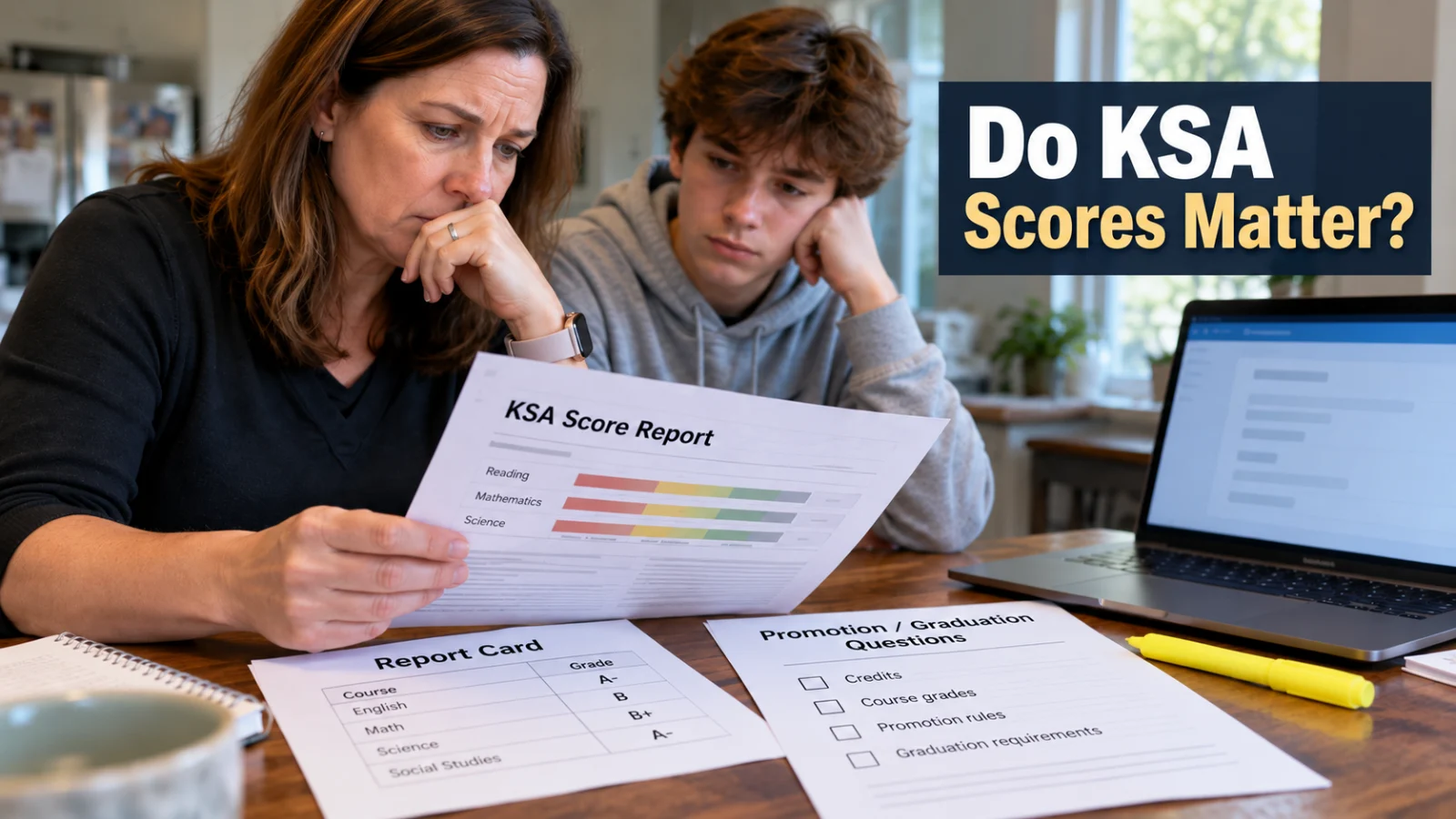
A Kentucky Summative Assessment score is not a course grade, and state rules bar Jefferson County Public Schools from making a minimum score on that test a requirement for a high school diploma. JCPS places students in grades nine through twelve by credits earned. The score still feeds the school's public accountability rating. It is not the report card.
The Kentucky Department of Education (KDE) calls these tests the Kentucky Summative Assessment (KSA). On its KSA page, updated July 15, 2026, KDE says the tests were called Kentucky Performance Rating for Educational Progress, shortened to K PREP.
What is the KSA, and who takes it?
KSA is the annual state test for Kentucky public school students in grades 3 through 8, 10, and 11.
The parent letter template on KDE's data release page, published September 17, 2026, lists the subjects. Reading and mathematics are grades 3 through 8 and grade 10. Science is grades 4, 7, and 11. Social studies, on demand writing, and editing and mechanics are grades 5, 8, and 11.
Grade 11 does not take the KSA reading or mathematics test. KRS 158.6453 requires a separate college admissions exam in the spring of grade 11. KDE's November 10, 2025 assessment email describes that 2026 exam as the SAT junior state administration.
The 2026 Important Dates sheet says students tested from April 13 through June 5, 2026.
Some students with significant cognitive disabilities take the Alternate Kentucky Summative Assessment instead, if the Admissions and Release Committee selects it. KDE's graduation requirements FAQ says a regular diploma still requires the regular graduation rules. The same FAQ says the minimum high school graduation requirements would not apply to a student working toward an alternative high school diploma and participating in the Alternate Assessment.
Does a KSA score change the grade in the class?
No. The posted grading rules do not turn a KSA performance level into the letter grade for a course.
The High School Student Progression, Promotion, and Graduation Handbook in Jefferson County Board of Education materials says teachers use two categories, Progression and Mastery. Progression is 10 percent to 30 percent of the grade. Mastery is 70 percent to 90 percent. No one assignment can count for more than one third of either category. KSA is not named.
The cover of that handbook prints both 2025 to 2026 and 2024 to 2025. Those grading sentences are in the copy as posted.
KDE's KSA page and the parent letter template both say no single assessment should ever be the sole factor in an educational decision. That tells schools not to use one test alone. It does not say a teacher is forbidden to look at the score.
On the report, a student gets a scale score and a performance level. The four levels are Distinguished, Proficient, Apprentice, and Novice. The parent letter template says the scale score runs from 400 to 600 in reading, mathematics, social studies, editing and mechanics, and on demand writing. Science runs from 700 to 900. Combined writing gets a performance level and no scale score.
Can a low KSA score hold a child back?
The posted JCPS handbooks do not set a KSA score that forces retention. They also do not say the score is ignored.
In high school, the handbook says placement depends on credits earned by the beginning of the school year. A freshman has 0 to 4.99 credits. A sophomore has 5 to 10.99. A junior has 11 to 15.99. A senior has 16 or more. Once a student is promoted by credits earned, the handbook says the student cannot be moved back a grade level.
The elementary handbook in board materials does not print a school year on its cover. It says JCPS generally does not recommend retention. If a school considers holding an intermediate student, a conference with the principal or counselor, the teachers, and the parents reviews progress, supports, assessment records, and work samples. The written decision goes by mail no later than the thirtieth week of school. A parent has ten days from that notice to start an appeal. For promotion, the handbook says administrators may look at report card grades, classroom assessments, other standardized assessments, observations, and support data.
"Other standardized assessments" can include a state test. That elementary handbook never says Novice, or any other KSA level, is the line for staying back.
The 2026 to 2027 Middle School Student Progression and Promotion Handbook says students are expected to pass at least two thirds of eighth grade courses, including language arts, mathematics, and social studies, and to score Apprentice or higher on the seventh grade reading state assessment and the seventh grade mathematics state assessment. The same paragraph allows school designed interventions or district designated competency modules, documented on the Intervention tab in Infinite Campus, instead of those scores. A student who scores below Apprentice on one or more of those assessments, or who does not show that competency, may still be considered for a transitional promotion from eighth to ninth grade.
Inside grades six and seven, that handbook uses courses, not a state test score. A student must pass at least two thirds of courses taken, including language arts and math in sixth grade and language arts, math, and science in seventh grade. If those courses are missed, the school may conditionally promote the student after competency modules are finished before August 1.
Can a KSA score block a diploma?
Not as a minimum score.
KDE's graduation FAQ cites 704 KAR 3:305, Section 7(2). That section says a local board shall not adopt any high school graduation requirements that include achieving a minimum score on a statewide assessment, as established in KRS 158.140. The FAQ says the college admissions exam is one of those statewide assessments, so a district cannot make a minimum score on that exam a graduation requirement either. The regulation's history line shows an effective date of July 6, 2026.
A Kentucky public diploma requires at least 22 credits under that regulation: 10 foundational credits and 12 personalized credits, plus technology competency, the civics requirement in KRS 158.141, and the financial literacy requirement in KRS 158.1411. Board Policy 08.113, printed in the JCPS handbook, repeats the 22 credit minimum.
Two other tests sit on the graduation list. Neither one is the KSA.
KRS 158.141 says students entering grade nine in 2025 to 2026 and after must complete either a half credit civic literacy course or a 100 question civics test. The local board picks which one. If the board picks the test, the student needs 70 percent. Board Policy 08.113, as printed in the handbook, keeps the test: 60 percent, and 70 percent for students who entered grade nine on or after July 1, 2025. The policy text does not mention the half credit course the statute allows.
The college exam is separate. The FAQ says a student below the Council on Postsecondary Education benchmark in English, reading, or mathematics must be offered accelerated learning before graduation, and that a transitional course does not count as an English credit or a math credit. Board Policy 08.113 says students who miss those benchmarks in English and language arts or mathematics shall take a transitional course or intervention before exiting high school. The FAQ offers the help. The JCPS policy requires the course or intervention. Neither sentence uses a KSA level.
The optional Early Graduation Program is narrower. The regulation says a student in that program must meet the college readiness benchmarks in 13 KAR 2:020. The JCPS handbook says the program is based on meeting performance criteria on the state required assessments and college readiness exams. The regulation names the college benchmarks. The handbook names state required assessments. A regular diploma does not go through that program.
The handbook also requires a senior defense of learning. Schools may adapt it for a student who enrolls during senior year and may exempt a student who enrolls in the spring. That presentation is not a KSA score.
What does the score change?
It changes how the school is rated.
KDE's How to Prepare for Public Release document says Kentucky is releasing 2025 to 2026 assessment and accountability data. Reading and mathematics results, and science, social studies, and writing results, are two indicators. The points come from performance levels on KSA and the alternate test. High schools are also rated on postsecondary readiness and graduation rate. Overall ratings use five colors, from highest to lowest: blue, green, yellow, orange, and red.
The same document uses a separate federal label, Comprehensive Support and Improvement, for the lowest performing schools in that count. That label is about the school, not one student's diploma.
Next year's test drops writing. The KSA page says House Bill 257 means the 2026 to 2027 KSA will no longer test writing or editing and mechanics. KDE's HB 257 at a glance says grades 3 through 8, 10, and 11 stay on the test.
When do parents see the 2026 scores?
The copy with your child's name and the public School Report Card are two different deliveries.
KDE's Monday DAC email of September 21, 2026 says Individual Student Reports from the spring 2026 Kentucky Summative Assessment and the alternate assessment became available in PearsonAccess next that day, under Spring 2026 Summative Published Reports. Pearson would begin mailing paper reports on Wednesday, September 30, and districts should have them by Wednesday, October 6. Districts get two copies of each report, one for the district and one to share with a parent or guardian. The email says those reports are not under embargo, and it encourages districts to share them as soon as possible. That login is for school staff. It is not a parent account.
Public school numbers are a separate release. KDE's special DAC email of September 30, 2026 says the public release of accountability data is Thursday, October 15, 2026, at 12:01 a.m. Eastern. Districts get that data under embargo on Tuesday, October 13, at 8 a.m. Eastern. The email says the public release excludes individual student information. The School Report Card resources page, published September 28, 2026, had still called October 15 tentative. The September 30 email is the confirmation.
The current parent letter is a template. The school inserts the date, the letterhead, and the signature. It explains the spring 2026 scores and points families to KDE Open House for school results. It does not say the letter has been sent.
What if the score looks wrong?
Ask the school that holds the report. KDE has not posted a parent form for challenging one child's KSA score.
The September 21 email is the description of the paper: two copies to the district, one meant to go home, with the paper scheduled to reach districts by October 6. Ask whether the name, grade, school, and subjects match the child who tested. If your copy never came, ask for the school file copy.
Write down each subject, the scale score, and the performance level. Write down the date you asked and the name of the person who answered.
School staff use PearsonAccess next for individual scores, and a Student Data Review and Rosters application after public reporting, according to the How to Prepare document. Neither is described as a parent login.
The KSA page lists the Office of Assessment and Accountability at 300 Sower Boulevard, 5th Floor, Frankfort, KY 40601, phone 502 564 4394, and dacinfo@education.ky.gov. That listing is for district assessment coordinators, not a parent appeal desk.
What should you check for promotion and graduation?
Check credits and course grades, not the KSA level.
High school placement is the credit count in the handbook. Course grades, assignments, and attendance are in Campus Parent, the Infinite Campus login for families. A missing KSA line there does not mean the course grade is unfinished.
If a school talks about holding an elementary student, ask which records are in the file. The posted elementary handbook requires the conference and the mailed notice. It does not require a KSA cutoff.
For the move from eighth to ninth grade, ask whether the file shows Apprentice on the seventh grade reading and math state assessments, or documented interventions or competency modules. That rule is in the Middle School Student Progression and Promotion Handbook.
For a diploma, start with the 22 credits, the civics rule for your child's ninth grade year, financial literacy, technology competency, and the senior defense in the handbook. If someone says a Novice score blocks the diploma, ask which written rule says that. The rule is Section 7(2), cited above.
The contact block on the JCPS handbooks page lists 502 313 4357 and jcps.help@jefferson.kyschools.us. For the report with your child's name on it, call the school first.