
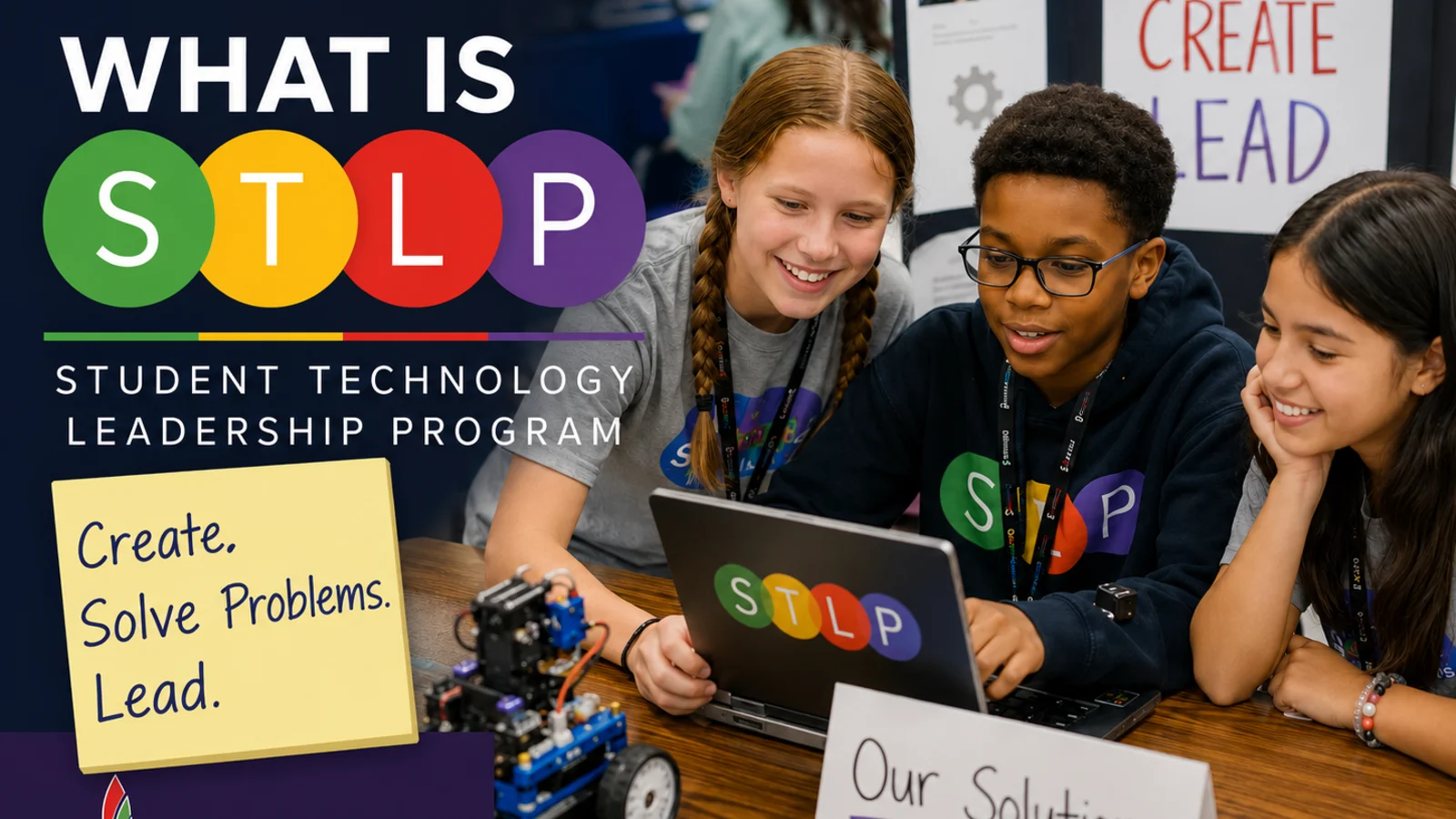
If your child likes technology, art, video, music, Minecraft, robotics, design, coding, journalism, problem solving, or simply creating things, there is a Kentucky school program you should probably know about.
It is called the Student Technology Leadership Program, better known as STLP.
The name can make STLP sound like a computer club for students who already know how to code. That description misses much of what the program actually offers.
The Kentucky Department of Education says STLP is open to students from kindergarten through grade 12 and is designed around students using technology to create, solve problems, communicate, and lead. Students can develop projects, produce digital work, compete in challenges, provide technology services, and eventually present their work at statewide events.
For JCPS families, the bigger takeaway is this:
Your child does not have to be a computer expert to belong in STLP.
And some of the things Louisville students are already doing through the program may surprise you.
What Is STLP?
STLP is a statewide Kentucky Department of Education program that gives students opportunities to use technology to create something, solve a problem, or serve their school or community.
Kentucky describes three major parts of the program: student projects, Creative Digital Arts, and the STLP State Championship. Students can also participate in challenges, leadership opportunities, service activities, and other technology experiences.
That can mean very different things depending on the student.
One child might develop an app.
Another might produce a podcast.
Another could create digital artwork, music, animation, photography, or video.
Others may work in robotics, website design, coding, technology support, journalism, or a project designed to solve a problem inside their school.
Kentucky's current STLP guidance specifically encourages schools to think beyond the idea of STLP as simply an extracurricular computer club. The state says STLP can be incorporated into classrooms and other parts of school life, and schools are free to organize participation in ways that work for their students.
That flexibility is useful, but it also means the STLP experience can look different from one JCPS school to another.
Your Child Does Not Have to Be Good at Coding
This may be the most important thing for parents to understand.
Kentucky tells schools that STLP should be available to all interested students, not just children who are already naturally talented with technology.
The state's guidance tells schools to give a wide range of students opportunities to participate and to find ways to expand participation when demand grows.
The actual competition options show why.
Creative Digital Arts can include photography, video, graphic design, digital art, audio, animation, storytelling, and other forms of digital creation. Kentucky's 2026 to 2027 kickoff materials are already encouraging students to begin exploring those categories and creating work now.
So think beyond the child who loves computers.
A student who loves drawing might enjoy digital illustration.
A strong writer might gravitate toward digital storytelling or journalism.
A child who loves music could explore digital audio.
A student who enjoys talking in front of people may enjoy presenting a project or producing a newscast.
A Minecraft fan may find an entry point there.
And a child who constantly points out things that could work better may be exactly the kind of student who could turn a real problem into an STLP project.
What Do JCPS Students Actually Do in STLP?
This is where STLP gets more interesting than the program name suggests.
Look at Bowen Elementary.
The school's STLP program has included students working on Spanish language outreach for families, an artificial intelligence awareness campaign, sensory items for children, a digital guide for families who are new to Bowen, and other projects intended to address needs inside and outside the school.
The Spanish outreach project eventually became more than a school activity.
Bowen won the elementary division of the 2024 Kentucky STLP State Championship with a project designed to help Spanish speaking families feel more connected to the school community. JCPS reported that 11 students participated in the project, including six multilingual students.
The 2026 state championship produced two more good JCPS examples.
Bloom Elementary won Kentucky's elementary project division with Bloom News Kidz, a student journalism project that expanded beyond Bloom and involved several JCPS elementary schools.
Alex R. Kennedy Elementary finished second with Translation Station, an app students developed using MIT App Inventor. The project created a communication kiosk intended to help teachers, students, and families overcome language barriers.
Those examples get to the heart of what strong STLP projects are supposed to do.
Students are not necessarily handed a technology assignment with instructions telling them exactly what to build.
Kentucky's project model encourages students to identify a genuine problem or need, investigate possible solutions, test ideas, make improvements, and eventually explain what they created and why.
For the right child, that can feel very different from completing another classroom assignment.
How Far Can a Student Go in STLP?
A project that begins inside a JCPS classroom or club can eventually reach a statewide audience.
Kentucky uses a project progression that allows teams to develop their ideas, receive feedback, and advance toward the STLP State Championship. The state event is held each spring at the Central Bank Center and Rupp Arena complex in Lexington.
And this is not a tiny gathering.
More than 20,000 people attended the 2026 STLP State Championship, according to the Kentucky Department of Education's Kentucky Teacher publication. Students from across Kentucky presented projects and competed in technology related events.
JCPS students have been highly competitive there.
After Bloom Elementary won its division in 2026, JCPS reported that the district had produced an STLP state champion for four consecutive years.
That does not mean every child who participates is headed to Rupp Arena with a trophy.
Nor should that be the only reason to join.
But parents should know that STLP can provide a progression from a school activity to regional and statewide recognition for students who want to take their work further.
STLP Is Bigger Than the Main Project Competition
Parents may hear about STLP projects and assume every participant spends the year developing one major team project.
There are more options.
Kentucky's Creative Digital Arts program gives students a place to submit original digital work. The current program includes areas such as photography, video, graphic design, digital art, audio, and animation.
The state championship also includes competitive challenges and opportunities involving areas such as robotics, coding, media, design, and other technology skills.
Older students can go even further into leadership.
Kentucky's STLP Engineer and Ambassador program is open to student leaders in grades 9 through 12. Selected students help support major STLP events and gain experience with technology and leadership. For the 2026 to 2027 school year, applications are due November 1, 2026, and each school may have up to two applicants.
That is another reason parents should avoid thinking of STLP as one narrowly defined club.
It is closer to an umbrella covering a variety of student technology, creativity, service, and leadership opportunities.
Are There Tryouts for STLP?
Kentucky does not impose a statewide tryout requirement for students who want to participate.
In fact, state guidance says schools should welcome interested students rather than limiting STLP to children who already demonstrate advanced technology skills.
But there is an important local catch.
Individual schools decide how their STLP opportunities are organized.
A school may have practical limits involving staff, meeting space, project teams, transportation, equipment, or the number of students who can enter a particular competition.
Some JCPS schools may run STLP as a recognizable club.
Others may incorporate it into classes or technology programs.
At Noe Middle, for example, JCPS currently lists STLP among its related arts offerings. Other JCPS middle schools list STLP among their clubs and activities.
So the question for parents is not simply, "Does Kentucky allow my child to participate?"
The better question is, "How does my child's school offer STLP?"
Does Every JCPS School Offer STLP?
Parents should not assume every JCPS school offers the same STLP program or even presents STLP in the same way.
Kentucky explicitly says there is no single model schools must follow. State guidance says STLP can be integrated into the curriculum rather than offered only as a separate club.
JCPS school pages reflect that variety.
Schools including Crosby Middle, Echo Trail Middle, Noe Middle, Olmsted Academy North, Bowen Elementary, and others currently identify STLP among their programs, courses, clubs, or student leadership opportunities.
But JCPS does not appear to maintain a simple parent facing directory showing every school with an active 2026 to 2027 STLP program, the grades served, meeting schedules, and local signup instructions.
That means families should verify opportunities directly with their child's school.
If you do not see an STLP club advertised, do not automatically assume your child cannot participate.
Ask whether STLP is offered through a class, library, technology program, media program, project team, or another activity.
Does STLP Cost Money?
The statewide program is not built around a membership fee that families must pay to participate.
Kentucky says its STLP resources are provided free of charge, and state guidance says official STLP events are free.
Parents should still ask their school whether participation could involve any local expenses.
Depending on the activity, those could potentially include transportation, meals, supplies, clothing, or other costs associated with a particular trip or project.
Do not assume there will be a charge, but do not assume every possible expense is automatically covered either.
The school can tell you what applies to your child's activity.
When Should Parents Ask About STLP?
Now.
That is especially true in September.
Kentucky's August 19 kickoff for the 2026 to 2027 STLP season says the project cycle is already beginning and encourages schools to start identifying problems and developing ideas rather than waiting until shortly before competition.
Kentucky has also scheduled STLP Get Recognized Week for September 14 through September 18, when participating schools are encouraged to formally connect their programs with the state for the new school year.
There is not one universal September deadline that every JCPS student must meet in order to participate.
Local schools may establish their own signup dates, meeting schedules, team selection processes, or project deadlines.
That is precisely why asking early matters.
A parent who waits until spring may discover that teams formed months earlier or that students have already spent much of the school year developing competition entries.
Why Should Your Child Consider STLP?
STLP should not be treated as another activity that parents simply add to a child's resume.
Its value depends on what the student actually does.
But consider the experience involved when a student identifies a problem, talks with other students, develops an idea, creates something, discovers that the first version does not work, changes it, and eventually explains the finished product to adults or judges.
That combines creativity, communication, persistence, collaboration, technology, and public presentation in one experience.
Kentucky's STLP project framework deliberately emphasizes problem solving, student voice, collaboration, technology skills, and presenting work to an authentic audience.
There is another benefit that is harder to measure.
STLP can give a student permission to discover an interest they did not know existed.
A child might enter because Minecraft sounds fun and discover an interest in design.
Another might help create a school podcast and realize they love journalism.
A student could work on an app and discover coding.
Someone else could become the person who presents the project and find out they are surprisingly comfortable speaking in front of an audience.
That discovery is one of the strongest reasons to consider the program.
Five Questions to Ask Your Child's School
Parents do not need to understand Kentucky's entire STLP system before getting started.
Ask your child's school these five questions:
Does our school participate in STLP this year?
Which grades can participate?
How does my child join or express interest?
Who is the school's STLP coach or coordinator?
Are there school specific signup dates or competition deadlines we should know about?
If the first person you ask does not know, try the school's library media specialist, technology teacher, activity coordinator, or front office and ask who oversees STLP.
Parents can also explore the Kentucky Department of Education's official STLP website, which includes the current Discovery Hub, project resources, Creative Digital Arts information, competition guidance, and important dates.
The Bottom Line
STLP is one of those opportunities whose name does not do a very good job of explaining what children can actually experience.
It is not just coding.
It is not just robotics.
And Kentucky does not intend it to be reserved for the students who already know the most about computers.
STLP can include apps, journalism, podcasts, video, music, digital art, photography, Minecraft, animation, design, robotics, technology service, public presentations, leadership, and projects built around real problems.
JCPS students have already used it to create translation tools, welcome families, produce student news, help classmates, and solve problems in their schools and communities. Some have taken that work all the way to state championships.
So if any part of STLP sounds like something your child might enjoy, there is one simple thing to do:
Ask their school about it now.
You may discover an opportunity neither you nor your child knew was there.