
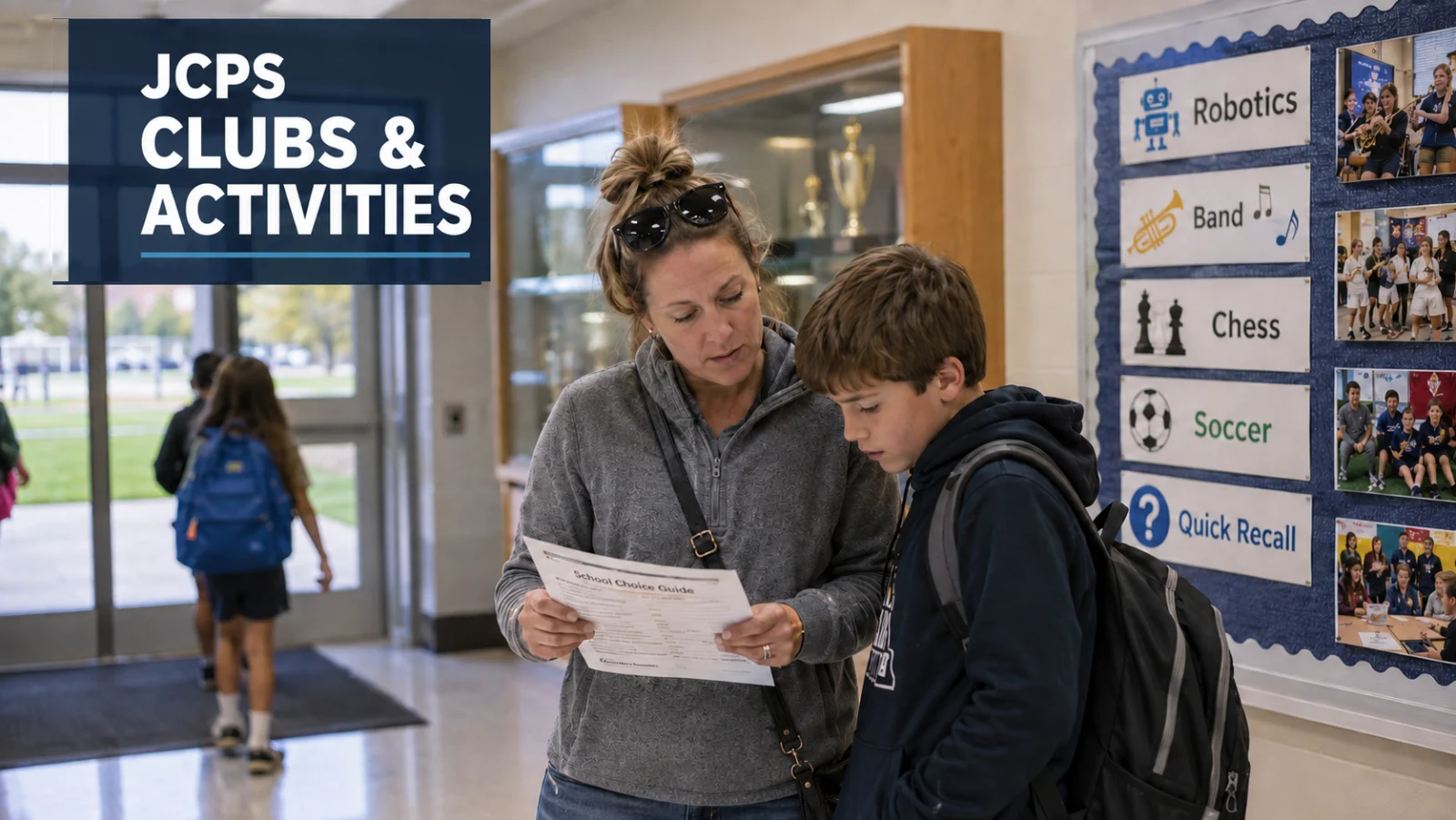
On paper, Eastern High has one of the biggest extracurricular menus in JCPS. Its current district profile advertises more than 75 athletic teams, extracurricular clubs and student organizations. At middle school, Farnsley publishes another unusually large number: more than 65 activities, clubs and athletics.
Those are the clearest large published numbers JCPS Insider found in the district's current 2026 to 2027 school choice materials.
But they do not prove Eastern and Farnsley actually offer the most extracurricular activities in JCPS.
JCPS does not publish a districtwide activity roster, and schools do not count the same things the same way. Some combine sports, clubs, student organizations and academic teams into one number. Some publish only examples. Others list dozens of opportunities without giving a total.
After that, the comparison gets messy.
For this review, JCPS Insider examined all of the school profiles in the district's current 2026 to 2027 middle and high school choice guides, then checked current school activity pages when a school published a numerical total or when a newer school page provided more specific information. We also reviewed elementary profiles for examples, but did not attempt to rank elementary schools because their activity information is even less standardized.
Eastern's 75 is a combined number
Eastern's published figure is hard to miss.
The school's current JCPS profile says it offers more than 75 athletic teams, extracurricular clubs and student organizations.
That makes Eastern the clearest high school standout by published number.
But look carefully at what is being counted.
It is not 75 clubs.
Sports teams are included. Student organizations are included. Extracurricular clubs are included. The public profile does not break the 75 into separate categories.
Ballard separates clubs from sports
Ballard does not advertise one combined extracurricular total in its current JCPS choice guide.
On Ballard's current principal page, Jason Neuss writes that the school has nearly 50 student led clubs along with dozens of varsity sports. The page is written in the first person and signed by Neuss, and the language was still published on the school website when JCPS Insider checked it in August 2026.
If Ballard has nearly 50 clubs before sports are counted, a parent cannot fairly look at Eastern's 75 combined activities and conclude that Eastern has substantially more opportunities.
They are measuring different things.
Atherton gives families another useful comparison. Its current school website advertises more than 40 clubs and student led organizations, with athletics presented separately on the site.
So among high schools that publish actual numbers, Eastern, Ballard and Atherton all appear to have substantial extracurricular programs. The public information does not support putting them in a clean first, second and third order.
Manual and Male show the problem with trying to rank schools
Some of the district's best known high schools do not give families a headline extracurricular number at all.
The current duPont Manual profile describes its five magnet programs: High School University, Journalism and Communications, Mathematics, Science and Technology, Visual Arts, and Youth Performing Arts School. It does not provide a comparable total for clubs, teams and student organizations.
Louisville Male's current profile also does not provide a total extracurricular count.
That does not mean either school has fewer opportunities.
Putting Manual below Eastern, Ballard or Atherton simply because another school publishes a number would create a ranking the available records do not support.
The same problem shows up throughout the guides. Some schools devote considerable space to activities. Others mention a few examples. Some give exact lists. Some use phrases such as a wide range of clubs and athletics.
That is marketing information, not a standardized dataset.
Farnsley has the clearest published middle school number
Farnsley's current JCPS profile says the school offers more than 65 activities, clubs and athletics. It also highlights robotics, engineering, academic teams and leadership opportunities.
Again, 65 is a combined number.
Meyzeek Middle publishes a similar type of figure, saying it has more than 40 extracurricular activities, clubs and competitive athletic teams. Its profile specifically identifies opportunities including KUNA, KYA, MATHCOUNTS, Science Olympiad, Governor's Cup, debate, Future Problem Solving, Quick Recall and robotics.
Echo Trail is a good example of why a current school page can tell parents more than a headline total.
The district's middle school guide names more than two dozen Echo Trail clubs and says the school offers all JCPS athletics. Echo Trail's live club page is even more current. Club signups for this school year run from August 24 through August 31. The page directs families to the current club promo video, meeting information, sponsors and participation requirements. The promo video announces 38 clubs for this year.
That is a much better snapshot of what students can actually join right now.
Crosby Middle illustrates the opposite problem. Its choice guide names 11 clubs and activities and 18 athletic offerings, by JCPS Insider's count, but never turns them into one combined number.
A ranking based only on the large numbers printed in school profiles would penalize Crosby for the way its information is presented.
Elementary schools are even harder to compare
JCPS elementary profiles contain plenty of extracurricular information, but they are not built for comparison.
In its current Clubs and Activities section, Blue Lick lists band, orchestra, STLP, robotics, cross country, soccer, Quick Recall, problem solving, Safety Patrol, basketball, LEGO Club, cooking, Art Clubs, Talent Club, tennis, volleyball and cheerleading, but gives no overall number.
Norton Commons Elementary explicitly says its student activities change annually based on student interests. Its current profile lists robotics, STLP, chess, Academic Team, band, orchestra, basketball, cheerleading, Beta Club and cross country, along with additional programming through its YMCA partnership.
That sentence about activities changing annually is worth remembering. A choice guide can tell a parent what a school generally offers. It cannot guarantee that every club listed will operate with the same sponsor, schedule or participation level every year.
A big club number does not automatically mean a better fit
A school with 60 activities is not necessarily a better choice for a particular child than a school with 25.
The more useful question is whether the activity your child cares about actually exists and is active.
A student interested in robotics may care far more about a strong VEX team than 30 unrelated clubs. A child who loves academic competition might be looking for Quick Recall, Future Problem Solving, MATHCOUNTS, KUNA or KYA. Another student may want theater, orchestra, debate, chess, student government or a particular sport.
And a club listed on a school page may not tell the whole story.
Before treating an extracurricular list as part of a school choice decision, ask the school whether the club met last year, which grades can participate, whether there are tryouts or participation limits, what fees are involved, when practices or meetings end and what transportation is available afterward.
JCPS itself tells families interested in athletics and activities to talk with the athletic director at their child's school about available opportunities.
For clubs and academic teams, the school office can also direct parents to the current sponsor.
There is an equity question hiding in these numbers
The schools that publish big round extracurricular totals are not a random sample.
A school with a polished activity page and an aggressive school choice pitch can look richer on paper than a West End, South End or smaller school that publishes only a handful of examples.
There are at least two possible explanations. Some schools may simply market their opportunities more thoroughly. Some schools may actually have more active clubs, coaches, sponsors and teams.
The public information JCPS provides does not allow parents to separate those possibilities.
That is a problem if extracurricular access is supposed to be part of how families compare schools.
The list JCPS does not publish
JCPS gives families pages and pages of information about individual schools. It maintains choice guides, school websites, sports information, academic competition pages and activity departments.
What it does not appear to publish is one districtwide list showing every active club, organization, academic team and sport at every school.
That missing data is probably the most interesting finding of all.
A useful districtwide roster could show whether each activity is active this year, which grades can participate, whether tryouts are required, whether there is a fee, who sponsors it and whether students have transportation after meetings or practices.
Then parents could actually compare opportunities across Eastern, Male, Manual, Ballard, Farnsley, Meyzeek, Hudson, Moore, Crosby and the rest of JCPS without trying to decode dozens of differently written school profiles.
For a parent trying to compare schools, that would be considerably more useful than another brochure.