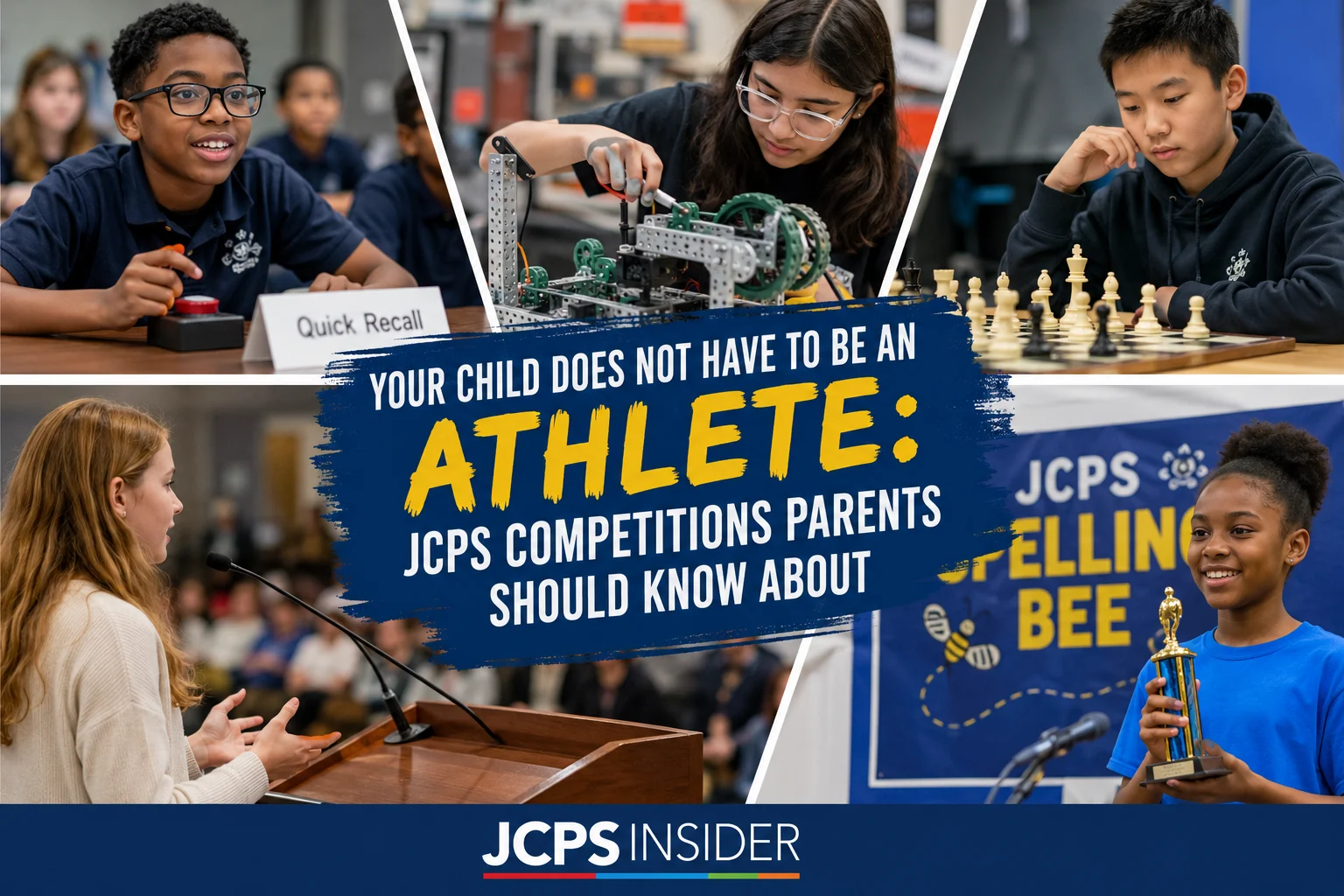
Your child does not have to be an athlete to have a competition season in Jefferson County Public Schools.
JCPS students can compete with buzzers, chess pieces, robots, speeches, spelling words, technology projects and career skills. Some of these opportunities begin in elementary school. Others can eventually take students to state, national or even world competition.
The challenge for parents is finding them.
There is no single JCPS signup page where a family can enter a child in every academic or extracurricular competition. Some programs are coordinated by the district. Others are offered through individual schools. Some require students to try out or earn a limited competition spot. And not every school offers every program.
That makes the beginning of the school year an especially good time to ask what is available.
JCPS officially coordinates Quick Recall leagues for elementary, middle and high schools, along with Future Problem Solving competitions and chess and debate leagues. The district also works with the 15th District Parent Teacher Association on the county spelling bee and serves as a liaison to the Kentucky Association for Academic Competition, which operates Governor's Cup.
But that is only part of the competitive world available to JCPS students.
Here are eight opportunities Louisville parents should know about.
1. Elementary students can get their first taste of academic competition
Parents sometimes assume serious academic competition begins in middle school. It does not.
JCPS elementary students can participate in academic competition, including Quick Recall and Future Problem Solving. Individual elementary schools also participate in Mayor's Cup competition. In March 2026, for example, Klondike Lane Elementary hosted a Mayor's Cup Academic Competition. Lowe Elementary currently lists Mayor's Cup among its student activities.
Quick Recall is probably the format parents will recognize most easily. Teams compete by answering academic questions using a buzzer system.
Future Problem Solving takes a different kind of student. It emphasizes identifying challenges, analyzing a problem and developing possible solutions.
That distinction matters.
A child who loves facts and reacts quickly may be drawn to Quick Recall. A child who enjoys brainstorming, strategy and creative thinking may be better suited to Future Problem Solving.
Parents should also know that joining the club and earning a competition spot are not always the same thing. At Lowe Elementary, for example, the school's current student activities information says Mayor's Cup requires a tryout and lists the season from November through March.
So do not wait for a tournament announcement in February.
Ask your elementary school now whether it has an Academic Team, Quick Recall team, Future Problem Solving team or Mayor's Cup team, and ask how students are selected.
2. Governor's Cup offers much more than Quick Recall
Governor's Cup is one of Kentucky's biggest academic competitions, and it offers more ways to participate than many parents realize.
The Kentucky Association for Academic Competition, commonly called KAAC, runs Governor's Cup for elementary, middle and high school students. Elementary students can advance through district and regional competition. Middle and high school students can advance through district, regional and state competition.
There are eight Governor's Cup events:
Quick Recall
Strategic Problem Solving
Mathematics assessment
Science assessment
Social studies assessment
Language arts assessment
Arts and humanities assessment
Written composition
A student can participate in as many as four events. Schools also do not have to enter every category.
That creates opportunities for students who would never consider themselves quiz bowl players.
A strong writer could compete in composition. A student who devours history could pursue social studies. A science obsessed student could compete individually even if Quick Recall is not a good fit.
And JCPS students have shown they can compete with anyone in Kentucky.
Noe Middle won the 2024 middle school Governor's Cup state championship. JCPS reported that more than 15,000 middle school students statewide took part in the competition that season.
The 2026 to 2027 Governor's Cup calendar is already posted. Schools have a November 1 registration deadline, and student entry opens December 12. Middle and high school State Finals are scheduled for March 19 through March 22, 2027, at the Galt House in Louisville.
Parents do not register their children directly with KAAC for a JCPS school team. The school handles participation.
That means the parent question is simple: Who coaches Governor's Cup at my child's school, and when does the team start selecting students?
3. STLP can turn an interest in technology into a statewide competition
Some children hear the words technology competition and immediately assume it means coding.
The Student Technology Leadership Program is much broader than that.
STLP is a Kentucky Department of Education program open to students from kindergarten through grade 12. Students can create technology projects, digital art and other original work, then showcase those efforts through local, regional and state events. The program includes projects, Creative Digital Arts and competition challenges.
A student might create an app.
Another might produce video.
Another might develop a technology solution to a problem at school.
Another might compete in a challenge involving design, digital creation or technology skills.
That flexibility is one reason STLP is worth asking about even if your child does not consider himself or herself a programmer.
JCPS had an especially strong showing at the 2026 STLP State Championship. Bloom Elementary won the elementary project division with Bloom News Kidz, while Alex R. Kennedy Elementary finished second with Translation Station, an app designed to improve communication among teachers, students and families.
The Kentucky Department of Education says STLP is open to every Kentucky student from kindergarten through grade 12, but the way students participate is generally organized through their schools.
Ask whether your school has an STLP coordinator, when students can join and which types of projects or competitions the school plans to enter this year.
4. Robotics can become much more than an after school club
If your child loves LEGO, machines, engineering or figuring out why something does not work, look closely at robotics.
JCPS does not offer one identical robotics program at every school. The district's current school choice materials show a mix of LEGO Robotics, VEX Robotics and other engineering opportunities depending on the school. Echo Trail Middle, for example, lists both LEGO Robotics and VEX Robotics, while Newburg Middle identifies VEX Robotics and Engineering as a school program.
Competition can also go much farther than a school gym.
Lowe Elementary reports that its students participated in the VEX Robotics World Championship in 2023.
That does not mean every robotics club is headed to a world championship. It does show parents what the upper end of the opportunity can look like.
The word "robotics" can also mean very different things from one school to another. A school might have an open club, a competition team, a classroom program or some combination of the three.
Parents should ask four separate questions.
Does the school have robotics?
What grade levels can participate?
Does the team compete against other schools?
Are there tryouts or a limit on team size?
A child who likes building things may never think to call himself an athlete, but competitive robotics can provide many of the same experiences: practice, teamwork, pressure, travel and the chance to represent a school.
5. Chess can be a school competition, not just a hobby
If your child plays chess at home, on an app or against a grandparent, ask whether the school has a competitive team.
JCPS says its Office of Academic Competition coordinates chess leagues.
But availability varies considerably by school.
The district's current middle school guide lists chess at schools including Conway, Echo Trail, Thomas Jefferson and Noe. Stuart Academy goes further, describing its chess club as nationally competitive.
That variation is exactly why parents should not assume that a chess club is simply a casual gathering.
Ask whether the club competes in the JCPS league, whether beginners can join, how the competition roster is chosen and when league play begins.
This can be an especially good option for a child who wants competition but is not drawn to performance, public speaking or team sports.
6. Debate gives students a place to compete with ideas
Some children enjoy researching an issue and building an argument almost as much as other kids enjoy shooting a basketball.
JCPS has a competition path for them too.
The district coordinates debate leagues through its Office of Academic Competition.
School programs can include different debate formats and levels. Meyzeek Middle, for example, reported winning a Wyatt Debate League tournament during the 2025 to 2026 school year. Its students competed in Lincoln Douglas Debate at both varsity and novice levels, as well as extemporaneous debate.
Debate can appeal to students who like public speaking, current events, research, persuasion or simply arguing their point with evidence.
It can also be easy for parents to overlook because a school may list it as Debate Club, Speech and Debate or under the name of a particular league.
Ask whether beginners are accepted, whether students need to try out and whether the school competes against other JCPS schools.
A child does not have to arrive as a polished public speaker. Learning how to research, organize an argument and speak under pressure is part of the point.
7. The spelling bee can lead much farther than a classroom contest
A spelling bee can look like one of the simplest competitions on this list.
Do not mistake simple rules for a small opportunity.
JCPS works with the 15th District Parent Teacher Association on the county spelling bee.
During the 2025 to 2026 school year, Crosby Middle reported that student Aaradhya R. Bobbala finished first overall in the JCPS Spelling Bee.
JCPS students have also advanced onto the national stage. Meyzeek Middle student Zachary Rara finished among the top 20 at the Scripps National Spelling Bee in 2025, according to JCPS.
For a parent, the biggest question is how the process begins at your particular school.
The district helps coordinate the county competition, but students generally have to move through a school selection process first. That means a child can miss the opportunity long before the county bee if the family does not know when the school holds its own competition.
If your child loves words, reading or vocabulary, ask who coordinates the spelling bee and when students qualify for the next level.
8. High school career pathways can have their own competitive world
For high school families, some of the best competitions may not have the words "academic team" anywhere in the description.
JCPS high schools offer career pathways connected to business, engineering, technology, healthcare, education, agriculture, media and other fields. Some of those programs connect students with Career and Technical Student Organizations and competitive events.
At Southern High, for example, JCPS specifically tells families that students in the Business Leadership Academy can compete through Future Business Leaders of America. Ballard lists Future Business Leaders of America and Educators Rising among extracurricular opportunities connected to its Business Services Academy. Valley High lists Career and Technical Student Organizations among its student leadership opportunities.
The competitions can involve skills that look very different from a traditional test.
Students may demonstrate business knowledge, presentations, leadership, technical abilities, design or career specific skills.
That means high school parents should ask a question they may never have considered:
What competitive organization is connected to my child's academy or pathway?
A student studying business, healthcare, engineering, education, media or another career field may already be sitting inside a program that offers competitions beyond the school.
The biggest catch: Not every JCPS school offers every competition
This is the most important limitation for parents to understand.
A districtwide program can exist without being offered in exactly the same way at every JCPS school.
The current JCPS school choice guides make that clear. One middle school might advertise Quick Recall, STLP, chess and robotics. Another might emphasize Science Olympiad, MATHCOUNTS or Future Problem Solving. Another might have a very different collection of clubs based on staffing, student interest and available sponsors.
That means you should not assume your school offers an activity simply because another JCPS school does.
The reverse is also true.
Your child's school may offer a competition you have never heard about because it appears only in a school newsletter, morning announcement, club fair or teacher message.
Does my child have to try out?
Sometimes.
There is no single JCPS selection rule covering all of these programs.
Competition teams often have limited slots. Governor's Cup, for example, allows schools to enter a limited number of students in individual events, while a Quick Recall team needs at least four competitors.
Individual schools may also use their own process to decide who competes. Lowe Elementary currently identifies Mayor's Cup as an activity requiring a tryout.
Parents should ask whether there is a tryout, test, audition or application and whether students who do not earn a competition spot can still participate in practices or club activities.
That last question can matter for younger students who are interested but not yet ready for the competition roster.
How much do these activities cost?
There is no single price.
Some district competitions may have school or organizational costs that are not charged directly to families. Governor's Cup, for example, charges participating schools an annual KAAC membership fee of $350 for the elementary division and $450 for middle and high school divisions. Those are school membership fees, not a published student admission charge.
Other activities may involve optional shirts, travel, equipment, tournament expenses or fundraising depending on the school and how far the team advances.
Parents should ask about costs before assuming either that the activity is free or that an expensive competition trip is required.
What should parents ask their school right now?
You do not need to know the name of every competition before contacting the school.
Ask these five questions:
What academic and nonathletic competition teams does the school offer this year?
Which grades can participate?
Are there tryouts, tests or limited roster spots?
When is the deadline to join or try out?
Who is the teacher or staff member who sponsors the team?
For middle and high school students, add one more:
Are there competitive organizations connected to my child's pathway, academy or elective classes?
Those questions are more useful than simply asking, "What clubs do you have?" because a general club list may not tell you which activities actually compete.
Your child may already have a competitive strength
Not every competitive child is athletic.
Some children want to be the first hand on a buzzer.
Some want to solve a problem nobody else has figured out.
Some want to build a robot.
Some want to argue a case.
Some can remember every historical fact they have ever read.
Some can spell a word after hearing it once.
Some would rather design an app than shoot a free throw.
JCPS has competition opportunities for all of those students. The district directly coordinates several of them, while others depend heavily on what an individual school chooses to offer.
The key is finding the opportunity early enough.
Parents already know to look for soccer tryouts, basketball season and football practice. Academic and creative competition rarely receives the same automatic attention.
It should.
If your child likes to build, write, speak, solve, memorize, design, research, create or compete, ask the school where that interest can go.
You may discover that your child has a team too.