
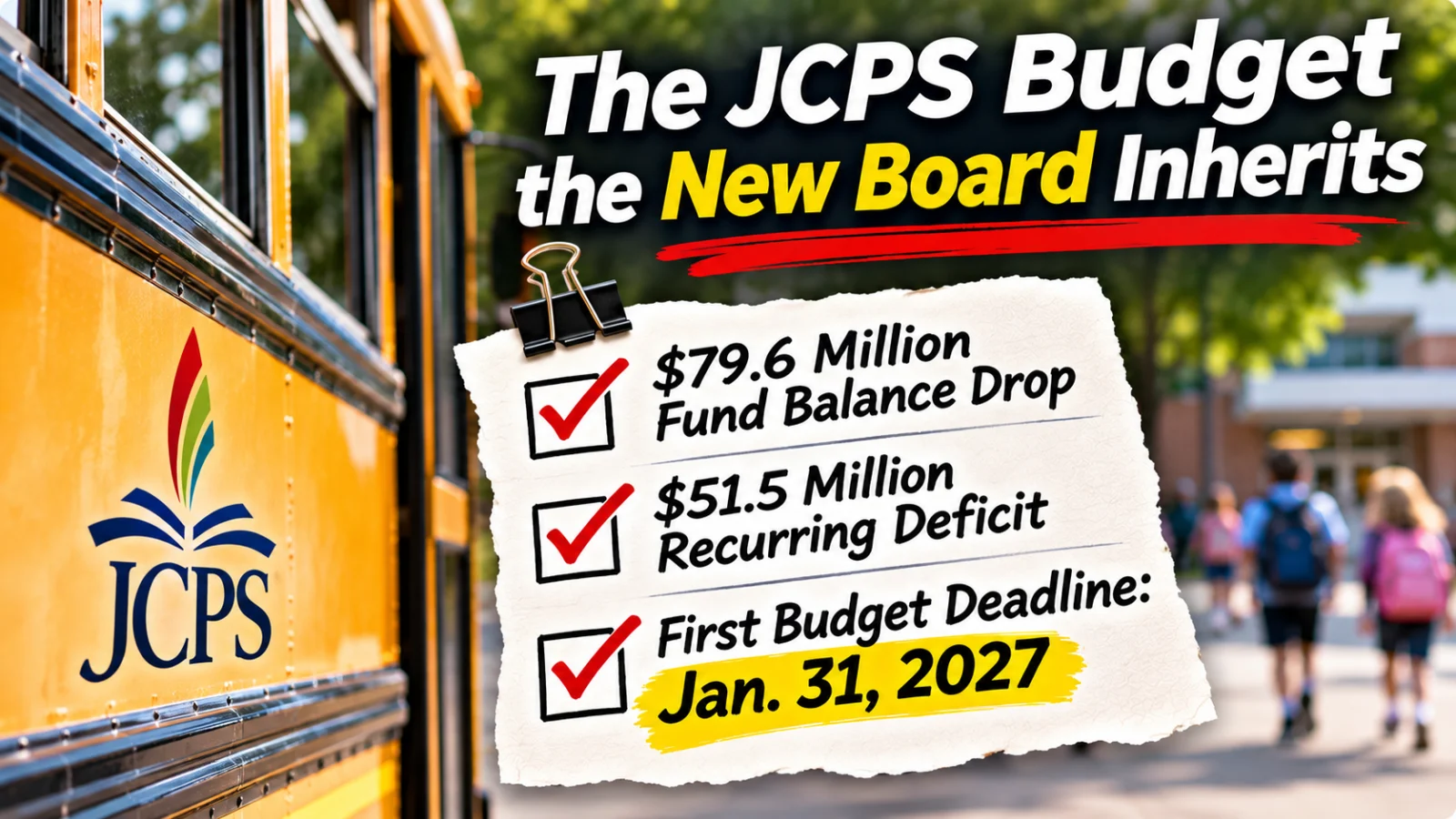
JCPS closed last year's books $79.6 million lighter and still carries a $51.5 million recurring gap. The district's own finance chief says next year looks $20 million to $30 million worse, and the new board's first budget deadline arrives January 31.
Jefferson County Public Schools is running this year on a working budget with a recurring deficit of $51,495,584, and its interim chief financial officer told the board on September 28 that 2027 is expected to be worse by "another $20 to $30 million." The five board members elected November 3 take office in January, and under board policy they must publicly examine a draft budget for 2027 to 2028 by January 31, 2027. That puts the first big money decision about four weeks after they organize.
Our September look at classrooms versus central office covered where this year's cuts landed. This piece is about the next budget: the numbers it starts from, the dates it has to hit, and the line items that decide how deep the next round goes.
What did the board actually approve for this year?
The Jefferson County Board of Education approved the Fiscal Year 2026 to 2027 Working Budget as Order #2026-149 at a special meeting September 28, according to the meeting record on the Kentucky School Boards Association portal. The meeting adjourned at 5:05 p.m. The budget then goes to the Kentucky Board of Education for approval, as KRS 160.470 requires.
The district's working budget presentation lists revenues without fund balance of $1,679,115,352 and expenses without contingency of $1,811,437,091. The difference is a $132,321,739 shortfall, and the deficit adjusted for nonrecurring expenses is $51,495,584.
The gap between those last two numbers is $80,826,155 in spending JCPS treats as one time. That's $29.4 million in bills carried forward from last year, $17.4 million in unspent money returned to schools and to Facilities/Operations, and $34 million in one time employee stipends, according to the working budget presentation and the full working budget document.
Here's the part parents should hold onto. The adjusted figure only stays at $51.5 million if those one time costs really don't come back. If stipends or carryover return next year, the gap a new board faces is closer to the bigger number.
How is JCPS covering the gap right now?
Savings. The district started this year with a projected fund balance of $244,575,124, the working budget says, and the $132.3 million difference "is captured through" that balance.
That cushion is shrinking. The district's Annual Comprehensive Financial Report for the year ended June 30, 2026, on the November 10 board agenda, says the General Fund "decreased fund balance by $79.6 million, much of which was due to planned spending as we come off the fiscal cliff from COVID-Relief grants (ESSER)." The agenda notes that copy still carries a DRAFT watermark while a second partner review finishes.
The working budget also holds a contingency of $112,253,386, or 5.8 percent. State law sets a floor of 2 percent, which the document puts at $38,473,810. The Kentucky Department of Education recommends at least 5 percent, or $96,184,524. So the district is above the recommended line, but only by about $16 million.
JCPS also borrows against its own tax bills. On September 22 the board awarded $100 million in short term Revenue Anticipation Notes to Truist Commercial Equity at a fixed 3.240 percent, according to the Series 2026N resolution. That's cash flow money, used to cover expenses before property taxes arrive. It isn't part of the deficit number, and the two shouldn't be added together.
Why do district leaders expect 2027 to be worse?
Because revenue came in lower than planned. Between the spring tentative budget and the September working budget, the district marked down general property tax by $11,286,380, state SEEK aid by $4,150,858 and investment interest by $2,797,296, according to the working budget. Occupational tax went the other way, up $10,440,480.
SEEK is Kentucky's main school funding formula, and it follows enrollment. The working budget presentation says SEEK "has decreased due to declining enrollment and declining fee-waiver count." The district's Annual Comprehensive Financial Report shows first month enrollment of 94,968 students in 2026, down from 97,462 in 2025, on the Enrollment by Level table on page 141, which notes that those figures reflect first month enrollment. The district's forecast for this year is about 94,400.
Two costs are flagged as unknown. The presentation warns of a "significant decrease anticipated" in state transportation funding, and says the impact "will not be realized until March." It also lists rising fuel costs and a central office move to the YUM facility as known and potential impacts. New expenses added since spring included $2.2 million for diesel, $1.7 million for utilities and $2.3 million more for nursing contract services.
WDRB and WAVE reported that interim CFO Tom Aberli told the board, "To be clear, we expect our financial situation to be worse next year in 2027 than it was this year by another $20 to $30 million." The same report said district officials project the deficit could be eliminated by 2030.
Did property taxes go up?
The rate went down, the revenue goes up. The board set the General Fund rate at 70.3 cents per $100 of assessed value on both real and personal property, Order #2026-148, down from 71.7 cents on real property and 73.5 cents on personal property last year. The district still expects the rate to "generate more revenue than received in the preceding year," about $833.1 million gross, because assessments rose. Of that, $66.4 million goes to the Building Fund and $766.8 million to the General Fund.
The working budget's forecast assumes the board takes the maximum 4 percent revenue increase allowed by law each year. If a future board chooses a lower rate, the forecast gets worse. JCPS's draft 2027 legislative priorities, on the November 10 agenda, ask lawmakers to give districts "more flexibility to raise funds locally."
When does the new board vote on money?
Board Policy 04.1, reprinted in the working budget, sets three deadlines for every fiscal year:
By January 31, the board must "formally and publicly examine a detailed estimate of revenues and proposed expenditures by line item" for the next year. That's the draft budget.
By May 30, the board must approve a tentative working budget with at least a 2 percent reserve.
By the last board meeting in September, the superintendent submits the final working budget, which goes to the state by September 30.
The superintendent's proposed 2027 meeting schedule starts with an organizational business meeting Tuesday, January 5, 2027. The only other regular meeting before January 31 is a work session Tuesday, January 26. The last regular meeting before the May 30 deadline is Tuesday, May 11. The current board is set to vote on that schedule November 10.
For comparison, last year's cuts started early. A September 22 finance presentation says the board received recommendations in November 2025 to close King and Zachary Taylor and restructure Liberty and TAPP, got the overall reduction plan in December, and approved school allocations and the draft budget in January. No closure recommendation for 2027 to 2028 appears on any board agenda posted through November 10, 2026.
Who's running district finances?
The top finance jobs are still being filled. In written answers to board members posted with the September 22 agenda, the district said it had candidates for Executive Officer of Finance "who we will be interviewing." The same board member Q&A says several fixes from the June 5, 2026 Plante Moran review are "sequenced behind hiring the Chief Business Officer and Executive Officer of Finance," and that a multiyear strategic financial plan "doesn't have a set date yet" because it's tied to the board adopting a districtwide strategic plan.
New members will be learning on the job. State law, as amended by the same act that shrank the board, requires members in their first two years to complete three hours of finance training, according to Section 7 of Kentucky Acts Chapter 154.
What should parents watch next?
Start with the state numbers in March. That's when the transportation impact lands and when SEEK is recalculated, the working budget says. Then watch three lines in the January draft: whether the $34 million in stipends returns, what happens to school carryover, and what the district assumes for the tax rate.
Board agendas and every budget attachment post on the KSBA public portal for Jefferson County, usually the week before a meeting. Each school's council gets a say too: Policy 04.1 says councils review categorical program budgets each year and can send comments to the chief financial officer before the board adopts them. If your school's budget questions go unanswered, call your child's school and ask for the date its council reviews the allocation, or call the district's main line at 502 313 4357.
JCPS Insider is an independent parent resource and is not affiliated with Jefferson County Public Schools.