
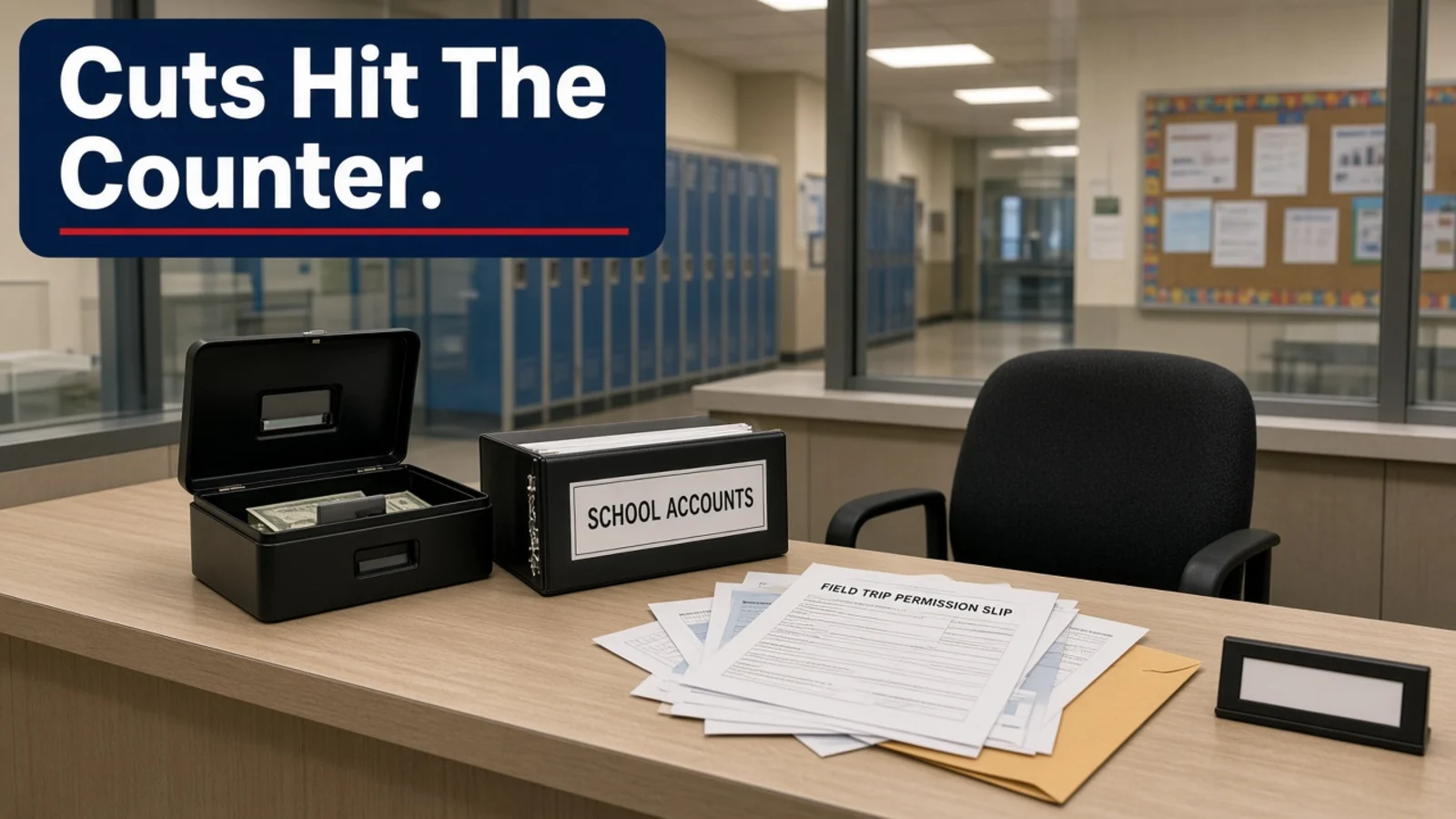
JCPS shrank a once $188 million shortfall to about $51.5 million on the working budget, largely by cutting central office roles. Parents still feel pressure in school support jobs, buses, and campus services that sit next to the classroom.
The board just accepted a nearly $2 billion working budget for 2026 to 2027. The gap left on the books is about $51.5 million, down from an early shortfall near $188 million after more than $115 million in cuts.
District leaders keep saying classrooms were protected. For parents, the useful question is narrower: what changes show up in the building, on the bus, and when you call the office?
What the working budget actually says
The Jefferson County Board of Education accepted the nearly $2 billion working budget on September 22. That document still needs Kentucky Board of Education approval. The working budget the board accepted shows an adjusted recurring gap of about $51.5 million after stripping one time items, and an unadjusted revenue to expense gap of about $132 million before that adjustment. Local coverage the next morning, including WDRB + WAVE and WLKY, reported the same split and added an $11 million drop in projected property tax revenue compared with the tentative budget, plus more than $2.5 million in unexpected diesel costs already absorbed.
Officials pointed to a $100 million line of credit for payroll timing before property tax money arrives. That borrowing sits next to cash flow pressure, not the recurring deficit number alone. District projections described earlier this month showed cash dipping about $20 million to $30 million below zero for stretches this year, with a deeper hole next year.
Superintendent Dr. Brian Yearwood told reporters the district is no longer staring at financial exigency, but is not clear of pressure. District projections described in local coverage now point to closing the deficit by 2030 if new costs do not pile on, after earlier spring forecasts had talked about balance closer to 2031.
For the longer arc of how JCPS got here, see JCPS Insider’s earlier budget crisis parent brief.
Where the cuts landed first
In January 2026, JCPS walked the public through a Draft Budget that framed the strategy as protecting classroom instruction while cutting elsewhere. That draft listed about $44 million from central office (including eliminating roughly 300 positions), $41 million from school budget funds not directly tied to student instruction, $13 million from Operations and Transportation, plus smaller cuts to contracts, subscriptions, and facilities.
By the time the working budget landed, local outlets reported more than $115 million reduced and 352 central office and centrally managed positions eliminated. That total includes vacant jobs and positions shifted into centralized pools, not 352 people gone from every campus in the same way. Other roles named in coverage included academic instructional coaches, school safety administrators, and elementary bookkeepers.
That last category is a clean example of how “central office versus classroom” language can miss what parents notice. Bookkeepers handle cash for field trips, after school activities, and school accounts. After pushback, WLKY reported that JCPS paused cutting filled elementary bookkeeper jobs for the next school year. Vacancies still were not to be filled the same way; some schools would lean on centralized support instead. Union leaders said the jobs would be revisited for 2027 to 2028.
So the parent translation is not “every school lost its bookkeeper.” It is “some schools keep a familiar person at the counter, some lean on a shared model, and principals are doing more with less flexible money.”
Instructional coaches and school safety administrators are the other names to listen for in a principal newsletter. They are not the classroom teacher of record. When those roles shrink, families usually notice slower follow through before they notice a change in the teacher roster.
Transportation is the pressure parents feel first
The January draft put $13 million on Operations and Transportation. Diesel overruns later added more pain. At the same time, JCPS spent 2026 trying to rebuild the driver roster after years of late dropoffs that Louisville families still remember.
Summer 2026 board updates before the first day put the district near 670 drivers on staff with dozens more in training, aiming for more than 700 drivers heading into 2026 to 2027, plus tools such as the My Ride K12 app and Bus Teller stop information. That is recovery language, not a promise that every route will run on time. Budget pressure still shows up as route churn, substitute buses, and hotline weeks. Fuel, overtime, and staffing remain sensitive while the deficit is open.
If your child’s ride plan depends on a friend bus or a temporary stop change, JCPS Insider’s guide on riding a different bus home is still the practical checklist. Approval has to come from the school and Transportation, not from a parent note alone. Student Transportation Services is at 502 485 3470.
School services that sit beside the classroom
The draft’s $41 million from school budget funds “not directly tied to student instruction” is the phrase parents should not skip. That is where field trips, extra duty help, campus projects, and flexible school spending often live. Teachers may still be in the room. The extras that make a week work can thin out first.
Central office cuts can also slow response time when a school escalates a problem. Fewer district specialists can mean a longer wait for behavior support, facilities help, or a specialized coach.
Ask your school what changed in support roles, flexible funds, and transportation contacts for 2026 to 2027, then compare the answer with last year. Districtwide charts will not give you that campus readout.
What to watch next without guessing
District officials quoted after the working budget said they do not have a plan for another broad cut round next year, while also warning that unexpected costs can change the picture and that 2027 could be harder. The budget still needs state approval. Cash timing still depends on tax receipts and that line of credit.
You do not need to audit the entire $2 billion document. Watch three signals at your school:
Who answers when you ask about money for a trip, a club, or a lost check: a school bookkeeper, a centralized contact, or the office alone.
Whether coaching, safety, or other support titles disappeared from the staff directory compared with last year.
Whether bus tools and the school’s transportation contact still match what you were told in August.
For deadlines that sit next to money decisions, including transfer windows and report card dates, keep Dates and Deadlines open.
If your school cannot explain a service change, call the main JCPS line at 502 313 4357 and ask for the department that owns it, or start with your regional assistant superintendent through the school office. Ask for the change in writing, with a named person, a named service, and a date you can check.