
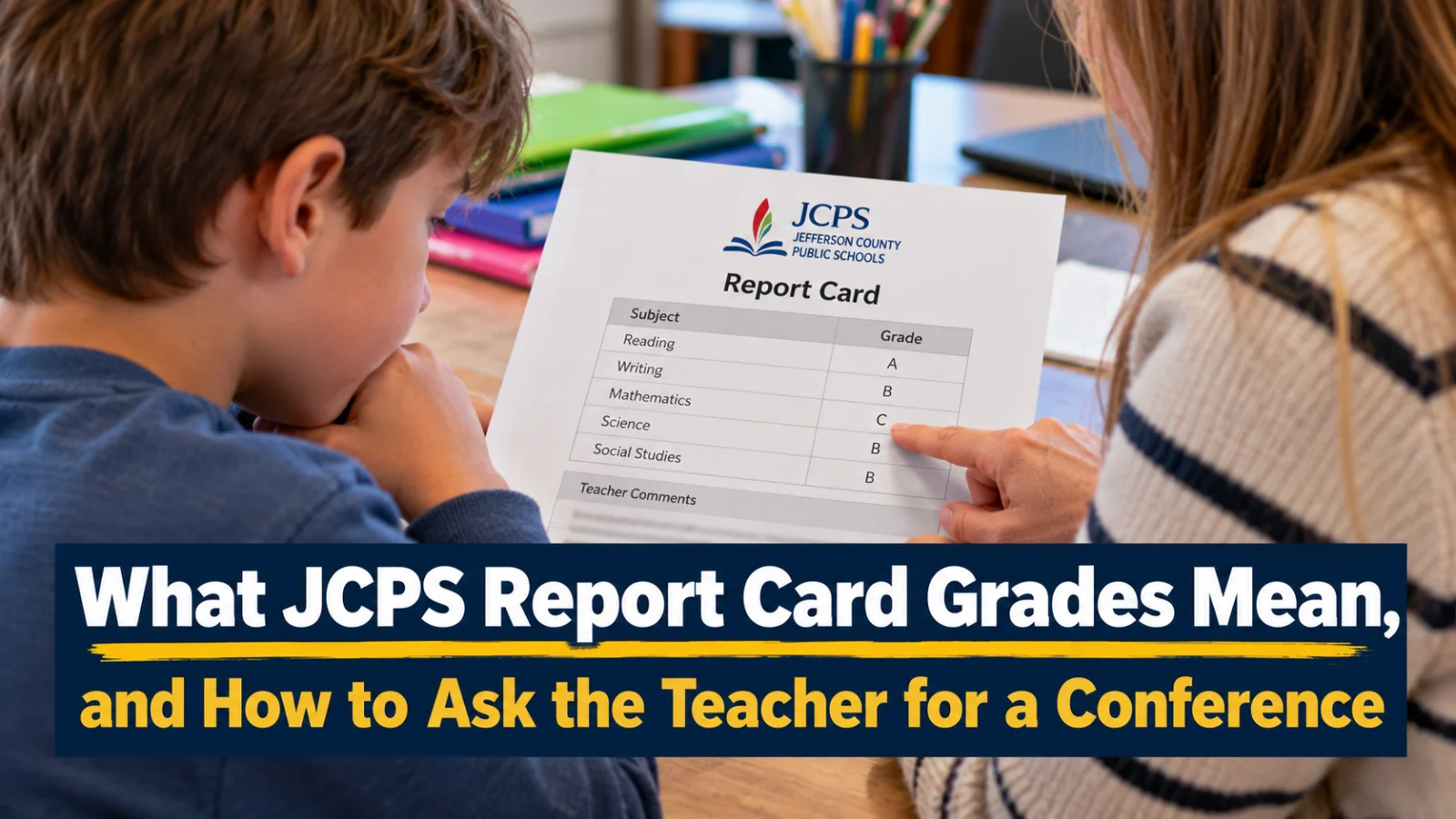
Jefferson County Public Schools elementary and middle school report cards for the first grading period of 2026 to 2027 are set to go home on October 22, according to the district's 2026 to 2027 parent and family school calendar. The same calendar marks October 13 as the end of the first elementary and middle grading period, and it notes that some schools run different schedules. High school dates are different.
This is your child's class report card. It is not the Kentucky Department of Education School Report Card that rates buildings, which goes public October 15.
The letters, numbers, and codes on the card come from the district's Assessing Learning and Grading Frameworks, the documents the Jefferson County Board of Education approves for each school level. The most recent versions JCPS Insider could open are the 2024 to 2025 elementary framework and the 2026 to 2027 middle school Student Progression and Promotion Handbook, a draft with tracked edits. Check any specific rule below against the copy your school is using. A 2026 to 2027 elementary version was not found, so elementary rules come from 2024 to 2025 and may have changed. The middle school handbook was checked October 13, 2026. Both documents are posted with Jefferson County Board of Education meeting materials on the KSBA board portal at the links above, and your school office can give you the version it follows.
What do the marks mean in kindergarten through grade 3?
Kindergarten through grade 3 is the Primary Program, and core subjects are not graded with letters. The elementary framework lists these performance codes:
O, Outstanding: work consistently meets or exceeds grade level expectations and standards.
S, Satisfactory: work meets grade level expectations and standards.
NI, Needs Improvement: improvement is needed to meet grade level expectations and standards.
U/I, Unsatisfactory or Incomplete: work does not meet grade level expectations, or there is not enough evidence to judge progress.
N/A, Not Applicable: the skill was not taught this nine week period.
Health and physical education, visual and performing arts, and other special areas use the same O, S, NI, U/I, and N/A codes from the Primary Program through grade 5.
Some cards also carry process codes, the numbers 4 through 1. The framework defines them as 4, consistently and independently; 3, frequently; 2, sometimes; and 1, rarely.
What do the letter grades mean in grades 4 through 8?
Grades 4 and 5 are the Intermediate Program, and core subjects get letters tied to percentages. The elementary framework lists A as 90 to 100 percent, meets or exceeds standards; B as 80 to 89, approaching standards; C as 70 to 79, developing understanding; D as 60 to 69, below standards; and U/I as below 60, significantly below standards or insufficient evidence.
The middle school handbook uses the same percentage bands, A through D and U/I below 60. It adds how the year adds up. Final grades are the average of the quality points from the four grading periods, with A worth 4, B worth 3, C worth 2, D worth 1, and U worth 0. For each year long course, a student must pass at least three of the four grading periods. A final exam grade may be used only to raise a final grade, not to lower it.
Schools that use standards based reporting may print a number from 4 down to 0 instead of a letter. The middle school handbook gives the conversion: 4 lines up with an A, 3 with a B, 2 with a C, 1 with a D, and the lowest mark with U/I.
What counts in the grade, and what does not?
The frameworks say academic grades are supposed to show what a student knows and can do, not whether tasks were finished. In the elementary framework, mastery of standards and skills counts for 100 percent of the academic grade, and no single assignment can count for more than 20 percent of that mastery category.
Behavior is reported separately. Both frameworks say grades are not lowered as punishment for misconduct, including turning in late work or not having supplies. Those behaviors belong on the conduct report, which is marked S for satisfactory, NI for needs improvement, or U for unsatisfactory. Conduct is not part of the academic grade.
The elementary framework tells teachers to use "incomplete" for missing assignments and not to give zeros, and it says homework is practice, not evidence for a grade. The middle school handbook says zeros for missing work are discouraged and suggests a "Missing" mark or a blank instead.
An incomplete has a deadline. The elementary framework says every incomplete must be turned into an academic grade before the end of the next grading period, or when the student withdraws, whichever comes first, and incompletes are not allowed in the last grading period of the year.
For a multilingual learner, both frameworks say a student may not get a D or U on assignments only because of English proficiency, and grades are to reflect the accommodations in the student's Program Services Plan. For a student with an IEP, the elementary framework says an IEP progress report goes home on the same schedule as report cards.
Should the low grade have been a surprise?
It should not have been, under the frameworks. The elementary framework says that if a student is not making satisfactory progress, the teacher must notify parents by phone or in writing at least two weeks before the end of the grading period, document that contact, and put an intervention plan in place. The 2026 to 2027 middle school handbook says that after notice of unsatisfactory performance, the teacher must develop an acceleration plan. The board policy section in both frameworks says parents must be told in a timely manner, before the progress report or report card goes out, when a student shows unsatisfactory performance or a change in performance.
The elementary framework also says explanatory comments must accompany every below standard grade, and that a student with an NI, D, or U in a core subject gets clarifying comments. If a low mark came home with no comment and no earlier call or note, that is worth naming in your message.
Each teacher is also supposed to hand out a copy of their grading procedures to students, parents, and the principal. If you never got one, ask for it.
How do you email the teacher or ask for a conference?
Start with the teacher. Board policy, as printed in both frameworks, says certified employees shall be available for conferences parents request, that reports to parents shall include a way for a parent or teacher to ask for one, and that conferences are scheduled at a mutually agreeable time as far as possible. Parents are encouraged to attend two parent teacher conferences a year.
Send one short email. Put the child, the grade or class, and the question in the subject line, for example: "Jordan Lee, grade 4 math, question about first grading period grade." In the body, name the marking period, quote the mark or comment you are asking about, and ask one clear thing: what evidence the grade is based on, whether an incomplete can still be finished, or whether you can meet. Offer two or three times you can do a meeting or a call.
The district calendar lists Family Teacher Conferences on September 23, 2026 and February 16, 2027. Between those dates, ask the teacher for a conference directly.
What if the conversation does not fix it?
The frameworks print the same appeal ladder. A concern about a grade goes to the teacher first. If it is not resolved, the parent asks for a meeting with the teacher and a counselor or assistant principal. If it is still not resolved, a meeting with the principal is scheduled, and under the elementary framework, the principal reviews the documentation and tells the parent the decision, the final step.
A posted grade can be changed by the teacher together with a school administrator, and the parent must be told of any change. For students with disabilities, the procedures required by federal and state law apply, and the IEP may be considered in an appeal. For copies or an explanation of those rights, the district's ECE family website tells parents to contact the Implementation Coach or school counselor at their child's school.
Before October 22, write down your questions so the first email names the class, the marking period, and the one mark or comment you need explained.