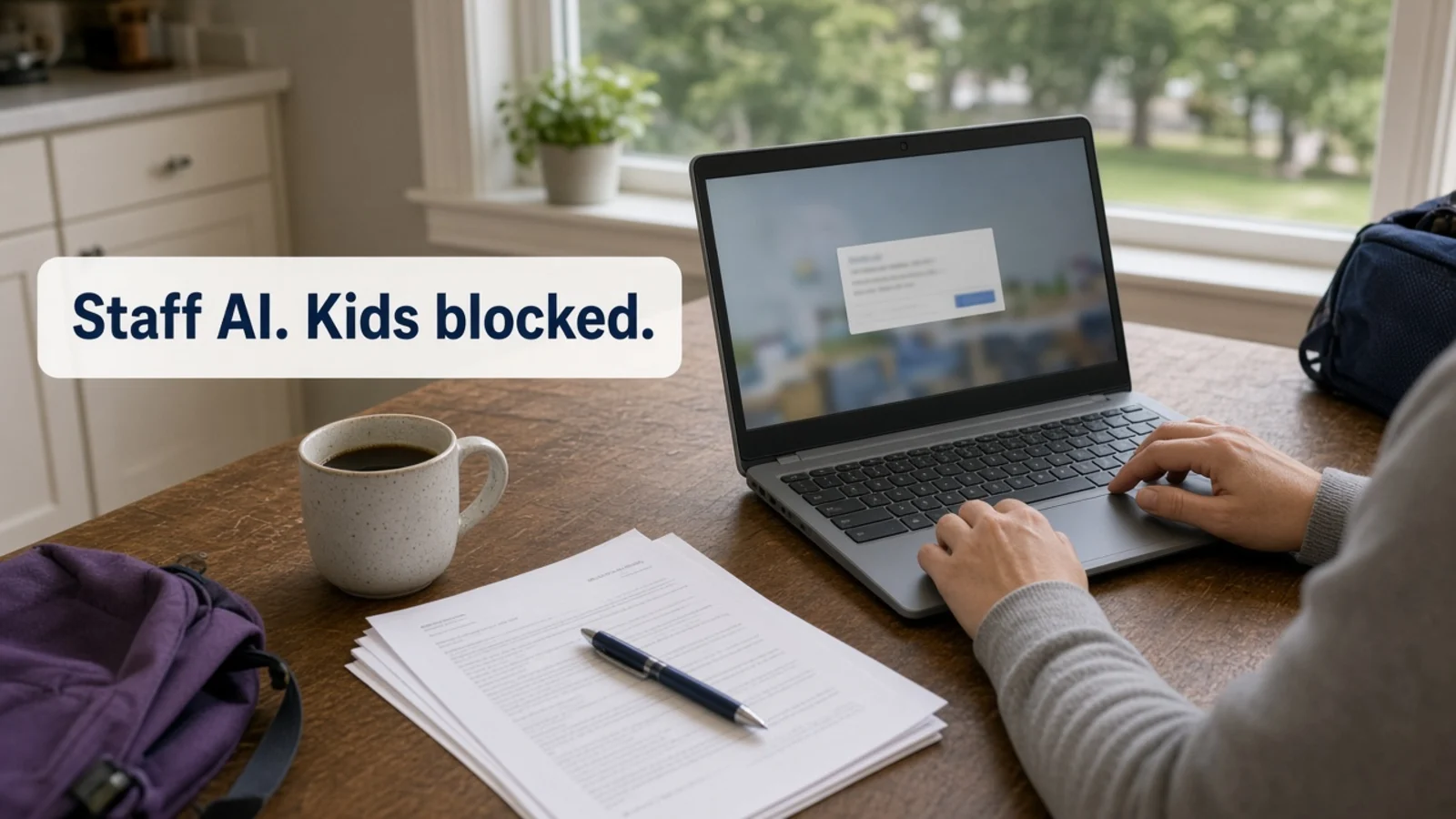
JCPS answered a Kentucky Open Records request about generative AI. Staff can use Google Gemini, Microsoft Copilot, and Claude for some work. Students are blocked. The district also says it has no records of staff putting student names, grades, IEPs, or discipline into AI since 2024.
JCPS Insider filed a Kentucky Open Records request on September 16, 2026, asking which generative AI tools JCPS has approved, what privacy contracts cover them, what staff may put into those tools, how student accounts are configured, and whether any help desk tickets or investigations show staff entered student information into AI.
JCPS answered through its Open Records Shared Mailbox.
On approved tools, the district wrote: “For staff access: Google Gemini, Microsoft Co-Pilot, Claude (approved for specific use cases).”
On students, JCPS wrote: “Students do not have access to Generative AI platforms per district policies using the internet filtering platform provided by the Kentucky Department of Education.”
Separately, on Google settings, JCPS wrote: “Within the Google Admin console, student access to Generative AI is disabled.”
On incident files since January 1, 2024, about staff entering student names, grades, IEPs, discipline records, or other personally identifiable student information into a generative AI tool, JCPS wrote: “We do not possess any records responsive to this request.”
Staff tools beyond Gemini
Public messaging has focused on Google and Gemini. The State of the District address on February 27, 2026, highlighted the district’s Google Workspace migration and Gemini in a secure enterprise environment. Local coverage, including WDRB, has described teachers using AI tools inside Google Classroom for lesson plans, quizzes, and instructional drafting.
The open records reply widens the official staff list. Microsoft Copilot is on it. Claude is on it too, but only for specific use cases. JCPS did not spell out those Claude use cases in the reply.
If a teacher, counselor, or office staffer is using AI at work, parents should not assume it is only Gemini. For how Gemini has been trained into classrooms, see JCPS Teachers Are Learning Google Gemini.
Students locked out on two controls
The KDE filter and the Google Admin setting are two different locks. One sits on the network. The other sits on the student account.
Together they answer the Chromebook question parents ask when Gemini headlines hit Facebook. According to JCPS, a student should not open generative AI through district filtered internet or a JCPS Google account.
Google expanded Gemini tools for students in Classroom in August 2026. Education Week reported that where a district had already turned student Gemini off, it stays off. The September open records reply still says JCPS has student access disabled in the Google Admin console.
That does not settle homework AI used at home on a personal phone or family laptop. It answers the school account and school network question the request pressed.
Superintendent Brian Yearwood’s February language about integrating Gemini into classrooms can sound broader than a student ban. The open records answer sits next to the Educational Technology update CIO Eric Satterly and staff presented to the Jefferson County Board of Education on March 31, 2026. Official minutes show Mr. Taylor Everett asked when phase two begins and when students currently lacking access will receive it. They also show Mr. James Craig expressing concerns about student safety and generative AI’s impact on learning quality. The minutes record that he “shared his personal discomfort with boilerplate agreements from large tech companies.” See the official minutes. Archived video is on the district’s JCBE YouTube channel.
Do not paste PII. Personalize lessons. No incident files.
The open records reply did not attach a new staff memo. It pointed to the Acceptable Use Policy and Access to Electronic Media materials in the JCPS policy chapter on KSBA, and to Generative AI in JCPS: A Commitment to Responsible Innovation.
JCPS Insider previously reported the key sentence on that generative AI page under Anonymization and Consent. JCPS says, “Even in approved platforms, Personally Identifiable Information (PII) should not be shared to guarantee individual privacy.” It then says that when individualized data analysis is required, “data must be anonymized or pseudonymized.” The fuller walkthrough is What Can JCPS Teachers Tell AI About Your Child?.
Public training and local coverage already sit in tension with that rule.
WDRB’s March 2026 story did not only show teachers generating lesson plans. District staff described feeding student needs into the tool so it could adjust instruction. One example used in that coverage was a class with students who are visually impaired. A classwide need can stay anonymous. Names, student numbers, individual disability records, or enough detail to identify one child cannot, under the district’s own published PII rule.
So parents are left with a concrete question the open records reply does not settle: if staff can describe student needs to personalize a lesson, what counts as allowed “needs,” what counts as prohibited personally identifiable information, and who decides when a prompt crosses that line?
Against that backdrop, JCPS told JCPS Insider it has no responsive incident reports, help desk tickets, compliance reports, or internal investigations since January 1, 2024, about staff entering student names, grades, IEPs, discipline records, or other personally identifiable student information into generative AI.
Read that carefully.
It is not the same thing as JCPS proving that no staff member ever pasted a student name, grade, IEP detail, or discipline note into Gemini, Copilot, Claude, or another generative AI tool. It is JCPS saying it does not have responsive records of the kind requested.
That can mean no incidents were logged. It can also mean incidents were never written up as tickets or investigations, were handled informally, or were filed in a way the open records search did not return. The record JCPS produced is the absence of responsive files, not a detailed audit of every prompt staff typed.
Contracts pointed to a portal
JCPS Insider asked for data privacy agreements and similar contracts covering generative AI tools with Google and other vendors since January 1, 2024.
JCPS said it does not maintain a list of agreements specific to AI tools that would identify which contracts might be responsive. It directed the public to the KSBA Public Portal for Agency 89.
That answer lands in a week when Louisville Public Media’s Kentucky Center for Investigative Reporting reported that JCPS lacks a complete list of active district contracts, a problem also noted in Kentucky State Auditor Allison Ball’s 2026 JCPS audit. Credit Louisville Public Media / KyCIR. Pointing parents to a portal is not the same as producing an AI specific contract packet.
This Open Records reply did not produce the Gemini, Copilot, or Claude contracts. KyCIR separately reported that JCPS does not have a data privacy agreement with Google and instead relies on the company’s terms of service and privacy statements.
On training recordings, JCPS pointed to the JCPS Digital Learning Channel on YouTube.
KyCIR’s September 22, 2026 investigation mapped vendor data sharing across hundreds of ed tech products. JCPS Insider’s Farnsley Middle reporting already showed AI generated material reaching families, with the open question being human review. See AI Errors Found in Farnsley Middle Student Agendas.
What parents can do
Ask the school to confirm that generative AI remains disabled for students on the Chromebook and JCPS Google account your child uses.
If a teacher mentions Gemini, Copilot, Claude, or AI lesson tools, ask which approved platform is being used and what student information, if any, goes into the prompt. Ask whether the tool connects directly to Google Classroom, Infinite Campus, or another system with individual student records. Ask who decides when a description of student needs becomes identifying information.
If you want the contracts, start at the KSBA portal JCPS cited. Do not expect the portal search to magically label every AI tool. If you cannot find Google, Microsoft, or Anthropic agreements, a narrower follow up open records request for those specific documents is the next move.
Read Generative AI in JCPS and the Acceptable Use materials in the JCPS policy chapter. Related JCPS Insider guides live under Homework and AI.
If you believe staff entered your child’s personally identifiable information into an AI tool, document what you know, ask the principal in writing, and keep the reply. Parents can also call the JCPS Call Center at 502 313 4357 or email jcps.help@jefferson.kyschools.us. The open records response says JCPS has no responsive incident files for the period requested. Your written question creates a record of your own.
JCPS Insider filed the request on September 16, 2026. JCPS answered through the Open Records Shared Mailbox.