
Your child does not have to be the best artist in the class to have a reason to enter PTA Reflections.
The national arts program gives students a chance to turn an idea into a drawing, photograph, story, original piece of music, film, or dance. Students who advance can move beyond their school and eventually reach state and national recognition. National PTA says Reflections has been giving students opportunities in the arts for more than 50 years.
For JCPS parents, there is one thing to understand before anything else: Reflections is not run as one centralized JCPS competition with one deadline for every student.
Students participate through a local Parent Teacher Association, or PTA, or a Parent Teacher Student Association, commonly called a PTSA. Eligibility, deadlines, available categories, and submission instructions can depend on the PTA through which the student enters.
That makes Reflections exactly the kind of opportunity a family can miss simply because nobody thought to ask about it.
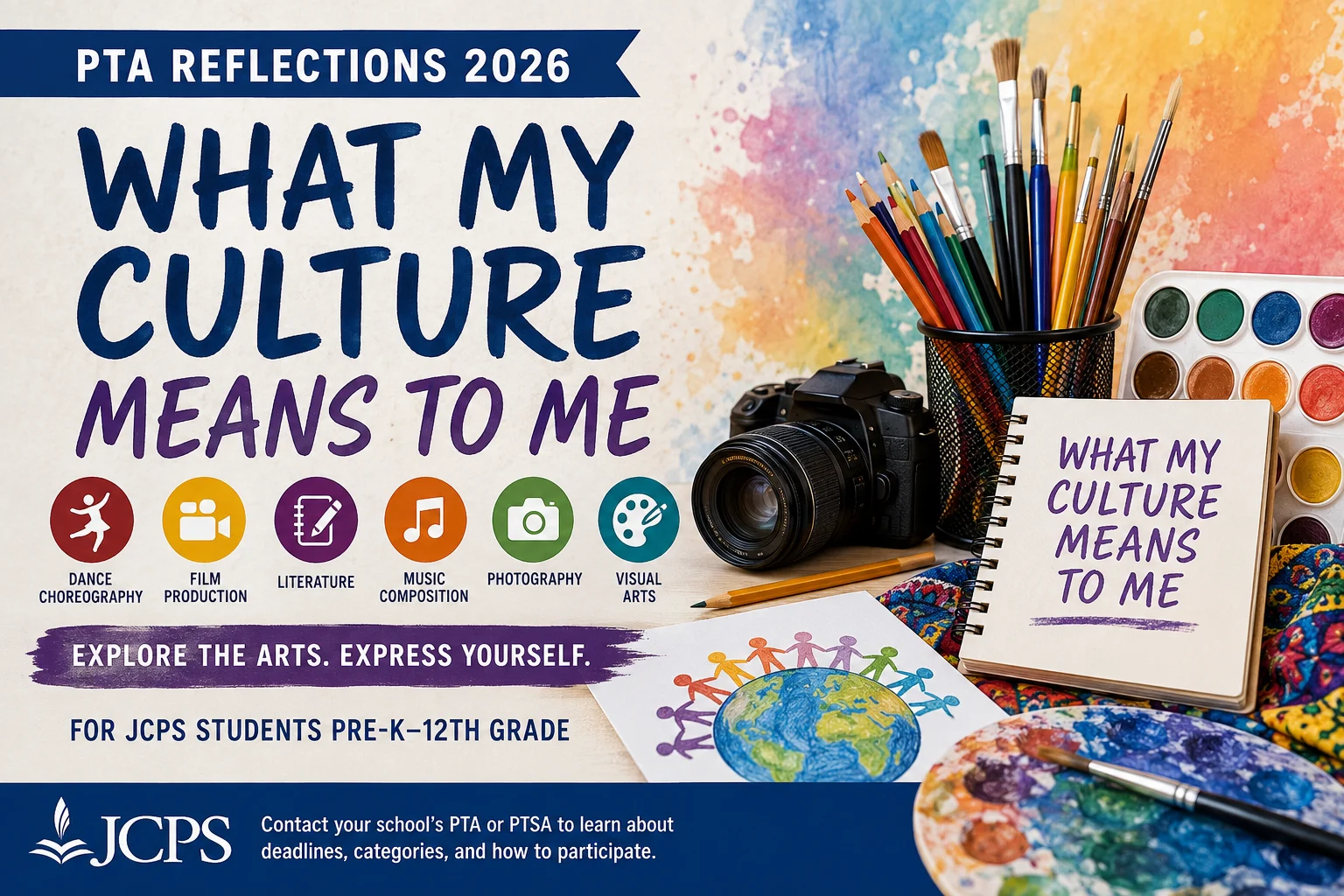
The 2026 Reflections theme is “What My Culture Means to Me”
For the 2026 to 2027 school year, students will create work inspired by the theme:
“What My Culture Means to Me”
The theme was created by Sophia Partola of Wilton High School PTSA in Connecticut. National PTA selected it through its student theme program.
Students are free to decide what the theme means to them.
A child might think about family traditions, food, music, language, neighborhood, religion, celebrations, heritage, values, memories, sports, community, or something entirely different.
That personal interpretation matters because Reflections is not judged only on artistic technique.
In fact, theme interpretation is the single biggest part of the national scoring system.
What can students enter in PTA Reflections?
National PTA recognizes six arts categories.
Visual Arts
Students can create original visual artwork. Depending on the medium and applicable rules, that can include drawing, painting, sculpture, collage, digital art, and other visual forms.
Photography
Students can submit original photographic work.
Parents should read the photography rules carefully before allowing a child to add text, graphics, or other digital elements. National PTA specifically says photography entries cannot include added graphics, text, or icons.
Literature
Students can express their interpretation through original writing.
That makes Reflections an option for children who enjoy stories, poetry, essays, or other forms of writing but may have little interest in traditional visual art.
Music Composition
Students can create original music. Reflections evaluates the student's composition rather than requiring the student to be the performer.
Film Production
Students can create an original film and make the major creative decisions involved in the project.
Dance Choreography
Students create original choreography that communicates their interpretation of the theme through movement.
A student can enter one or more available arts categories, although parents should confirm which categories their local PTA is offering.
That variety is part of what makes Reflections easy to underestimate.
A child who says, “I'm not an artist,” may already spend hours making videos, writing stories, taking pictures, creating music, drawing characters, or choreographing dances.
One of those interests could fit Reflections.
Who can participate?
National PTA divides the traditional competition into four grade groups:
Primary for pre K through grade 2
Intermediate for grades 3 through 5
Middle School for grades 6 through 8
High School for grades 9 through 12
There is also an Accessible Arts division.
Accessible Arts is an optional pathway for students who identify as having a disability and may receive services under the Individuals with Disabilities Education Act or Section 504. It allows certain accommodations while keeping the student's ideas and artistic decisions at the center of the entry.
For example, an adult may assist a student with typing or transcription when needed, but the adult should not independently choose the title, write the artist statement, or make the student's creative decisions.
Parents of a student who may benefit from Accessible Arts should ask their PTA about the current participation rules before beginning an entry.
Does every JCPS school offer PTA Reflections?
Parents should not assume that every JCPS school runs Reflections in exactly the same way.
National PTA tells families to participate through a local PTA or PTSA and specifically advises parents to check with their school, front office, or PTA to determine what options are available. Available categories and divisions can also vary locally.
Reflections is clearly present within JCPS.
Current JCPS school webpages for schools including Chenoweth Elementary, Tully Elementary, St. Matthews Elementary, and Stonestreet Elementary list or describe PTA Reflections among their student or PTA activities.
The 15th District PTA, which serves Louisville, is also promoting the 2026 to 2027 Reflections theme.
But a parent should still verify participation at the individual school.
If you cannot find Reflections on your school's website or PTA page, ask the front office for the PTA contact or check directly with the PTA or PTSA.
National PTA also says families whose local PTA does not support Reflections should check with their state PTA to see whether another participation option is available.
When is the PTA Reflections deadline for JCPS students?
This may be the most important part of the article.
Do not wait for a single JCPS wide deadline.
National PTA says each state PTA establishes its Reflections process and deadlines, and students should begin by contacting their local PTA.
Louisville adds another layer because JCPS schools are served by the 15th District PTA.
JCPS school information describing the local process says entries advance from local PTAs to the 15th District PTA, with selected entries then moving to Kentucky PTA.
As of August 19, Kentucky PTA's newly rebuilt website was still labeled “Under Construction,” and JCPS Insider could not verify a published 2026 to 2027 Louisville student submission deadline there.
That does not mean families should wait.
The student's first deadline is normally the deadline set by the PTA accepting the entry, and it must come early enough to allow judging and advancement through the later rounds.
Ask your school's PTA for its Reflections deadline now.
Last year's dates are not reliable for this year's competition.
How does my child enter PTA Reflections?
The process should begin locally.
1. Ask whether your school is participating
Check your PTA or PTSA website, newsletter, social media, school announcements, or front office.
Do not assume that a lack of information means the program is unavailable. Ask.
2. Get the exact school deadline
Write down the date.
This is especially important because National PTA does not set one student deadline for every school in the country.
3. Ask which categories are available
Your child may be interested in photography or film, but you should confirm the categories your PTA is accepting before the project begins. National PTA specifically tells families to check locally because available categories and divisions may differ.
4. Read the rules for that category
Do this before creating the final entry.
Rules differ depending on whether the student is submitting photography, literature, film, music, visual art, or dance.
5. Create something new for this year's theme
National PTA says entries must be new artwork created for the Reflections program.
Students should not simply pull out an old drawing, photograph, story, or school assignment and submit it because it happens to fit the theme.
6. Complete the title and artist statement
Every entry must include an original title and an artist statement.
National PTA requires the artist statement to contain at least 10 words and no more than 100 words.
Do not treat this as paperwork to finish five minutes before submission.
It can affect how judges understand the entire entry.
The best artist does not automatically win
This is probably the most useful thing for parents to understand about Reflections.
National PTA's scoring system gives a possible 100 points to an entry.
The points are divided this way:
Interpretation of the theme: 40 points
Creativity: 30 points
Technical skill: 30 points
That means interpretation of the theme carries more weight than technical skill.
A beautifully executed piece that barely connects with “What My Culture Means to Me” does not necessarily have an advantage over a less polished entry built around a thoughtful and original interpretation.
National PTA says judges consider the artwork itself and the artist statement when scoring theme interpretation.
For a child who enjoys creating but has never won an art award, that should make Reflections more inviting.
The contest is asking students to communicate an idea, not simply prove who has had the most art lessons.
Do not let an adult write the artist statement
Parents can help children understand the instructions.
They can remind them about the deadline, read the rules together, discuss the meaning of the theme, and ask questions that help the child explain an idea.
But the creative work needs to belong to the student.
National PTA says each entry must be the original work of one student. Artistic assistance from friends, family members, or teachers is not allowed, and titles and artist statements must reflect the student's own words and interpretation.
Instead of rewriting a child's statement, a parent might ask:
What does your artwork show?
Why did you make it this way?
What part connects most strongly to the theme?
What does culture mean to you?
What do you want someone to understand after seeing your work?
Then let the child answer in the child's own voice.
A fourth grader's artist statement should sound like a fourth grader.
Can students use Canva or artificial intelligence?
Parents should pay close attention to this year's digital rules.
National PTA allows students to use digital technology or software to develop, enhance, or present an entry, but the technology cannot provide the primary design or concept. Entries also cannot be created entirely with generative tools or made entirely from material supplied by a technology platform.
Students who use digital tools must disclose how they were used. National PTA requires a description of the tools and methods, including any generative elements, in the Additional Details section of the entry form. That explanation should contain between 10 and 50 words.
Canva deserves particular attention.
National PTA says platforms with templates, graphics, icons, images, or other material created by someone else should be used sparingly, if at all. The student's own creativity must remain the foundation of the entry.
There are also category specific restrictions.
For example, adding graphics, text, or icons to a photography submission is not allowed under the national guidance.
If your child plans to use artificial intelligence, Canva, editing software, templates, stock material, or another digital platform, read the exact category rules before the final entry is created.
Do not assume that something is allowed simply because the software makes it easy to do.
How far can a JCPS student's Reflections entry go?
Potentially much farther than the school hallway.
Students begin through a participating PTA and can earn recognition through additional levels, potentially reaching state and national judging. National PTA does not accept individual entries sent directly by students or local PTAs at the national level. Entries have to advance through the established process.
At the national level, the competition is selective.
For the 2025 to 2026 program, National PTA recognized more than 240 students with national awards after two rounds of national review. Seven students received the top Outstanding Interpretation Award.
Those top national winners each received an $800 scholarship, while their local PTA received $200 for arts and cultural programming. National Award of Excellence recipients received $200 scholarships.
Those were the awards for the previous competition and should not be assumed to be identical for the 2026 to 2027 cycle.
Still, they show what Reflections can become.
A project that starts at a kitchen table in Louisville can eventually be judged alongside student artwork from across the country.
Does it cost anything to enter?
Parents should verify this locally.
National PTA does not impose one national membership rule for every student. Instead, student eligibility, including any membership requirements, is determined by the state PTA.
JCPS Insider could not verify a newly published Kentucky rule for the 2026 to 2027 cycle on Kentucky PTA's rebuilding website as of August 19.
Before purchasing PTA membership specifically for Reflections or spending money on special supplies, ask the local program coordinator what is actually required.
A strong entry does not necessarily require expensive materials.
A student may already have what is needed to write a story, take a photograph, create a drawing, compose music, make a short film, or choreograph a dance.
What should JCPS parents do now?
If this sounds like something your child might enjoy, there is no reason to wait for a flyer to appear in the backpack.
Do these five things:
Ask your school's PTA or PTSA whether it is participating in Reflections this year.
Get the exact student deadline.
Ask which categories are being accepted.
Read the current National PTA rules for your child's category.
Have your child begin thinking about what “What My Culture Means to Me” means personally to them.
Then get out of the way enough to let the project belong to the child.
The bottom line
PTA Reflections is not simply a contest for children who already consider themselves artists.
It can be a doorway for the child who writes stories after school, photographs everything, makes videos for fun, experiments with music, draws constantly, or creates dances in the living room.
And because interpretation of the theme receives more judging weight than technical skill, an original idea and a strong personal connection can matter as much as artistic polish.
For JCPS families, the biggest obstacle may be discovering the program in time.
Reflections participation starts locally, deadlines can vary, and families should not assume their school will use the same process as another JCPS school.
So if your child might be interested, ask one question now:
Is our PTA doing Reflections this year?
That question could lead to an opportunity your child never knew existed.