
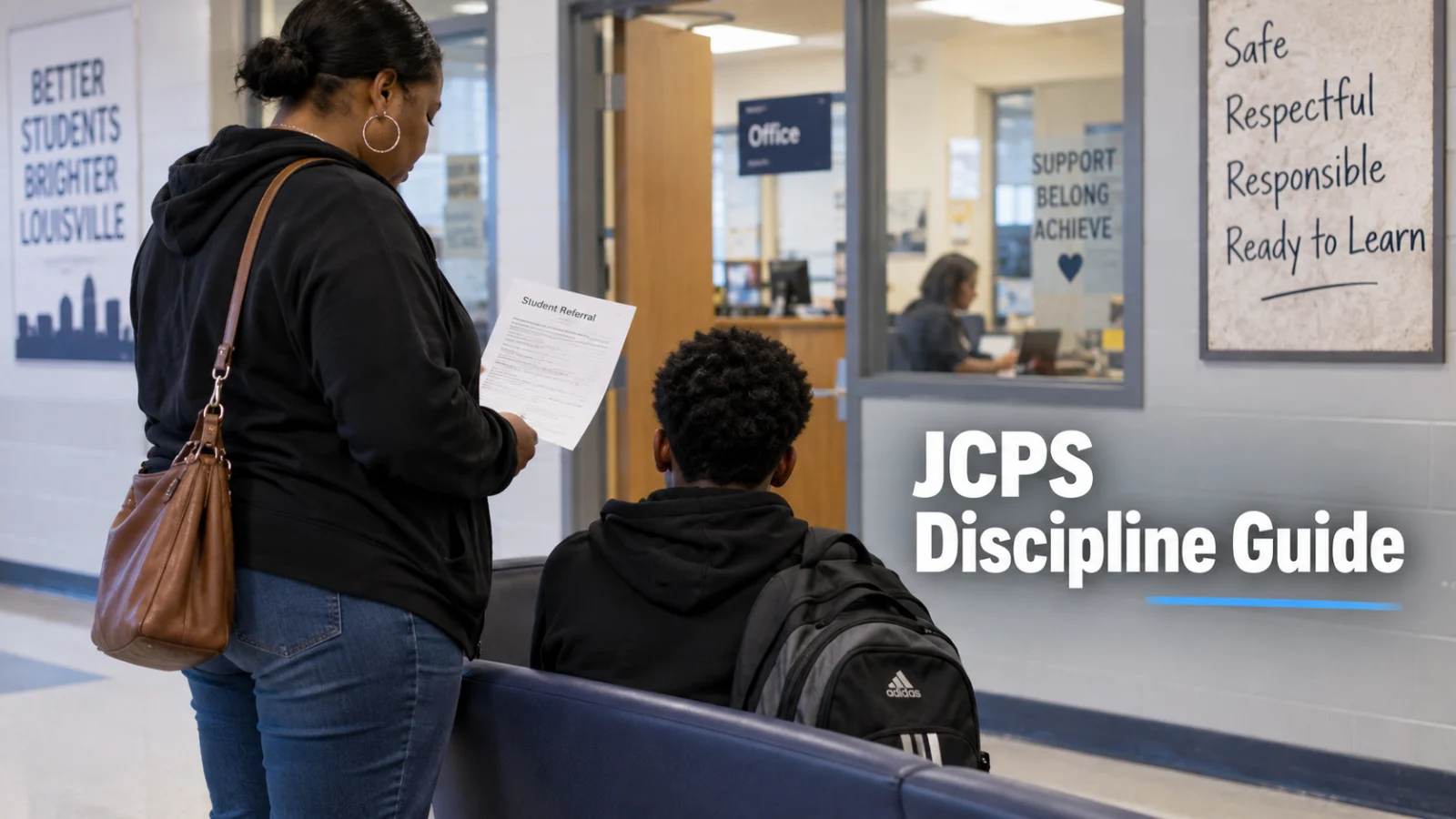
A discipline referral does not automatically mean suspension. JCPS uses escalating consequences, but repeated behavior can move a student up the ladder, serious safety incidents can move much faster, and Kentucky law now adds another set of rules at the most serious end.
A student gets sent to the office. The school calls home. The word “referral” gets used.
What happens after that depends on much more than how many times the student has been in trouble.
JCPS uses graduated interventions and consequences, with lower level behavior generally handled at the lowest appropriate level and more serious conduct moving to administrators, suspension, Student Relations, or alternative placement. But there is no requirement that a student pass through every level before a serious consequence can be used.
The Jefferson County Board of Education approved the district’s 2026 to 2027 Student Support and Behavior Intervention Handbook on May 12.
Parents can open the current Student Support and Behavior Intervention Handbook page on the JCPS website. The district points families to pages 22 and 23 for the behavior level explanation. Suspension and alternative placement appeal procedures are on pages 36 and 37.
JCPS uses separate behavior code charts for preschool through grade 3, grades 4 and 5, and grades 6 through 12. Early Childhood consequences stop at Level 3 rather than Level 4.
Level 1 and Level 2 usually start with keeping the student in school
For students covered by the kindergarten through grade 12 consequence system, Level 1 includes relatively minor classroom disruptions. JCPS gives examples such as talking out in class, leaving class without permission, being out of a seat, and dress or device violations.
Those behaviors typically are not referred to an administrator until classroom interventions have failed to correct them. JCPS says the goal is to correct the behavior while limiting missed instructional time.
Level 2 covers behavior that is more serious or disruptive. Examples include horseplay, skipping class, leaving school grounds, and profane or vulgar language. These incidents involve school administration, but the handbook still describes the goal as correcting the behavior while keeping the student in school.
Possible responses can include conferences, detention, behavior supports, counseling, restorative responses, or an in school removal.
One term parents may hear is ISAP, the In School Adjustment Program. A student assigned to ISAP is moved to another location inside the school and continues receiving classroom assignments. JCPS records that as an in school removal rather than an out of school suspension.
Level 3 is where suspension becomes a real possibility
Level 3 includes acts against a person or property that JCPS says indirectly endanger the health or safety of others. Fighting, harassment, and possession of drugs or alcohol are among the examples in the handbook.
Those behaviors can result in short term removal from school. JCPS says consequences should still be graduated, and an out of school suspension should include a conference with the parent and student when the student returns.
The district’s suspension procedure defines a Level 3 suspension as one to three school days. A principal or assistant principal can issue it.
Repeated lower level conduct can also reach this point.
JCPS has one escalation rule for repeated behavior
The handbook contains a specific rule for repeated Level 1 or Level 2 behavior.
If a corrective strategy has been used for the same behavior more than three times, an administrator may use professional judgment and move to a Level 3 consequence. That can include a suspension of one to three school days. JCPS also says the parent should be made aware of the repeated behavior and work with the school on a plan to address it.
The wording gives administrators discretion.
It does not say that three unrelated referrals automatically result in suspension, and it does not say that the next incident must produce one.
Kentucky has another three times rule, and it measures something different
Kentucky law creates a separate path involving classroom removals.
Under KRS 158.150, a student removed from the same classroom three times within 30 days is considered chronically disruptive and may be suspended without another basis for suspension being required.
JCPS added an important check for lower level cases.
When one of those classroom removals involves Level 1 or Level 2 behavior, the handbook says the principal must consult the Regional Assistant Superintendent before imposing an out of school suspension.
So the district rule for repeated corrective strategies and the state rule for repeated classroom removals are not interchangeable. One tracks the same behavior being addressed repeatedly. The other tracks removal from the same classroom three times within 30 days.
Serious incidents can skip much of the ladder
Progressive discipline does not mean every student starts at Level 1.
JCPS says the progressive approach can apply to some Level 4 incidents, but student and staff safety remains a major consideration. Level 4 includes serious conduct such as assault, possession of a dangerous instrument, and terroristic threatening. These cases can involve immediate removal, law enforcement, a school threat assessment, and referral to Student Relations.
The suspension procedure defines a Level 4 suspension as six to ten school days and says those cases may be referred to an assistant director of Student Relations for a conference.
A suspension of 11 to 20 school days requires a formal hearing unless the parent or guardian waives it. The hearing must be held within three school days of notification of the suspension, and the parent or guardian must receive the hearing officer’s written decision within five school days.
A student therefore does not need a history of minor discipline before a serious safety incident can trigger a major response.
Suspension starts a short appeal clock
For a suspension of one to ten school days, JCPS says the student must be told the charge, be given an opportunity to explain their version of the incident, and have the right to appeal.
Kentucky law separately requires notice of the charge, an explanation of the evidence if the student denies it, and an opportunity for the student to give their version of events.
The deadline parents are most likely to miss is the first one.
A written suspension appeal must go to the administrator who suspended the student within three school days of notification of the suspension and appeal process. If that appeal is denied, the next written appeal goes to the principal within five school days. A final school suspension appeal can then go to the Regional Assistant Superintendent within another five school days. That final letter can be delivered, mailed, or emailed to the Regional Assistant Superintendent at VanHoose Education Center, 3332 Newburg Road, Louisville, KY 40218.
A student or parent may request that the student remain in school while the suspension appeal is pending. The principal can refuse that request if the student is a danger to others or is so likely to be destructive or disruptive that education cannot continue safely and orderly, unless the student is referred to alternative placement.
JCPS Student Relations can assist a family with an appeal letter at 502 485 3335. JCPS Insider’s Student Bill of Rights parent guide explains the suspension appeal process and other student rights in more detail.
Students can also request make up work within three school days after returning from suspension. Once the work is provided, the student receives the number of school days suspended plus one additional school day to submit it.
Alternative placement is a different decision
A suspension removes a student from school for a defined period.
Alternative placement changes where the student receives instruction.
The current JCPS handbook says students who continue serious behavior after repeated opportunities and consequences, or who commit serious offenses, can be suspended and referred to Student Relations for review for possible placement in a behavior support alternative school.
A referral is not necessarily the placement decision.
Parents can separately appeal a referral to alternative placement. The first written appeal goes to the specialist, Student Relations, Jefferson County Public Schools, Lam Building, 4309 Bishop Lane, Louisville, KY 40218. The letter must be mailed, emailed, or delivered within five school days of the decision. If that appeal is denied, the next appeal goes to the assistant director of Student Relations, followed by the district administration steps listed in the handbook.
The current handbook also contains a much stronger sentence for two categories of cases. It says that in situations involving a staff assault or deadly weapon, the student will automatically be placed in a behavior support alternative site.
That language is in the handbook the Board approved for the current school year.
Then Kentucky law changed
The timing creates the hardest part of the current discipline system to explain.
JCPS approved its 2026 to 2027 handbook on May 12.
An amended version of KRS 158.150 took effect July 15.
Then, on August 11, the Jefferson County Board approved its annual 2026 policy update. The official Board record lists Policy 09.435, Expulsion, among the policies adopted on second reading.
The amended state law requires local boards to have a policy requiring at least 12 months of expulsion when the Board makes any of three specified findings.
Those are:
The Board determines through clear and convincing evidence that a student made threats posing a danger to students, faculty, or district staff.
The Board determines that a student brought a weapon to school under the statutory definition. The statute specifically includes bus stops.
For a student in grades 6 through 12, the Board determines that the student intentionally caused or attempted to cause physical injury to a district employee at school or a school function, or recklessly caused or attempted the injury with a deadly weapon or dangerous instrument.
Those are specific legal findings. A fight, threat, staff confrontation, or Level 4 referral does not by itself establish that one of those findings has been made.
Kentucky law also says an expelled student generally must continue receiving educational services in an appropriate alternative program or setting unless the Board makes the required safety finding that the student cannot appropriately be placed there. Transportation does not have to be provided for that alternative program, and an expelled student cannot participate in district extracurricular or interscholastic activities during the expulsion.
The statute separately allows a superintendent, in circumstances defined by law, to use an alternative program or setting instead of expulsion when returning the student to the regular school setting is likely to substantially disrupt education or threaten safety. Before that placement can be imposed under this provision, the parent, guardian, or legal custodian must have an opportunity for a hearing before the Board or an authorized appeals committee.
That leaves parents reading three layers adopted at different times: the May handbook, the July statute, and the August Board policy update.
They do not fit together neatly enough to reduce a serious case to one sentence. In a staff assault, weapon, or serious threat case, the exact allegation, the legal finding being considered, and whether the district is imposing suspension, alternative placement, or pursuing Board expulsion all matter.
JCPS goes further for its youngest students
Kentucky law says suspension of primary school students should be considered only in exceptional cases involving safety concerns for the child or others.
JCPS sets a stronger district practice.
The current handbook says that unless state law requires otherwise, JCPS does not suspend students in preschool through grade 3. If an incident at that grade level involves a law violation, the school is supposed to conduct a threat assessment to determine what supports are needed and how to protect the student and others. Depending on the outcome, a brief suspension can still be considered for safety. If the principal believes a suspension is warranted, the principal must request approval from the Regional Assistant Superintendent.
The younger student behavior structure also differs from the one older students use. JCPS says Early Childhood consequences begin at Level 1 and end at Level 3.
Students with disabilities have another set of protections
An IEP or Section 504 plan does not prevent school discipline, but it can change what the district must do.
Kentucky law treats removal of an eligible special education student for more than ten consecutive school days, or a pattern of removals totaling more than ten school days during the school year, as a potential change in educational placement. The Admissions and Release Committee then has responsibilities involving the student’s placement and whether the behavior was related to the disability.
JCPS also directs schools to follow its special education and Section 504 procedures when discipline affects a student with a disability.
Five questions to ask when the school calls
What exact behavior code and consequence level is the school using? Ask what conduct the school says occurred and whether it is being treated as Level 1, Level 2, Level 3, or Level 4.
What decision has actually been made? A discipline referral, ISAP assignment, suspension, Student Relations referral, alternative placement decision, and expulsion proceeding are different actions with different procedures.
If this is being escalated because of repeated behavior, what is being counted? Ask whether the school is relying on repeated corrective strategies for the same behavior or the separate three classroom removals within 30 days rule. If the latter involves Level 1 or Level 2 conduct, ask whether the required Regional Assistant Superintendent consultation occurred.
What is my next deadline? The first suspension appeal can be due within three school days. An alternative placement referral has its own five school day appeal deadline.
Does my child’s IEP or Section 504 plan change the process? Ask whether the proposed removal requires a manifestation determination, Admissions and Release Committee action, or another disability protection.