
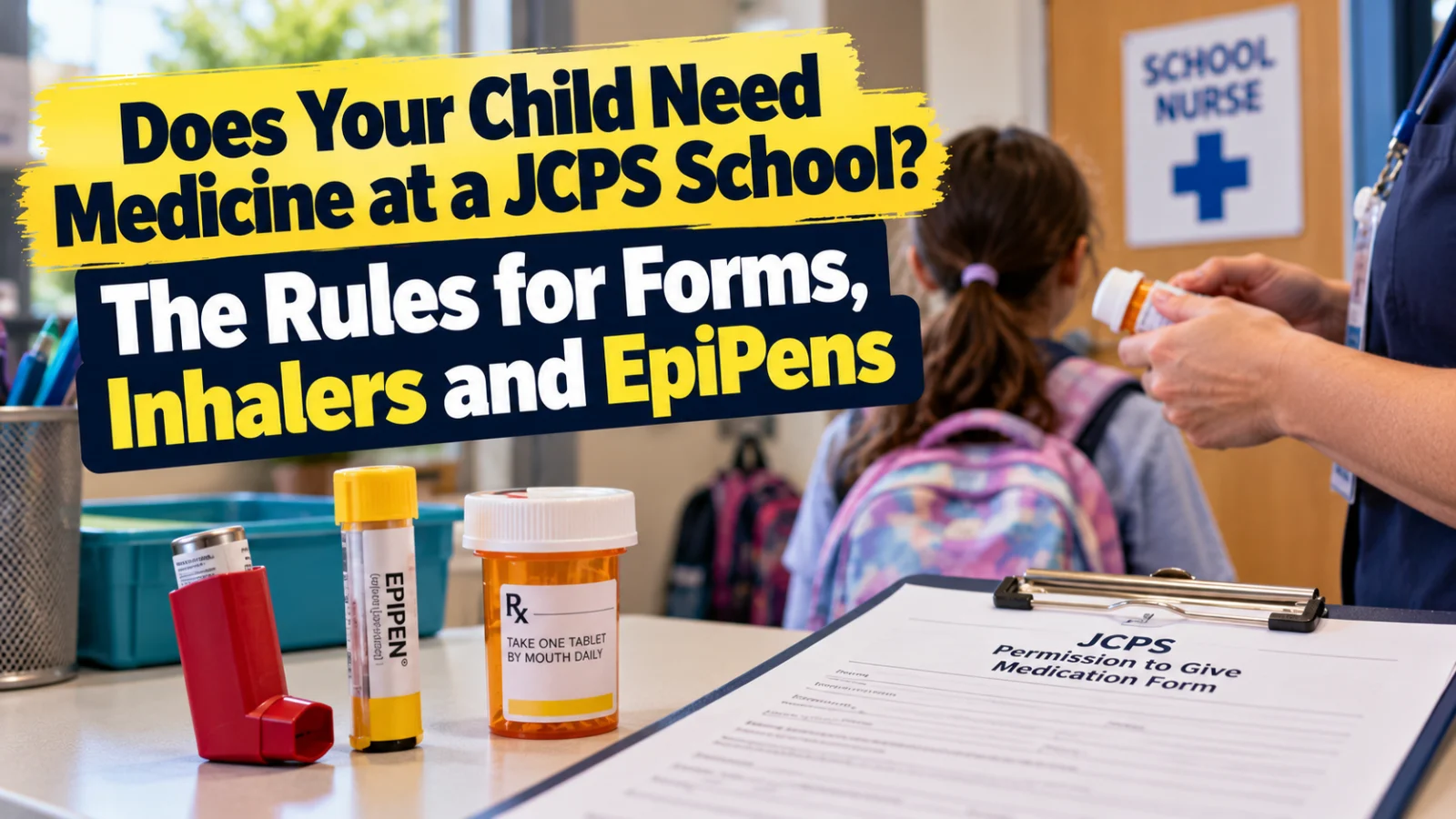
Before a Jefferson County Public Schools employee can give your child any medicine at school or on a field trip, a signed authorization has to be on file for the current school year. JCPS medication guidance, posted for 2026 to 2027 on school pages such as Blue Lick Elementary's back to school page, says, "Before a single dose of medication can be administered to a student in a JCPS school or on a field trip, appropriate authorization must be on file." It adds, "Authorization forms are valid only for the current school year."
So a form you turned in last year doesn't cover 2026 to 2027. We rechecked that guidance, the state health guide and the Kentucky statutes below on October 29, 2026.
Which form do you need?
You need the JCPS Permission Form for Prescribed or Over the Counter Medication. It's linked from that guidance, and school offices keep copies. The district's medication documents folder lists the current English version as "Permission to Give Medication Form Rev 7.8."
The guidance says, "Authorization forms must be signed by the parent/guardian, and over-the-counter medications must also be signed by a health-care provider." It also says "JCPS cannot accept written or verbal requests from parents for medication administration or for any changes related to medication." A new dose or a new time needs new written authorization from the provider, and every daily medicine needs a set time.
The Kentucky Department of Education's 2026 Health Services Reference Guide states the statewide rule plainly: "Written parental/guardian consent and healthcare provider authorization are required for all medications, including over-the-counter medications (OTC)."
The JCPS text isn't consistent on this point. A few lines below the sentence requiring a provider signature for over the counter medicine, the same guidance lists only two cases when a "Medical provider signature" is needed: when an over the counter medicine "will be given more than three days in a row," or "If the student will be self-carrying a medication." Blue Lick's own note farther down the same page goes further: "ALL medications require a physician's approval." Field Elementary's health page is blunter still: "the authorization form for over-the-counter medications must be signed by a physician." Every JCPS school statement we found, and the state guide, points to a doctor's signature for over the counter medicine, even if the three day line suggests otherwise. The three day limit also appears on a separate district form, the Nurse Office Consent for Treatment/Emergency Information, which lets a licensed nurse give over the counter medicines listed on it, such as ibuprofen and acetaminophen, after assessing your child, and says they "cannot be given for more than three (3) days in a row without a note from your child's health care provider." For any medicine you send from home, even a few days of ibuprofen, get the Permission Form signed by your child's provider, because the district guidance and the state guide both require it.
How do you get the medicine to school?
You bring it, in the original container. The guidance says, "All medications should be brought to school by the parent/caregiver in the original, labeled container." Don't send pills in a sandwich bag or a backpack pocket.
If getting medicine to school is hard, the guidance says to contact school staff.
What is a School Health Plan, and does your child need one?
A School Health Plan is the district's written emergency plan for a known condition. The JCPS guidance says "School Health Plans (SHPs) are needed for each student with a known health condition." Both the parent and the health care provider must sign for the plan to be valid, and the plans are kept at the school. JCPS posts separate plans for asthma, diabetes, seizures, non food allergies, respiratory disorders and other conditions.
The plan is separate from the medication permission form. The guidance says "An additional authorization form (see authorization forms above) may be needed to administer medication." For an inhaler or EpiPen, plan on doing both. It also says each plan submitted to a school must be faxed to Health Services at 502 485 3670, and it lists 502 485 3387 for questions.
A JCPS announcement on free health services, dated August 18, 2026, says the district started this year with "a school nurse assigned to every school building." Your school office can give you the nurse's name and the days the nurse is in the building. If the question is whether a sick child should stay home, our JCPS fever rules guide covers it.
The nurse isn't always the person who hands over the pill. Kentucky's school health regulation, 702 KAR 1:160, says a local board "shall require proof that all unlicensed school personnel who have accepted delegation to perform medication administration in school have completed a training course" from the state. If an office staffer gives your child's medicine, you can ask whether that training is on file.
Can your child carry their own inhaler or EpiPen?
Yes, under Kentucky law, if the paperwork is in place and your child has what the law calls a documented medical condition. KRS 158.832, as amended effective April 10, 2026, defines that as "a life-threatening allergy, asthma, risk of anaphylaxis, risk of respiratory distress, diabetes, hypoglycemia, adrenal crisis, or other life-threatening medical condition as diagnosed by a health care practitioner."
KRS 158.834 says every local school board "shall permit the self-administration of medications by a student who has a documented medical condition" when the parent provides written authorization and a written statement from the child's health care practitioner.
That practitioner statement has to say the student has the condition and "has been instructed in self-administration." It must list the name and purpose of each medicine, the dose, when it's taken and under what special circumstances, and how long it's prescribed.
Two more rules come with self carry. The school must tell you it incurs no liability for injury from the student's own use of the medicine, and you sign a statement acknowledging that. The law says that doesn't excuse the school's own negligence. And permission has to be renewed every school year.
Under KRS 158.836, once those steps are done, a student with a documented medical condition may carry and use that medicine at school, at school activities, and on school grounds before and after school, including school based child care and after school programs.
What if your child is too young to carry an EpiPen?
The medicine still has to be close. KRS 158.836 says a student with a documented medical condition shall have epinephrine, a rescue inhaler, a nebulizer, glucagon, Solu-Cortef or other prescribed medicine, provided by the parent or guardian, "in his or her possession or in the possession of the school nurse, school administrator, or his or her designee in all school environments that the student may be in." The law names "the classroom, the cafeteria, the school bus, and on field trips."
The same law requires a written individual health care plan for that student in all those places. It says that plan can be part of an IEP or a 504 plan. If your child already has one, ask that the allergy plan be written into it. Our IEP and 504 comparison explains the difference between the two.
The state's reference guide applies the rule to all prescribed emergency medicines, including seizure rescue medicines. It lists epinephrine, rescue inhalers or nebulizers, glucagon, Solu-Cortef and seizure rescue medicines. It says they must be available "in all school environments in which the student may be present, including classrooms, cafeterias, school buses, and field trips."
What happens on a field trip?
A trained adult has to go. The district's Field Trip Procedures, revised May 2024 and posted with Jefferson County Board of Education meeting materials, say that if "medications, EpiPens, inhalers, Diastat, or Glucagon are to be administered to a student on a field trip, a staff member trained in the administration of the medication shall accompany the student on the field trip." The same procedures tell staff to contact Health Services at 502 485 3387 before a trip is approved when a student needs medicine. The permission form still has to be on file.
If a field trip permission slip comes home and your child carries emergency medicine, ask the teacher in writing who the trained staff member on the trip will be.
Does the school keep any emergency medicine of its own?
Kentucky law encourages it but doesn't require it. KRS 158.836(3) says each school "is encouraged to keep epinephrine in a minimum of two (2) locations in the school, including but not limited to the school office and the school cafeteria." A school that does must keep it "in a secure, accessible, but unlocked location," and the rule applies only to the extent the epinephrine is donated or the school "has sufficient funding to purchase" it. The law encourages the same for rescue inhalers or nebulizers, in places such as the school office and athletic office, and for undesignated glucagon. The state's 2026 reference guide adds opioid antagonists to the list of medicines schools may keep for emergency use. Don't treat stock medicine as a substitute for your child's own prescription, and ask your school nurse what your child's school keeps.
What should you do this week?
Pick up the Permission Form for Prescribed or Over the Counter Medication from your school office and take it to your child's doctor with any School Health Plan your child needs. For self carry, ask the doctor to write the instruction statement KRS 158.834 requires. Questions go to JCPS Health and Wellness at 502 485 3387.