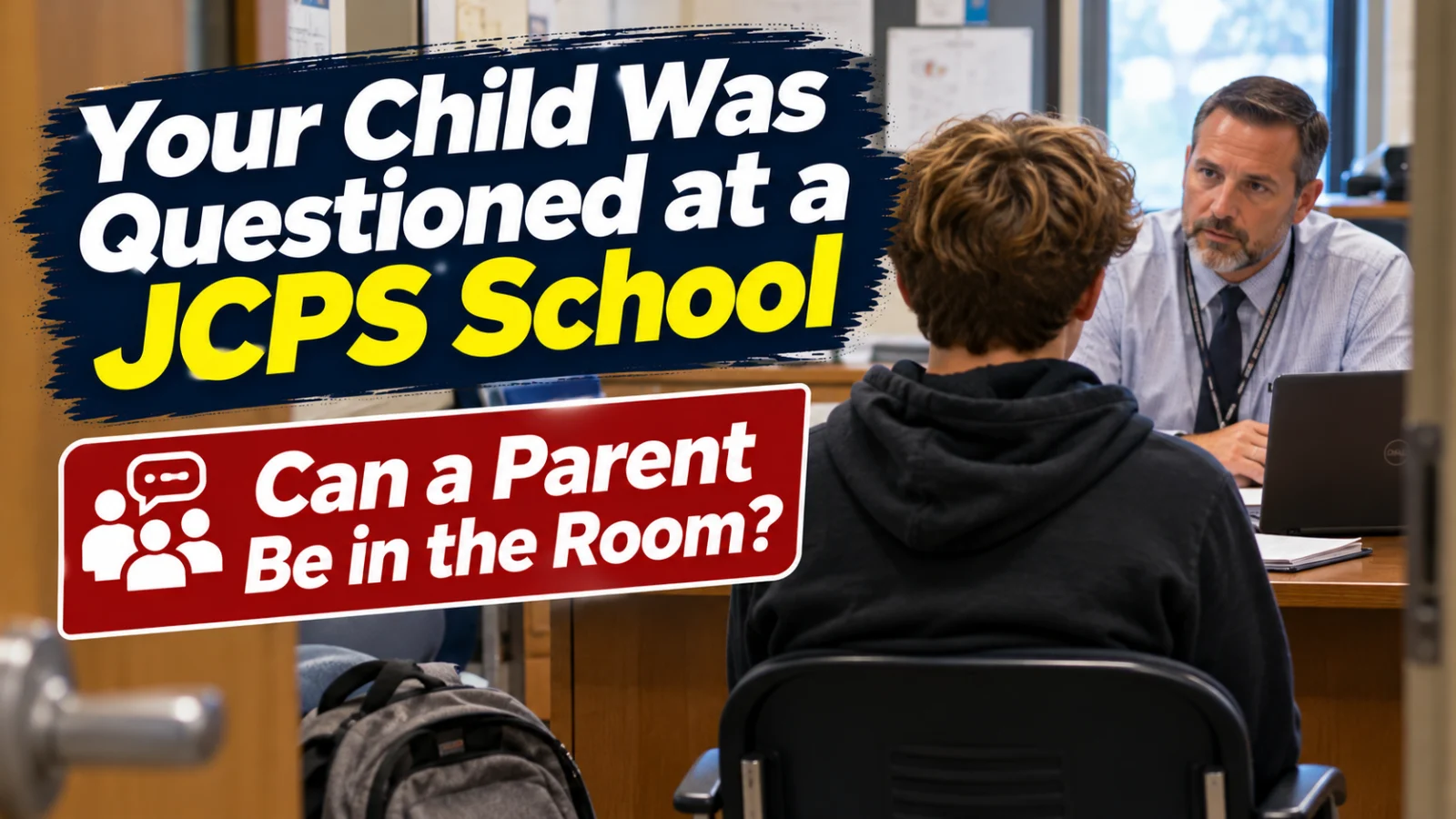
A Jefferson County Public Schools principal or assistant principal can question your child about a fight, a vape or a missing phone without calling you first. Nothing in Kentucky's suspension law or JCPS's discipline policies gives a parent the right to sit in on that conversation. The rules change when a police officer joins in.
JCPS's Student Support and Behavior Intervention Handbook for 2026 to 2027 gives every student the right to "tell their side of the story and/or report unfair treatment to a person in authority." Nothing in the handbook's list of student rights gives a parent a seat during questioning. The one place that list puts a parent or advocate in the room is a conference on readmission after an out of school suspension. The laws, policies and JCPS pages below were checked November 2, 2026, and the board policy amendment dates come from the JCPS policy manual hosted by the Kentucky School Boards Association that day.
Can a JCPS principal question my child without calling me first?
Yes. Kentucky treats questioning for school discipline as part of running a school, not as a police interrogation.
The state's suspension law, KRS 158.150, requires three things before a student is suspended. The student gets oral or written notice of the charges, an explanation of the evidence if the student denies them, and "an opportunity to present his or her own version of the facts." When an immediate suspension is needed to protect people or property, those steps can come afterward, but no later than three school days after the suspension. JCPS board policy 09.431, Due Process, amended July 25, 2023, repeats the same three steps. None of them mentions a parent.
The Kentucky Supreme Court said the same thing in N.C. v. Commonwealth in 2013: "questioning by school officials is relevant and necessary to student discipline and safety, and ... such matters are not impacted by Miranda when only school discipline is involved."
Parents do get a promise about notice, just not about timing. JCPS policy 09.43, Student Disciplinary Processes, amended August 11, 2026, says "Serious disciplinary problems shall be promptly reported to the Principal and to the parent(s) of the student." The handbook's parent rights section adds the right "to be notified in a timely manner when their child is removed from the instructional environment for a substantial amount of time due to their behavior." Neither defines "promptly" or "timely," and neither says the call comes before questions are asked. If your child is suspended, KRS 158.150 requires the school to report it to you in writing immediately.
The same policy says each school council's discipline policies "shall provide for involvement of parents in disciplinary situations involving their children." Those council policies are set school by school, so ask your school's front office for its council discipline policy. It may say more than the district rule does.
What changes when a police officer is in the room?
Once a JCPS officer treats your child as a suspect, district procedures require contact with a parent, and Kentucky courts can require Miranda warnings. JCPS runs its own police department, and board policy 02.31, amended August 11, 2026, lets the district employ school resource officers, or SROs, "directly by the District as part of the JCPS Police." The same policy says "the purpose of the SRO program is not to enforce or administer matters of school discipline and student conduct."
JCPS's school resource officer procedures, policy 02.31 AP.1, revised June 24, 2025, say an SRO or JCPS Police staff member "shall make contact with a parent/guardian of a District student under the age of 18" when any of these is true:
The student receives a citation.
The student is detained and receives a citation.
The student "is a suspect and is being or may be interviewed."
The student has been given Miranda rights.
The student is a witness and may be subpoenaed to testify.
The student is the victim of a crime.
That third line requires contact with a parent. It doesn't say the contact has to come before the interview, and it doesn't give the parent a seat in the room. The one exception runs the other way: officers "shall not make contact" with a parent who is suspected of a crime against the student.
The Kentucky Supreme Court case shows why the officer matters. At Nelson County High School, an assistant principal questioned a student about hydrocodone pills with the school's deputy sheriff seated next to the student and the door shut. The student's mother wasn't contacted until after he confessed. The court threw out the confession and set this rule: school officials "may question freely for school discipline and safety purposes, but any statement obtained may not be used against a student as a basis for a criminal charge when law enforcement is involved or if the principal is working in concert with law enforcement," unless the student first gets Miranda warnings. The ruling covers students who are in custody, and it notes that the U.S. Supreme Court requires a child's age to be weighed in deciding that. For how that plays out with fights and threats, see our guide to when bullying becomes a police matter.
If an officer takes a child into custody, KRS 610.200 says the officer "shall immediately inform the child of his constitutional rights" and notify the parent of the custody and the specific charges. A 2026 bill, Senate Bill 358, would have required officers to arrange for a child to talk with a lawyer before a custodial interrogation. Its last recorded action was March 2, 2026, when it was sent to the Senate Committee on Committees. It didn't become law.
What if police come to school about something that happened off campus?
JCPS policy says that should be rare. Policy 09.4361, Police Interrogations and Investigations, last amended March 27, 2018, splits police questioning two ways. For crimes on school property, administrators decide when to call in law enforcement. For crimes unrelated to school, the policy says it "should not normally be necessary" for officers to question students on campus during school hours. It allows that "only in demonstrated emergency situations," with the principal's prior approval, and the administrator has to document it.
Outside abuse and neglect cases, the policy doesn't mention calling parents.
Can a social worker talk to my child at school without telling me?
Yes, in an abuse or neglect investigation. KRS 620.072 says "A school or a child-care provider shall provide the cabinet access to a child subject to an investigation or assessment without parental consent." The cabinet is the Cabinet for Health and Family Services.
JCPS policy 09.4361 says that in those cases school officials "shall follow directions provided by the investigating officer or Cabinet representative as to whether to notify a parent prior to an interview." So the school may know about the interview and still not be allowed to tell you.
Can I see what my child said or wrote?
Usually, the part about your child. JCPS policy 09.14 says student records "shall be made available for inspection and review to the parent(s) of a student or to an eligible student on request." Under the federal privacy rule at 34 CFR 99.10, the district has to grant access within a reasonable time, and no more than 45 days after the request. Ask in writing; the district's request form is procedure 09.14 AP.24.
There's a limit. When a record covers more than one student, such as a witness statement about a fight, 34 CFR 99.12 says a parent "may inspect and review or be informed of only the specific information about that student." Expect other children's names and words to be blacked out or held back.
JCPS Insider found no handbook or board policy language that says whether a student must write or sign a statement. Ask the school whether your child signed one and request a copy.
Video is its own question, covered in our guide to whether parents can see JCPS security camera video.
What should I ask the school after I find out?
Write down the answers, with names and times. Start with these questions:
Who questioned my child, and when?
Was an SRO, JCPS Police officer or outside officer present for any part of it?
Was my child told what the charge was and what evidence the school had?
Did my child write or sign anything?
Was a citation issued, or was a report made to police?
Is there a suspension, and on what dates?
If there is a suspension, the appeal clock is short. The handbook says the first appeal letter goes to the administrator who suspended your child within three school days of notice of the suspension and appeal process. Student Relations will help you write it at 502 485 3335. Our guide to JCPS suspensions and alternative placement walks through the later steps.
If your child has an IEP or 504 plan, tell the school right away. The handbook requires a manifestation determination when a student with a disability, or one in the referral process, faces a change of placement for a code of conduct violation or a removal of more than ten days.
What can I tell my child before this ever happens?
Tell your child they can ask for you. Nothing requires the school to stop and call, but you'll want to know later whether your child asked.
Tell them the difference between a principal and an officer. A principal asking questions for school discipline owes your child a chance to give their side under KRS 158.150. A police officer is different: a student has the same right to stay silent that every Miranda warning describes.
If police were involved, call the JCPS Police Department's non emergency line at 502 485 3111 between 7:30 a.m. and 4 p.m. and ask whether a citation or juvenile complaint was filed. Juvenile complaints go through the Court Designated Worker's Office at 600 W. Cedar Street, 502 595 0036, open 9 a.m. to 5 p.m. weekdays, according to the JCPS Police page.